Webull vs Coinbase: Complete 2026 Crypto Platform Showdown
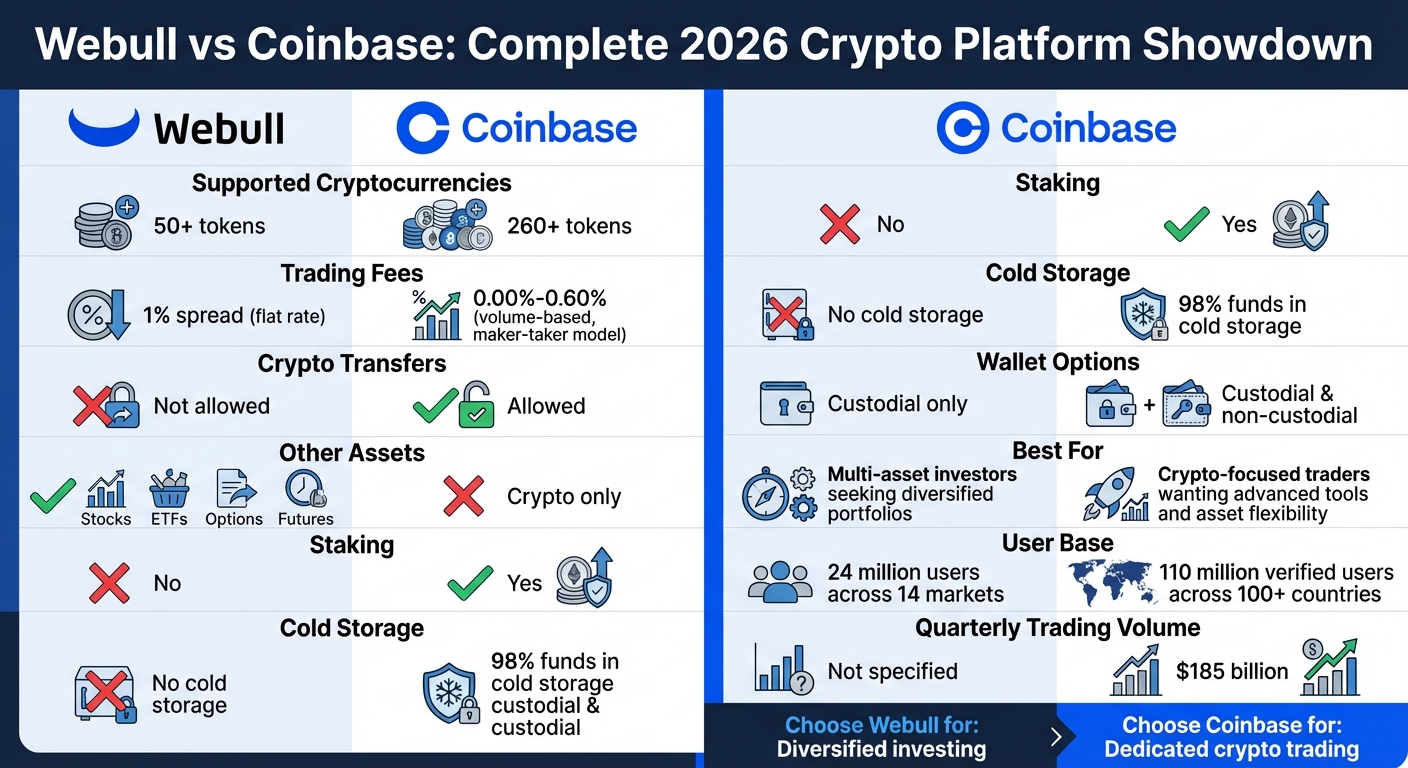
Webull and Coinbase cater to different needs in the cryptocurrency space. Webull is ideal for users seeking an all-in-one platform that combines crypto trading with stocks, ETFs, and other assets. Meanwhile, Coinbase focuses exclusively on crypto, offering a wider selection of digital currencies and tools tailored to crypto enthusiasts.
Key Differences:
- Cryptocurrency Options: Webull supports 50+ tokens, while Coinbase offers over 260.
- Fees: Webull charges a 1% spread per trade. Coinbase uses volume-based fees, starting at 0.60% for takers and 0.40% for makers.
- Crypto Transfers: Coinbase allows external wallet transfers, but Webull does not.
- Target Audience: Webull suits multi-asset investors, while Coinbase appeals to crypto-focused traders.
Quick Comparison:
| Feature | Webull | Coinbase |
|---|---|---|
| Supported Cryptos | 50+ | 260+ |
| Fees | 1% spread | 0.00%-0.60% (volume-based) |
| Crypto Transfers | Not allowed | Allowed |
| Other Assets | Stocks, ETFs, options, etc. | Crypto only |
| Staking | No | Yes |
| Security | AES-256, no cold storage | AES-256, 98% funds in cold storage |
| Wallet Options | Custodial only | Custodial & non-custodial |
If you want a platform for diversified investments, Webull is a better fit. For dedicated crypto trading with advanced tools and asset flexibility, Coinbase is the stronger choice.
Webull vs Coinbase 2026: Feature Comparison Chart
Webull vs Coinbase - Which Crypto Exchange is Right for You? (The Ultimate Comparison)

Webull Overview
Webull started as a stock trading platform but has grown into a multi-asset brokerage serving 24 million users across 14 markets. Today, it offers trading options for stocks, ETFs, options, ADRs, Treasury bonds, futures, prediction markets, and cryptocurrencies. This all-in-one approach attracts investors looking to manage their entire portfolio in one place, making it particularly appealing for those who value convenience. This evolution has paved the way for its current focus on crypto trading.
In August 2025, Webull brought crypto trading back into its main app after separating it in 2023. According to U.S. CEO Anthony Denier, this reintegration was driven by improved regulatory clarity. The move simplifies access for users and aligns with ongoing changes in the regulatory landscape.
Currently, Webull supports 24/7 trading for over 50 cryptocurrencies, including popular options like Bitcoin (BTC), Ethereum (ETH), Solana (SOL), Dogecoin, Cardano, Shiba Inu, Avalanche, and Polygon. You can start trading with as little as $1. The platform offers tools such as candlestick charts, technical indicators, real-time price tracking, customizable alerts, and basic market and limit order options. Additionally, in 2024, Webull partnered with Coinbase Derivatives to provide Bitcoin and Ethereum futures for U.S. retail investors, expanding its offerings to include derivatives trading alongside spot markets.
Key Features of Webull
Webull is available on both mobile (iOS and Android) and desktop platforms, with a beginner-friendly "Webull Lite" mode for those new to trading. For more experienced users, it provides advanced charting tools, real-time market data, and paper trading features. Crypto trades on Webull are facilitated through Webull Pay LLC and executed via Apex Crypto, with a typical spread of about 1.0% per side.
Currently, crypto trading is only available in the United States and Brazil, though Webull has plans to expand into additional markets. The platform charges $0 commission on crypto trades, but it earns revenue through the spread, leading to an approximate 2.0% round-trip cost when buying and selling.
Limitations of Webull
For dedicated crypto traders, Webull has some notable drawbacks. The limited cryptocurrency selection is a key issue. While offering 50+ tokens might seem sufficient, it pales in comparison to platforms like Coinbase, which list hundreds, or even Binance, which supports thousands of digital assets. If you're interested in niche altcoins or newer DeFi tokens, Webull won’t meet your needs.
Another major limitation is that you cannot withdraw crypto to external wallets. This means your digital assets remain locked within Webull's ecosystem, and users cannot access their private keys. Without the ability to transfer coins to hardware wallets, engage in liquidity mining, or move assets to other platforms, Webull doesn’t cater to crypto enthusiasts who prioritize self-custody. For users who follow the principle "not your keys, not your coins", this is a dealbreaker.
Additionally, the platform’s spread-based pricing model can lead to higher costs, especially for active traders. For instance, a $10,000 Bitcoin trade on Webull would incur about $200 in spread costs, compared to $100 on Coinbase or $20 on Binance.US. While the $0 commission policy may sound attractive, frequent traders often end up paying more due to these hidden costs. Webull is better suited for buy-and-hold investors who prioritize convenience over cost and trade less frequently.
Coinbase Overview
Established in June 2012, Coinbase is one of the oldest cryptocurrency platforms in the market. Unlike Webull, which offers a mix of asset types, Coinbase focuses exclusively on digital currencies. With over 110 million verified users across 100+ countries, Coinbase processes a staggering $185 billion in trade volume each quarter[7]. This dedicated approach to crypto has enabled the platform to create tools and services tailored specifically for digital asset investors.
Coinbase promotes itself as a secure and accessible hub for crypto trading. Supporting over 200 cryptocurrencies, it allows users to invest in fractional amounts, making it easy for beginners to start small. The platform even offers its own stablecoin, USD Coin, which is backed 1:1 by U.S. dollars. Its crypto-centric design is evident in its tools, fee structures, and safety measures.
As of 2026, Coinbase continues to prioritize features that cater to both new and experienced users. For beginners, the onboarding process is quick - users can start trading in less than half a day. The Coinbase mobile app is highly rated, with a 4.7/5 score on the App Store and 4.5/5 on Google Play[1]. Additionally, the Coinbase Earn program offers an educational library where users can earn free crypto by watching videos and completing quizzes about various digital assets.
Key Features of Coinbase
Coinbase provides both custodial and non-custodial wallet options, giving users the flexibility to manage their private keys. Its Advanced Trade feature includes maker-taker pricing, starting at 0.60% for takers and 0.40% for makers on trades under $10,000. For users who prefer full control, the Coinbase Wallet app allows them to hold their private keys and transfer crypto freely to external wallets or platforms - an essential feature for those who follow the "not your keys, not your coins" philosophy.
For high-volume traders, fees decrease significantly. Monthly trading volumes exceeding $400 million see fees drop to 0.05% for takers and 0.00% for makers[4]. The platform also offers advanced charting tools, real-time market data, and a variety of order types beyond the basics.
Coinbase includes staking options for eligible cryptocurrencies, enabling users to earn passive income on their holdings. The Coinbase One subscription, priced at $5 per month, enhances these benefits by boosting staking rewards by 5%, offering 4.5% APY on the first $10,000 in an account, and including $500 in free trades each month[1]. Other features include recurring buys, crypto conversion, and the Coinbase Card, which allows users to spend crypto anywhere Visa is accepted.
Security is a cornerstone of Coinbase’s operations. The platform stores over 98% of crypto funds offline in cold storage and uses AES-256 encryption, two-factor authentication, and comprehensive crime insurance. Impressively, Coinbase has never been hacked. U.S. dollar balances are FDIC-insured through third-party banks, and additional protections include monitoring for third-party data breaches, proactive security alerts, and a "Lock My Account" feature for added peace of mind.
Limitations of Coinbase
One of Coinbase’s main drawbacks is its higher fees for standard transactions. Users relying on the simple trading interface face flat fees - $0.99 for orders up to $10, $2.99 for orders up to $205, and a variable fee of about 1.5% for larger orders, along with a 0.50% spread fee. Transactions using a linked bank account or digital wallet incur a 1.49% fee, while debit or credit card purchases come with a 3.99% fee.
For instance, buying $1,000 worth of Bitcoin through a bank account on the standard interface results in approximately $15 in transaction fees plus the spread, totaling around $20. While Advanced Trade offers significantly lower fees, beginners might find themselves paying more on the standard interface. Similarly, active traders without volume discounts may face rising costs compared to platforms that offer flat, transparent pricing structures.
Head-to-Head Comparison
With the platform overviews in mind, let’s dive into a side-by-side comparison of key features to help you make an informed choice.
Supported Cryptocurrencies
Coinbase stands out with support for more than 260 cryptocurrencies, including major players like Bitcoin and Ethereum, alongside a wide variety of altcoins[6]. Some reports even suggest the platform could offer access to as many as 5,890+ assets[2]. This extensive selection makes Coinbase a strong choice for investors aiming to diversify their portfolios.
On the other hand, Webull focuses on a smaller selection of major cryptocurrencies. While this streamlined approach might simplify things for beginners, it limits options for those who want to explore less mainstream assets.
Fees and Pricing
The fee structures on these platforms reflect different priorities. Webull keeps things straightforward with a flat 1% spread on all cryptocurrency transactions[3][4]. For instance, buying $1,000 worth of Bitcoin would cost you $10 in fees. While the simplicity is appealing, frequent traders could find these fees adding up quickly.
Coinbase, however, uses a maker-taker fee model on its Advanced Trade platform. Taker fees begin at 0.60%, while maker fees start at 0.40%. High-volume traders - those handling over $250 million in monthly trades - can see maker fees drop to 0.00%[1][3][4]. For smaller trades on the standard Coinbase interface, fees range from $0.99 to $2.99, with a variable 1.5% fee on larger transactions[4].
Webull also charges $8 for domestic wire transfers and $25 for domestic withdrawals (or $45 for international withdrawals)[1]. Coinbase’s withdrawal fee is similarly $25, though deposit fees vary depending on the payment method used[5].
| Fee Type | Webull | Coinbase |
|---|---|---|
| Crypto Trading | 1% spread (all volumes) | 0.00%–0.60% (volume-based on Advanced Trade) |
| Small Order Fees | 1% spread | $0.99–$2.99 flat fee |
| Domestic Withdrawal | $25 | $25 |
| Wire Transfer (Incoming) | $8 domestic, $12.50 international | Not specified |
Security and Wallet Options
Both platforms prioritize security, but their methods differ. Webull Pay utilizes institutional-grade security for custody, trading execution, and staking[8][9]. It employs AES-256 encryption, two-step authentication via SMS, and provides FDIC insurance for fiat funds[1][3]. However, Webull does not allow cryptocurrency transfers[3].
Coinbase, meanwhile, stores 98% of customer funds offline in cold storage and has maintained a spotless record of never being hacked[1][3]. It offers both custodial and non-custodial wallet options, allowing users to manage their private keys[3]. Security measures include AES-256 encryption, SSL protection, and multiple two-factor authentication methods - such as Google Authenticator, Duo, SMS codes, and security keys[3]. Additionally, U.S. dollar balances are FDIC insured through partner banks.
| Security Feature | Webull | Coinbase |
|---|---|---|
| Encryption | AES-256 | AES-256 with SSL |
| Cold Storage | Via institutional partnership | 98% of funds stored offline |
| Two-Factor Authentication | SMS codes | Google/Duo authenticators, SMS, security keys |
| Wallet Type | Custodial | Custodial and non-custodial options |
| Crypto Transfers | Not allowed | Allowed (with non-custodial wallet option) |
| Hacking History | N/A | Never hacked |
Trading Tools and Features
When it comes to trading tools, each platform caters to different types of users.
Webull is better known for its advanced charting tools designed for stocks and options trading. Its crypto trading features, however, are more basic. Users can access real-time market data and technical indicators, and the mobile app is clean and easy to navigate. That said, experienced crypto traders might find the platform lacking in depth.
Coinbase, in contrast, offers a well-rounded suite of tools suitable for both beginners and seasoned traders. The Advanced Trade platform includes sophisticated charting, multiple order types, and real-time data feeds. Its mobile app is highly rated - 4.7/5 on the App Store and 4.5/5 on Google Play[1]. Other features include staking for passive income, recurring buys, and crypto conversion. Coinbase also offers a subscription service, Coinbase One, for $5 per month, which includes $500 in free trades each month[1].
Advantages and Disadvantages
Let’s break down the key strengths and weaknesses of each platform to help you decide which one aligns best with your investment needs.
Webull Pros and Cons
Webull shines as a multi-asset trading platform, offering stocks, ETFs, options, and even cryptocurrencies - all in one place. This makes it a great choice for those managing diverse portfolios. The platform also features advanced charting tools and technical analysis capabilities, along with commission-free trading for stocks and ETFs. Plus, there’s no minimum deposit required for standard accounts, and fractional shares make it appealing for beginner investors.
However, Webull has its limitations when it comes to cryptocurrency. The platform supports only a small range of digital assets - between 8 and 48 - and lacks the ability to transfer crypto in or out. This means your crypto assets are locked within Webull, with no option for cold storage. Additionally, SIPC protection doesn’t cover crypto holdings. Fees can add up too, with a 1% spread on crypto trades and high margin rates starting at 8.74%. Customer service is another weak spot, as it’s known for being hard to reach and lacks a chat feature.
| Pros | Cons |
|---|---|
| Multi-asset platform for stocks, ETFs, options, and crypto | Limited selection of cryptocurrencies (8–48 assets) |
| Advanced charting and analysis tools | Crypto cannot be transferred off-platform |
| Commission-free trading for stocks and ETFs | No cold storage for crypto holdings |
| No minimum deposit and fractional shares available | 1% spread on crypto trades |
| Highly rated mobile app | High margin rates starting at 8.74% |
| Paper trading feature for practice | Hard-to-reach customer service, no chat option |
Coinbase Pros and Cons
Coinbase is a go-to platform for cryptocurrency enthusiasts, offering access to over 260 digital assets. It’s designed to be beginner-friendly, with an intuitive interface, but also caters to advanced users through its Coinbase Advanced Trade tools. Security is a major highlight, with robust measures like extensive cold storage and a track record free of major hacks. Users also have flexibility, thanks to custodial and non-custodial wallet options, allowing them to transfer crypto freely. The Coinbase Learn program is another standout, rewarding users with crypto for completing educational materials.
That said, Coinbase’s fees can be a drawback, especially on the standard platform or for smaller trades made with debit or credit cards, where fees can reach up to 3.99%. Customer service has faced criticism for being unresponsive, and the platform is exclusively focused on cryptocurrency, leaving out traditional investment options like stocks or ETFs. Support is limited to an online contact form, with no email assistance available.
| Pros | Cons |
|---|---|
| Access to over 260 cryptocurrencies | High fees, especially for card purchases (up to 3.99%) |
| User-friendly interface with advanced tools for experienced traders | Customer service has a poor track record |
| Strong security with extensive cold storage | Limited options for deposits and withdrawals |
| Custodial and non-custodial wallet options for full control | Advanced tools may overwhelm beginners |
| Educational rewards through Coinbase Learn | Support limited to an online contact form |
| Publicly listed on NASDAQ, with SEC oversight | No traditional investment products like stocks or ETFs |
| FDIC insurance for U.S. dollar balances | Complicated fee structure can confuse users |
Who Should Choose Webull
Webull is a great fit for investors looking to trade stocks, ETFs, options, and crypto within a single account, making it easier to manage a variety of investments. With access to nearly 15,000 equities from the U.S., Canada, and Hong Kong, plus digital assets, the platform offers plenty of options for building a diversified portfolio [2].
Younger investors, particularly millennials and Gen Z, will find Webull appealing whether they're just starting out or have already gained some trading experience. Features like no minimum deposit for standard accounts, commission-free trading on stocks and ETFs, and fractional shares make it accessible for those with smaller budgets. For more seasoned traders, advanced charting tools, technical analysis capabilities, and extended trading hours provide the functionality needed to make informed decisions. This mix of beginner-friendly and advanced features is why Webull attracts such a broad range of users.
"Webull is a favorite of young millennial investors who are just starting, but it also attracts medium-level and advanced traders due to low fees." - SmartAsset [1]
Webull also supports long-term financial goals, offering options like Traditional IRAs, Roth IRAs, and rollover IRAs in addition to standard brokerage accounts. This makes it a solid choice for active traders who want to combine short-term strategies with long-term retirement planning, all within one platform.
That said, Webull may not be ideal for those focused solely on cryptocurrency. The platform has a limited selection of digital assets and doesn't allow external transfers, which could be a dealbreaker for crypto-focused investors [4]. While Webull shines as a hub for diverse investments, its crypto features fall short for those who prioritize digital assets above all else.
Who Should Choose Coinbase
Coinbase is the go-to platform if you're looking for a wide variety of cryptocurrencies and complete control over your assets. With support for over 200 tradable cryptocurrencies [3][4], Coinbase stands out compared to Webull, which offers a more limited selection of 8 to 48 assets [2]. This extensive range includes major coins as well as smaller, lesser-known options that Webull doesn't provide, making it an attractive choice for both beginners and seasoned crypto enthusiasts.
"It offers a much larger selection, so you'll be able to buy bigger and smaller coins. You can feel confident that your crypto is safe and insured on Coinbase. The exchange also has low fees if you use its advanced trade tool. Most importantly, Coinbase doesn't restrict what you can do with your crypto." - Benzinga [3]
Coinbase's user-friendly interface and educational resources make it ideal for newcomers, while advanced traders benefit from tools like in-depth analytics and diverse order types through Coinbase Advanced Trade. The platform’s robust wallet features also give users full control of their assets. For instance, the free Coinbase Wallet app allows you to transfer crypto to external wallets or other exchanges seamlessly [3].
If earning passive income is a priority, Coinbase offers staking opportunities through its Coinbase One plan. Users can earn 4.5% APY on the first $10,000 and enjoy an additional 5% boost on staking rewards [1].
For those prioritizing security, Coinbase is a strong choice. As a publicly traded, U.S.-based company with a proven track record, it’s often regarded as one of the safest platforms for crypto trading. In fact, it’s been called "the safest and most legit platform for crypto trading in 2025" [7]. With its combination of robust security, extensive crypto options, and flexible control, Coinbase is a solid pick for anyone serious about cryptocurrency as a key part of their investment strategy.
Final 2026 Verdict
For crypto enthusiasts in 2026, Coinbase shines as a top choice, thanks to its wide range of assets, strong cold storage security, and user-friendly tools that cater to beginners and seasoned traders alike. Its straightforward design and educational resources make it an excellent gateway into the world of cryptocurrency. By focusing solely on crypto, Coinbase distinguishes itself from platforms that offer a broader mix of investments.
On the other hand, Webull appeals to those seeking a multi-asset platform. It allows users to manage stocks, ETFs, options, and a smaller selection of cryptocurrencies - all within a single account.
When comparing fees, security features, and available assets, it becomes clear that each platform serves a different audience. Ultimately, advanced traders face a choice: go with Coinbase for its specialized crypto tools and extensive asset selection, or choose Webull for a more integrated approach to managing diverse investments.
FAQs
How do Webull and Coinbase differ as crypto trading platforms?
Webull and Coinbase serve different needs in the world of crypto trading. Webull focuses on offering a streamlined platform where users can trade not just cryptocurrencies but also stocks, ETFs, and options. However, its crypto offerings are limited to just 8 tokens, and it doesn’t provide a digital wallet. Additionally, the higher transaction spreads may not appeal to those managing diverse or larger crypto portfolios.
In contrast, Coinbase stands out with support for over 200 cryptocurrencies, including popular stablecoins like USD Coin. Its platform is designed with beginners in mind, offering an intuitive interface, built-in digital wallets, and strong security measures. While Webull might appeal to seasoned traders looking for a multi-asset trading experience, Coinbase is better suited for those starting out or aiming to explore a broader range of cryptocurrencies.
Can I transfer cryptocurrency from Webull to an external wallet?
Webull lets you transfer some cryptocurrencies to an external wallet. At the moment, the supported options are Bitcoin (BTC), Litecoin (LTC), and Bitcoin Cash (BCH). However, not all cryptocurrencies offered on Webull can be moved externally, so double-check whether the specific asset you'd like to transfer is eligible.
What are the differences in fees between Webull and Coinbase for active crypto traders?
Webull lets you trade cryptocurrencies without paying a commission, but they include a 1% spread on every trade. Coinbase takes a different approach, charging fees based on your trading volume. Their maker and taker fees range from 0.05% to 0.60%. If you trade often, these fees can stack up quickly. So, when deciding between the two, think about how frequently you trade and the size of your transactions.