Accelerated NICs with FPGA for Networks
FPGA-accelerated Network Interface Cards (NICs) are transforming futures trading by reducing network latency to nanoseconds. Unlike traditional NICs that rely on CPUs, FPGA NICs process network data entirely in hardware, eliminating delays caused by software. This makes them ideal for platforms like NinjaTrader, where speed and precision are critical.
Key Takeaways:
- Latency Reduction: FPGA NICs cut latency from microseconds to nanoseconds, with leading models achieving under 3 nanoseconds.
- Consistent Performance: Unlike standard NICs, FPGA cards deliver fixed processing times, crucial for automated trading strategies.
- Optimized VPS: By offloading network tasks to hardware, FPGA NICs free up CPU resources, ensuring smoother trading operations.
- Hardware Offloading: Tasks like packet filtering and protocol processing are handled directly in the NIC, bypassing the operating system.
- Advanced Features: Sub-nanosecond timestamping, pre-trade risk checks, and kernel bypass technology enhance reliability and compliance.
FPGA NICs, such as the AMD Alveo UL3524 and Exegy Nexus SmartNIC, deliver unparalleled speed and consistency. For NinjaTrader users leveraging top VPS providers for futures trading, this technology ensures ultra-fast order execution and robust trading performance.
Accelerated Algorithmic Trading on Alveo X3522PV: The Ultimate HFT Solution
How FPGA Technology Reduces Network Latency
FPGA NICs bring a game-changing advantage to futures trading on NinjaTrader by shifting the entire network stack into hardware. Unlike traditional NICs that rely on CPU processing - leading to delays during peak activity - FPGA NICs handle the full TCP/IP or UDP stack directly in hardware. This approach eliminates CPU and operating system overhead, ensuring fixed latency where every packet is processed along the same path [6][8].
Hardware Offloading Explained
Hardware offloading takes this concept further, slashing latency even more by transferring tasks like packet filtering, routing, and protocol processing from the CPU to specialized FPGA circuits. Advanced technologies like AMD Solarflare Onload and TCPDirect enable kernel bypass, allowing trading applications to interact directly with NIC hardware. Modern FPGA NICs also use a cut-through architecture, which begins processing packets as soon as the header is received [1].
In September 2023, AMD introduced the Alveo UL3524 fintech accelerator, equipped with 64 ultra-low latency transceivers and 780,000 logic cells. Benchmark tests showed transceiver latency of under 3 nanoseconds. Strategic partners have adopted this technology to build custom trading applications capable of operating at nanosecond speeds [2]. Since 2015, Microsoft Azure has deployed FPGA-based SmartNICs (AccelNet) across over 1 million hosts, offloading tasks like tunneling and load balancing from CPUs. These SmartNICs deliver consistent VM-to-VM TCP latencies below 15 microseconds at 32 Gbps throughput, providing fixed processing times essential for precise trading operations [8].
Predictable Latency for Trading
For automated trading strategies running on TraderVPS infrastructure, predictable latency is non-negotiable. Variability in latency can lead to missed orders or slippage, undermining trading performance. FPGA NICs address this by creating a dedicated hardware path for each packet, avoiding the unpredictability caused by CPUs managing multiple tasks simultaneously.
During high market volatility, traditional NICs often falter when data feeds hit 825–850 Mb/s, resulting in erratic latency. In contrast, FPGA-based NICs maintain consistent performance even under heavy throughput [6]. For example, Arista's 7130 series, leveraging FPGA-enabled switching in its MetaMux application, can process orders in as little as 39 nanoseconds - far faster than traditional switches [10].
Moreover, many FPGA NICs feature sub-nanosecond timestamping, ensuring precise latency measurements and aiding regulatory compliance, such as MiFID II [9]. These timestamping capabilities also synchronize distributed trading systems and maintain audit trails with picosecond-level accuracy [10]. These hardware-driven efficiencies are critical for enabling NinjaTrader VPS systems to deliver ultra-low latency performance in live trading environments.
Benefits for NinjaTrader Futures Trading on VPS

Faster Order Execution
FPGA NICs revolutionize the speed at which NinjaTrader executes futures trades by shifting the entire network stack into dedicated hardware. This approach eliminates delays caused by CPU processing, operating system calls, and context switches - issues that often hinder standard VPS systems. With this technology, order execution moves from microseconds down to nanoseconds.
What does this mean for your trading? Your NinjaTrader strategies can operate with zero jitter, avoiding the unpredictable latency spikes that occur when standard NICs compete for CPU resources during volatile market conditions. FPGA-accelerated cards deliver transceiver latencies of under 3 nanoseconds, with some order entry applications sending orders to exchanges in as little as 39 nanoseconds [2][10]. The "parse-to-risk-to-send" cycle, which typically takes several microseconds, is reduced to under 500 nanoseconds [11]. Even when market feeds exceed 825 Mb/s - where traditional NICs start to falter - FPGA technology maintains consistent performance [6].
This level of acceleration doesn’t just improve execution speed; it also enhances the overall efficiency of your VPS, ensuring smoother and more reliable trading operations.
Optimizing VPS Infrastructure for Low Latency
FPGA NICs do more than just speed up order execution - they also optimize VPS infrastructure to deliver peak performance for trading platforms like NinjaTrader. By offloading all network processing from the CPU, FPGA NICs free up virtual CPU cores to focus entirely on running NinjaTrader’s strategy logic, rendering multiple charts, and managing the platform’s interface. This eliminates the resource competition that can bog down standard VPS systems [5][6].
For traders running complex automated strategies across multiple charts, this separation is a game-changer. Standard VPS NICs often overload the CPU with both network processing and trading calculations, leading to bottlenecks during high-volume market events. FPGA NICs solve this by implementing the entire TCP/IP or UDP stack in hardware, ensuring 100% lossless packet capture even in fast-moving markets [12]. This means your NinjaTrader platform won’t miss a single price tick, no matter how intense the trading environment gets.
Additionally, FPGA technology enables hardware-level risk management. Pre-trade compliance checks, such as price collars and maximum order rates, are performed within fixed-latency hardware pipelines before orders even leave the NIC [11]. Unlike software-based risk gates, which can introduce variable delays, this hardware-based approach ensures regulatory compliance while maintaining the ultra-low latency performance essential for futures trading. These features, combined with FPGA acceleration, provide a consistent edge for traders using TraderVPS infrastructure.
FPGA NIC Solutions for Trading
Specialized FPGA-based solutions are taking trading performance to new heights, building on the low-latency benefits previously discussed.
Exegy Nexus SmartNIC
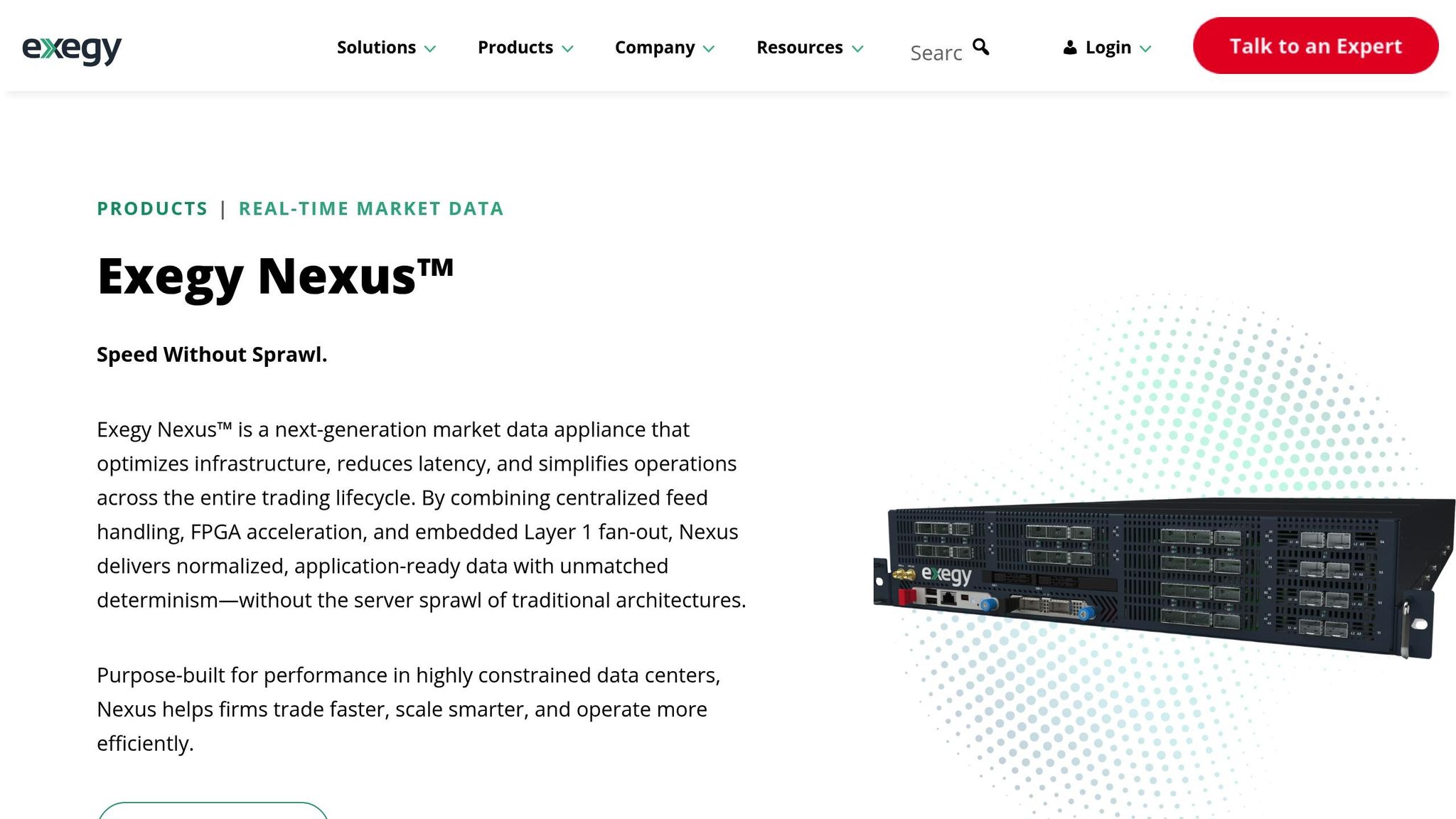
The Exegy Nexus SmartNIC is a managed FPGA platform designed specifically for trading environments. Unlike traditional NICs that demand significant in-house engineering, Nexus simplifies the process by delivering market data to software applications in just 2 microseconds [14]. It handles parsing, order book building, and filtering directly at the hardware level [14][3]. This eliminates the need for costly, time-intensive engineering efforts, which can exceed $5 million and take over three years [15].
In June 2025, a U.S. equities broker demonstrated Nexus's effectiveness through a return-on-investment analysis. By reducing its server count from 32 to 22, the broker saved $1.4 million annually. Further reductions to 17 servers, achieved by offloading the API, resulted in nearly $2 million in savings while improving system determinism [14]. The platform delivers exceptional performance, achieving tick-to-trade latencies of under 2 microseconds for UBBO-triggered trades and below 350 nanoseconds for raw signal triggers [15].
Magmio FPGA Network Card
Magmio’s FPGA network card offers a unique solution for traders who want the benefits of FPGA acceleration without needing specialized programming knowledge. Using this platform, traders can write strategy code in standard C++, which is then automatically converted into optimized FPGA configurations [16]. This approach removes the traditional barrier of requiring FPGA expertise while still delivering performance at the nanosecond level.
The card also employs kernel bypass technology via its proprietary API, allowing standard socket-based trading applications to bypass the operating system kernel. This results in significantly lower latency while enabling traders to retain their existing setups, such as NinjaTrader with secure managed hosting, along with custom indicators [16]. This ensures ultra-low latency trading without disrupting established workflows or functionalities.
Algo-Logic FPGA Accelerator

The Algo-Logic FPGA Accelerators are built for real-time data processing and ultra-low-latency order execution. Leveraging platforms like the AMD Alveo UL3524, which features 64 ultra-low latency transceivers and 780,000 LUTs, these accelerators achieve transceiver latencies of under 3 nanoseconds, offering a 7X improvement over traditional solutions [2][7].
These accelerators excel in handling high-volume data streams without any performance degradation. Even when market feeds exceed 825 Mb/s, where traditional NICs often falter, FPGA-based solutions maintain consistent and deterministic performance [6]. Advanced features like hardware timestamping with 4-nanosecond precision [13] and pre-loaded packet transmission capabilities, saving up to 60 nanoseconds on the transmit path, further enhance their appeal [13]. These innovations integrate seamlessly with TraderVPS infrastructure, setting a new standard for trading speeds and reliability.
Integration with TraderVPS Infrastructure
Expanding on the latency improvements already mentioned, integrating FPGA NICs with TraderVPS takes trading performance to another level.
Compatibility with TraderVPS Plans
FPGA NICs connect seamlessly to TraderVPS servers via standard PCIe slots. For example, the VPS Ultra plan - equipped with 24 AMD EPYC cores, 64 GB of DDR4 RAM, and optimized for running 5–7 NinjaTrader charts - pairs exceptionally well with FPGA acceleration. By shifting network processing tasks to FPGA hardware, CPU resources are freed up for charting and executing strategies, ensuring ultra-low latency even when data feeds exceed 850 Mb/s.
Modern FPGA NICs, like the AMD Alveo X3 series, feature a compact, single-slot PCIe design that fits into standard 1U, 2U, and 4U racks. These cards require a PCIe Gen3 or Gen4 x8 slot and support 10/25 GbE connectivity through DSFP or Direct Attach Copper connections [1][19]. For traders who demand maximum throughput, the Dedicated Server plan - with 12+ AMD Ryzen cores and 10 Gbps+ network capacity - provides an excellent platform for leveraging FPGA acceleration.
The result? Predictable and consistent performance, even when handling several gigabits per second of market data [6].
With hardware compatibility covered, the integration process is equally straightforward.
Integration Process
Installing an FPGA NIC is as simple as inserting the card into a PCIe slot and connecting the necessary cables [1].
On the software side, integration is made possible through kernel bypass technology using frameworks like AMD Solarflare Onload or TCPDirect. These tools enable BSD socket–compliant TCP/UDP communication, allowing NinjaTrader to interact directly with the FPGA hardware without requiring any changes to the existing trading code. Custom indicators and automated strategies continue functioning as they did before, but now with the added advantage of nanosecond-level latency improvements. This streamlined integration ensures that NinjaTrader remains optimized for ultra-low latency execution.
Time synchronization is achieved through PTP (IEEE 1588-2008) or PPS connections, ensuring the VPS clock aligns perfectly with exchange timestamps for precise order execution and regulatory compliance [1][19]. Traders can also fine-tune performance by adjusting host buffer sizes - smaller buffers for ultra-low latency or larger ones (up to 1 TB) for high throughput [17]. Thanks to standardized frameworks like Enyx nxFramework, the entire setup process is typically completed in just a few hours, not weeks [18].
Performance Comparison
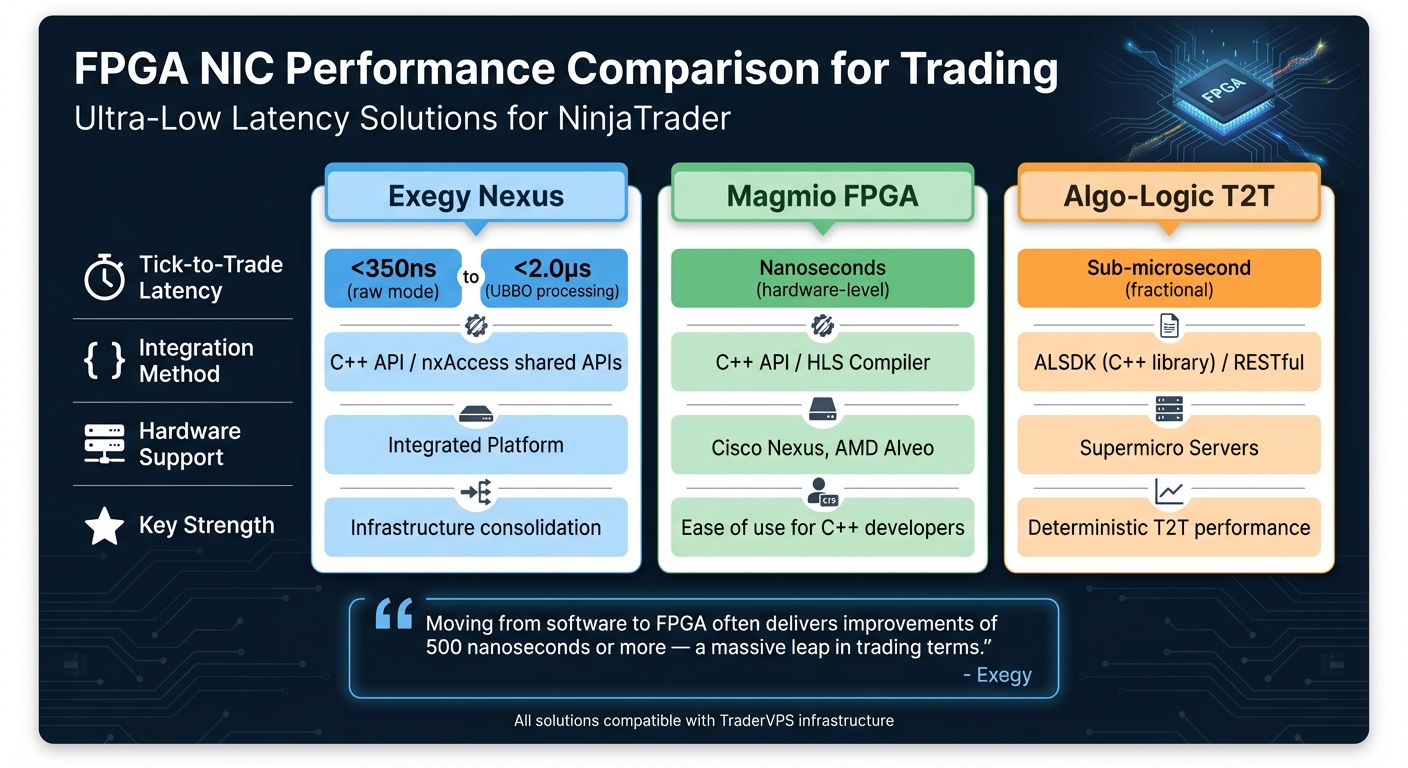
FPGA NIC Performance Comparison for Trading: Latency and Features
Let’s dive into how some leading FPGA NIC solutions stack up when it comes to performance. These devices are designed to deliver the ultra-low latency needed for lightning-fast futures trading, where even microseconds can make or break an order.
In futures trading, latency is everything. Exegy Nexus stands out with its tick-to-trade latency of under 350 nanoseconds in raw mode and below 2.0 microseconds for UBBO processing [15]. This is thanks to its "offload-first" design, which processes parsing, book building, and filtering entirely in hardware. Meanwhile, Magmio FPGA achieves nanosecond-level latency, offering developers a seamless integration with C++ [21]. On the other hand, Algo-Logic's T2T systems deliver deterministic, sub-microsecond latency, completely eliminating OS-related jitter [20].
"Moving from software to FPGA often delivers improvements of 500 nanoseconds or more - a massive leap in trading terms." - Exegy [15]
FPGA NIC Comparison Table
| Feature | Exegy Nexus | Magmio FPGA | Algo-Logic T2T |
|---|---|---|---|
| Tick-to-Trade Latency | <350ns (raw) to <2.0µs (UBBO) [15] | Nanoseconds (hardware-level) [21] | Sub-microsecond (fractional) [20] |
| Integration Method | C++ API / nxAccess shared APIs [15] | C++ API / HLS Compiler [21] | ALSDK (C++ library) / RESTful [20] |
| Hardware Support | Integrated Platform [15] | Cisco Nexus, AMD Alveo [21] | Supermicro Servers [20] |
| Key Strength | Infrastructure consolidation [15] | Ease of use for C++ developers [21] | Deterministic T2T performance [20] |
This table highlights how these FPGA NIC solutions, when paired with TraderVPS, provide the ultra-low latency edge that premium futures trading demands. Each option brings its own strengths, ensuring there’s a solution to fit various trading needs.
Future of FPGA NICs in Financial Networks
The evolution of FPGA NICs is set to push the boundaries of speed and efficiency in financial networks. Over the next decade, these devices are expected to achieve true nanosecond-level performance, driven by continuous advancements in technology. A recent example is AMD's release of the Alveo UL3524 accelerator card in September 2023. This card, powered by a custom 16nm Virtex UltraScale+ FPGA, achieved an impressive transceiver latency of under 3 nanoseconds, a milestone spearheaded by Hamid Salehi, AMD's Director of Product Marketing [2]. Such breakthroughs point to a future of even faster trade executions, particularly in high-frequency trading platforms.
AI is also becoming a key player in this space. Frameworks like FINN now enable developers to compile quantized neural networks using PyTorch, which can then run directly on FPGA hardware. This advancement allows AI-driven trading strategies to execute with remarkable speed and precision [2]. For NinjaTrader users on TraderVPS, this integration ensures ultra-low latency, even with AI-based strategies. Olivier Cousin, Director of FPGA Solutions at Exegy, emphasized this potential, stating:
"By combining the pioneering ultra-low latency FPGA technology from AMD with Exegy's expertise in capital markets, we're able to deliver a comprehensive solution that addresses the ever-increasing optimization needed to build the trading infrastructure of tomorrow." [2]
Another exciting development is the full offloading of hardware stacks. Next-generation FPGA NICs are now capable of handling the entire TCP/UDP stack in hardware, ensuring steady performance even during periods of intense market activity [6].
Composable infrastructure is also gaining momentum in financial networks. For instance, Arista Networks' MetaMux, part of the 7130L series, achieves order sends in just 39 nanoseconds. When paired with Layer 1 replication, it reduces round-trip times to 44 nanoseconds, cutting down on network hops and simplifying cabling [10].
Precision timing is another area seeing significant progress. Advanced synchronization standards like White Rabbit and PTP v2.1 are becoming integral to FPGA NICs, enabling sub-nanosecond accuracy across distributed trading environments [6]. For NinjaTrader users on TraderVPS, these improvements mean tighter execution windows and greater consistency, even as market conditions fluctuate. These enhancements are set to further empower users, delivering both precision and reliability in trading operations.
Conclusion
FPGA NICs are transforming the world of futures trading by delivering latency measured in nanoseconds with unmatched consistency. By eliminating kernel interrupts and bypassing CPU bottlenecks, these cards ensure the steady performance that NinjaTrader users rely on, especially during volatile market swings. The difference between microsecond-level CPU processing and nanosecond-level FPGA execution can mean the difference between capturing or missing fleeting market opportunities.
This leap in performance translates directly into better trading operations. When paired with TraderVPS infrastructure, FPGA NICs enable ultra-low latency execution while maintaining compatibility with traditional VPS setups. Hardware solutions like the AMD Alveo UL3524, Exegy Nexus SmartNIC, and Magmio FPGA cards bring enterprise-level performance to traders through accessible VPS hosting options.
For those running automated strategies on NinjaTrader, FPGA-based pre-trade risk checks can complete in under 25 nanoseconds, ensuring a smooth and uninterrupted order flow [4]. Additionally, hardware-based protocol parsing processes market feeds instantly, while A-B line arbitrage ensures traders receive the most up-to-date information by merging redundant data streams. These capabilities are critical for high-frequency futures trading, where every nanosecond counts.
As AI-powered FPGA trading and full hardware offloading continue to evolve, they are setting new benchmarks for speed and precision in financial networks. Whether using the VPS Pro plan with 16GB of RAM or a Dedicated Server with 128GB of RAM and 10Gbps+ networking, the combination of FPGA acceleration and optimized VPS hosting gives traders a measurable edge in today’s competitive trading environment. TraderVPS remains at the forefront, integrating these advancements to redefine what’s possible in trading speed and reliability.
FAQs
How do FPGA-based NICs reduce latency for futures trading on NinjaTrader?
FPGA-based Network Interface Cards (NICs) are game changers when it comes to reducing latency. By shifting critical network processing tasks directly to hardware, these NICs can deliver sub-nanosecond transceiver latency - less than 3 nanoseconds - and offer up to 7× lower latency compared to traditional NICs.
For NinjaTrader users involved in futures trading, this translates to faster market data updates and quicker order execution. In high-speed trading, where every millisecond counts, integrating FPGA NICs into a VPS trading setup can provide a serious competitive edge, ensuring trades are executed with unmatched reliability and efficiency.
What benefits do FPGA-based NICs offer for trading systems compared to traditional NICs?
FPGA-based NICs are designed to deliver ultra-low latency and increased throughput, making them a perfect fit for high-frequency trading scenarios. By handling market data and order protocols directly in hardware, they bypass operating system delays and minimize CPU competition, ensuring more stable and reliable performance.
Another advantage is their energy efficiency. These NICs consume less power than traditional software-driven alternatives, making them a smarter choice for power-conscious setups. For traders using futures trading platforms like NinjaTrader, FPGA NICs can dramatically boost execution speeds, offering the precision and quick response times essential for staying competitive in fast-moving markets.
How do FPGA-based NICs improve trading performance with TraderVPS?
FPGA-based Network Interface Cards (NICs) are seamlessly integrated into TraderVPS infrastructure by being installed directly into the PCIe slots of the VPS host. These cards take on essential networking tasks - like packet parsing, timestamping, and updating order books - right on the FPGA hardware. This offloads the CPU, allowing it to focus entirely on running the NinjaTrader execution engine. The result? Blazing-fast trade execution and ultra-low latency.
Top-tier FPGA NICs, such as AMD’s Alveo series, bring transceiver latencies down to under 3 nanoseconds. This drastically cuts the time required to process market data and execute trades. TraderVPS configures these NICs with pre-built low-latency pipelines that integrate effortlessly with the VPS’s virtual network interfaces. This makes it simple for traders to connect their NinjaTrader platforms. On top of that, these advanced NICs support custom AI-driven algorithms, speeding up decision-making and improving execution efficiency for futures trading.