Micro Futures Guide: /MGC, /MNQ, /MES Contracts
Micro futures are smaller versions of standard futures contracts, designed for traders with limited capital. They represent one-tenth the size of E-mini futures, offering lower financial barriers and precise risk control. Key contracts include:
- /MES (Micro E-mini S&P 500): Tracks the S&P 500; valued at $5 per point.
- /MNQ (Micro Nasdaq-100): Follows the Nasdaq-100; valued at $2 per point.
- /MGC (Micro Gold): Represents gold; each tick equals $1.
These contracts offer nearly 24-hour trading, lower margins (as little as $50 intraday), and no Pattern Day Trading (PDT) rule restrictions. They are ideal for beginners or traders seeking smaller, flexible positions.
Quick Comparison:
| Feature | /MGC (Gold) | /MNQ (Nasdaq-100) | /MES (S&P 500) |
|---|---|---|---|
| Multiplier | 10 troy ounces | $2 × Index | $5 × Index |
| Tick Value | $1.00 | $0.50 | $1.25 |
| Volatility | Medium-High | High | Medium |
| Settlement | Physical | Cash | Cash |
| Best For | Hedging, Gold | Momentum Trading | Beginners |
Micro futures simplify trading in major markets while requiring less capital. They are an accessible way to trade indices and commodities with manageable risk.
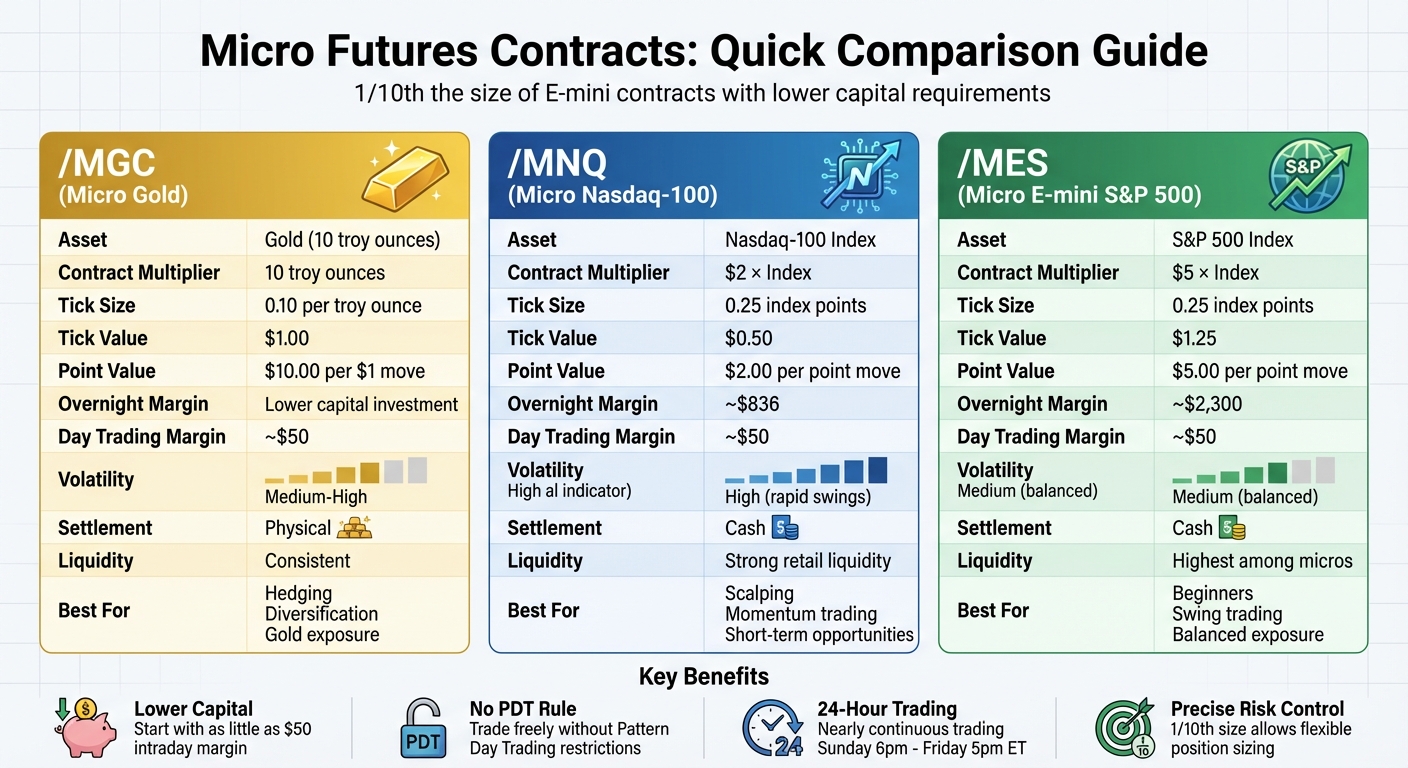
Micro Futures Contracts Comparison: /MGC, /MNQ, /MES Specifications
Beginner’s Guide to Micro E-mini S&P 500 Futures (/MES) | Futures Trading Explained
Contract Specifications for /MGC, /MNQ, and /MES
Before diving into trading, it’s crucial to understand the specific details of each micro futures contract. These specifications outline the capital requirements, how price changes impact your account, and the trading hours for each contract. Let’s break down the details for /MGC, /MNQ, and /MES.
/MGC (Micro Gold) Specifications
The /MGC contract represents 10 troy ounces of gold and trades on the COMEX division of the CME. A movement of 0.10 points in the gold price translates to a $1.00 change in profit or loss. For instance, if gold rises from $2,050.00 to $2,051.00 per ounce, your position would gain $10.00 - or lose $10.00 if it moves the other way.
This contract settles physically, meaning you’d receive or deliver gold upon expiration if you hold the position. However, most traders avoid this by rolling or closing their positions before the contract expires. Trading hours span from 6 p.m. ET Sunday to 5 p.m. ET Friday, with a one-hour pause each day from 5 p.m. to 6 p.m. ET.
/MNQ (Micro Nasdaq-100) Specifications
The /MNQ contract is tied to the Nasdaq-100 Index, with a value of $2 per index point. Each tick represents 0.25 points and is worth $0.50, so a one-point move (equal to four ticks) results in a $2.00 change in your position.
Unlike /MGC, /MNQ settles in cash, avoiding the complexities of physical delivery. It operates on a quarterly expiration schedule - March, June, September, and December. Since its launch in 2019, /MNQ has seen a surge in trading volume, offering strong liquidity for retail traders. Typical bid-ask spreads are just 1–2 ticks. The trading hours mirror other micro contracts, running from 6 p.m. ET Sunday through 5 p.m. ET Friday.
/MES (Micro E-mini S&P 500) Specifications
The /MES contract tracks the S&P 500 Index and is valued at $5 per index point. A single tick equals 0.25 points and is worth $1.25, so a one-point move (four ticks) changes your position by $5.00.
Like /MNQ, this contract settles in cash and follows the same quarterly expiration schedule. Since its introduction, /MES has become one of the most actively traded micro futures, with tight bid-ask spreads ranging from $1.25 to $2.50. It also offers nearly 24-hour trading, operating from 6 p.m. ET Sunday to 5 p.m. ET Friday.
Comparing /MGC, /MNQ, and /MES Contracts
When deciding which micro futures contract aligns with your trading goals, understanding the key differences between /MGC, /MNQ, and /MES is essential. Each contract has distinct characteristics designed to suit various trading strategies and market preferences.
- /MES: Offers exposure to the S&P 500 with moderate volatility and excellent liquidity, making it an ideal choice for those seeking balanced market participation.
- /MNQ: Known for its rapid price movements, this contract is perfect for traders who thrive on momentum and short-term opportunities.
- /MGC: Provides access to precious metals, particularly gold, making it a popular choice for diversification and hedging during uncertain times.
Contract Comparison Table
| Feature | /MGC (Micro Gold) | /MNQ (Micro Nasdaq-100) | /MES (Micro E-mini S&P 500) |
|---|---|---|---|
| Contract Multiplier | 10 troy ounces | $2 × Nasdaq-100 Index | $5 × S&P 500 Index |
| Tick Size | 0.10 per troy ounce | 0.25 index points | 0.25 index points |
| Tick Value | $1.00 | $0.50 | $1.25 |
| Notional Value (Approx.) | Variable with gold price | ~$49,850 (at 24,926) | ~$30,000 (at 6,000) |
| Overnight Margin (Approx.) | Lower capital investment | ~$836 | ~$2,300 |
| Day Trading Margin (Approx.) | N/A | ~$50 | ~$50 |
| Volatility | Medium to High | High (rapid price swings) | Medium (balanced) |
| Liquidity | Consistent liquidity | Strong retail liquidity | Highest among micros |
| Best For | Diversification, hedging | Scalping, momentum trading | Beginners, swing trading |
Micro futures contracts are particularly appealing due to their lower capital requirements, making them accessible to a broader range of traders. They also come with reduced commission costs compared to traditional E-mini contracts. Moreover, these contracts allow traders to bypass Pattern Day Trading rules, making them suitable for accounts of any size.
Benefits of Trading Micro Futures
Micro futures have changed the game for retail traders, providing access to major markets that were once out of reach for many. Introduced by CME Group in May 2019, these contracts are precisely 1/10th the size of E-mini contracts, making them far more accessible. This smaller size brings advantages like improved capital efficiency, better risk management, and ample liquidity.
Lower Capital and Margin Requirements
One of the biggest perks of micro futures is the reduced financial barrier to entry. For example, trading an E-mini S&P 500 (ES) contract requires about $23,000 in overnight margin, while its smaller counterpart, the Micro E-mini S&P 500 (MES), only needs around $2,300. The difference is even more striking for day traders - ES demands roughly $500 in margin, whereas you can trade MES with as little as $50.
"Micro E-mini futures launched in 2019, precisely 1/10th the size of their E-mini counterparts, making them ideal for smaller accounts and flexible risk control. This innovation opened futures trading to an entirely new group of traders who needed lower capital requirements and more precise position sizing."
– Optimus Futures [2]
For traders with a $1,000 account and an $80 intraday margin requirement for /MES [3], this setup leaves room for proper risk management - something that’s nearly impossible with standard E-mini contracts. Lower capital requirements also mean lower costs overall. Commissions for micro contracts are typically around $0.29 per side, compared to $1.09 for E-mini contracts. Plus, since micro futures aren’t subject to the Pattern Day Trader (PDT) rule, you can day trade freely with a smaller account, avoiding the restrictions that stock traders often face.
Better Risk Control and Position Sizing
With micro futures being 1/10th the size of standard contracts, you gain precise control over your risk exposure. For instance, with the Micro E-mini S&P 500, a 0.25 index point move equals $1.25, compared to $12.50 for the E-mini. This allows you to adjust your position size to fit your risk tolerance.
Here’s a practical example: Imagine you have a $10,000 account and a 1% risk tolerance ($100 per trade). With a 20-point stop loss on an MES contract ($100 ÷ $5 = 20 points), you can comfortably trade 1–2 contracts. However, with an ES contract, the same $100 risk would only allow for a 2-point stop loss ($100 ÷ $50 = 2 points), which is often too restrictive for many trading strategies [2].
This flexibility also makes it easier to scale your positions incrementally or take partial exits, giving you more control over your trades - something that’s tough to achieve with larger contracts.
High Liquidity and 24-Hour Trading
Micro futures also shine in terms of liquidity. The Micro E-mini S&P 500 (/MES) boasts the highest liquidity among all micro contracts, ensuring tight bid-ask spreads and dependable order execution, even during volatile times. Similarly, the /MNQ contract has become a favorite among active traders, thanks to its strong retail participation.
Another advantage is the near 24-hour trading window, five days a week. This extended schedule lets you react to global market events no matter where you are or what time it is. Whether you’re trading /MGC, /MNQ, or /MES contracts, the liquidity and flexibility of micro futures make them an excellent choice for diverse trading strategies.
Trading Strategies for Micro Futures
Micro futures open up a world of trading opportunities, offering flexibility and precision with reduced risk. Thanks to their smaller contract size, traders can explore a range of strategies - whether it's taking advantage of short-term market moves, hedging against risk, or capitalizing on longer-term trends.
Scalping and Day Trading
Micro futures like /MNQ (Micro E-mini Nasdaq-100) and /MES (Micro E-mini S&P 500) are ideal for scalping and day trading because of their tight spreads and high liquidity. These strategies aim to capture quick, small profits by holding positions for just seconds or minutes. To succeed, traders need to rely on tight stop-loss orders to manage risk effectively. These fast-paced tactics pair well with the broader flexibility that micro futures offer.
Hedging with /MGC
For those looking to hedge, /MGC (Micro Gold Futures) provides an affordable way to gain exposure to gold. During times of economic uncertainty or rising inflation, gold often moves in the opposite direction of other portfolio assets. By using /MGC, traders can balance risk without committing a large portion of their capital to a hedge, making it a practical choice for portfolio diversification.
Trend Following and Swing Trading
Micro futures like /MNQ and /MES also work well for trend-following and swing trading strategies. These approaches rely on technical tools, such as moving averages, to identify entry and exit points. Swing trading, in particular, involves holding positions for several days or even weeks, allowing traders to adjust their positions as trends gain momentum. This strategy offers a way to capitalize on market movements while maintaining flexibility.
Risk Management and Tips for Beginners
Trading micro futures requires a disciplined approach and strong risk management. Even though these contracts are smaller, the risks they carry are very real and need to be addressed from the outset.
Position Sizing and Stop-Loss Orders
Every trade should include a stop-loss to cap potential losses. One of the benefits of micro futures is their flexibility - you can trade multiple smaller contracts instead of committing to a single large position. This approach allows you to set different stop-loss levels for portions of your trade, offering more precise risk control.
For volatile micro futures, tighter stop-loss orders can help protect your capital from sudden price swings [8]. For instance, if you have a $10,000 account and a 1% risk tolerance (equivalent to $100), you could trade /MES contracts with a 20-point stop and safely manage 1–2 contracts [2].
Additionally, maintaining a solid margin buffer can further protect your trading position.
Maintaining Adequate Margin Buffers
Stop-losses are essential, but relying solely on minimum margin requirements is risky. To better handle market volatility, it’s wise to maintain a margin buffer of 3–5 times the required margin. This extra cushion can help you avoid margin calls during volatile periods and reduce the stress of managing open positions [2].
"The listed margin is just the minimum required to open a position. It doesn't give you much room to manage risk, ride out volatility, or recover from a losing trade. If the market moves even slightly against you, your position could be liquidated or trigger a margin call."
– MetroTrade [3]
For beginners, starting with a balance of $500 to $1,000 provides a realistic and manageable foundation for trading micro contracts. While some contracts can technically be traded with less than $100, having a larger balance offers a safer and more practical starting point [3].
Using VPS for Automated Trading
If you’re running automated strategies or trading during off-hours, a Virtual Private Server (VPS) can help mitigate connectivity risks. Services like TraderVPS offer low-latency, NinjaTrader-optimized technology to keep your automated systems running smoothly. With 24/7 uptime and built-in DDoS protection, a VPS ensures your trading strategies remain active - an essential advantage when dealing with the near-continuous liquidity of micro futures markets.
Conclusion
Micro futures (/MGC, /MNQ, /MES) provide traders with significant market exposure at just one-tenth the size of standard contracts. This smaller scale lowers the cost of entry while still offering meaningful access to the market [4][5][6]. Whether you're new to trading and working with limited capital or a seasoned trader looking to fine-tune your positions, micro futures allow for flexibility with reduced financial commitment and manageable risk.
To navigate these markets successfully, it's essential to stick to a disciplined trading plan. Define your position sizes, use stop-loss orders to cap potential losses, and set daily loss limits to keep emotions in check [7][1]. Discipline is further reinforced by journaling trades, setting stops thoughtfully to account for market fluctuations, and practicing strategies in simulated environments [7]. Remember, even with smaller contract sizes, the leverage involved in futures trading can lead to substantial losses without proper risk management.
Reliable execution plays a crucial role in maintaining this discipline. Robust technology is just as important as a sound strategy. For those utilizing automated systems or trading during off-hours, a Virtual Private Server (VPS) can ensure consistent performance. TraderVPS offers infrastructure optimized for NinjaTrader, featuring 24/7 uptime and DDoS protection. With plans starting at $69/month, their VPS Lite option helps you avoid disruptions and maintain low-latency execution during nearly continuous trading sessions.
If you're just starting out, begin with single contracts and gradually build your expertise. While these contracts make it easier to learn and adapt, they still require the same level of caution and respect as any serious trading instrument.
FAQs
What are the main differences between the /MGC, /MNQ, and /MES micro futures contracts?
The /MGC, /MNQ, and /MES micro futures contracts stand out due to differences in their underlying assets, contract sizes, and tick values.
- /MGC (Micro Gold): This contract is tied to the price of gold and represents 10 troy ounces. Each tick corresponds to $0.10 per 0.1 ounce, resulting in a tick value of $1.
- /MNQ (Micro Nasdaq-100): Linked to the Nasdaq-100 index, this contract uses a $2 multiplier, where a 0.25-point tick equals $0.50.
- /MES (Micro S&P 500): Tracking the S&P 500 index, this contract has a $5 multiplier, making a 0.25-point tick worth $1.25.
These micro contracts are scaled-down versions of their standard counterparts, requiring approximately one-tenth of the capital. This smaller size makes them particularly appealing to retail traders. The main distinctions lie in the assets they represent - gold for /MGC and equity indexes for /MNQ and /MES - and their respective tick values.
How can micro futures help traders manage risk effectively?
Micro futures offer traders a way to manage risk with greater precision by minimizing the financial stakes of each trade. Take the Micro E-mini contract, for instance - it's just 1/10th the size of a standard E-mini. This means that for every tick, the account moves by only $1.25, as opposed to the $12.50 seen with the larger contract. Thanks to this smaller tick value, margin requirements are much lower too. For example, an overnight Micro S&P 500 contract might require about $2,300, compared to a hefty $23,000 for its full-size counterpart. This reduced exposure makes it easier to stick to a defined risk budget.
The affordability of micro futures also opens up opportunities for flexibility. Traders can test new strategies, spread their investments across assets like Micro Gold (/MGC), Micro Nasdaq (/MNQ), and Micro S&P 500 (/MES), or fine-tune positions without tying up significant capital. They’re ideal for practicing sound risk management techniques like setting tighter stop-losses, scaling positions, or hedging - all while keeping portfolio volatility in check. These benefits make micro futures particularly appealing for beginners or those with smaller trading accounts.
What are the trading hours and margin requirements for micro futures contracts?
Micro futures contracts are available for trading nearly around the clock. They kick off at 5:00 PM Central Time (CT) on Sunday and continue until 4:00 PM CT on Friday. There’s a short daily break in trading from 3:15 PM to 3:30 PM CT.
One of the appealing features of micro futures is their low margin requirements, which make them accessible to a wide range of traders. For example, intraday margins can start as low as $81.05 per contract, though the exact amount depends on the specific instrument and your broker. Be sure to confirm the latest margin requirements directly with your broker.