Forex Trading Benefits: Unique Edges Revealed
Forex trading is the largest financial market globally, with daily volumes reaching $7.5–$9.6 trillion as of 2025. Its standout features include 24/5 trading, high liquidity, leverage options, and the ability to profit in both rising and falling markets. This article highlights ten key benefits that make forex trading appealing:
- Massive Liquidity: Ensures fast trade execution and low transaction costs.
- 24/5 Access: Trade anytime across global sessions - Sydney, Tokyo, London, and New York.
- Leverage: Amplify positions with ratios up to 50:1 (U.S.-regulated markets).
- Bidirectional Profitability: Earn whether currency values rise or fall.
- Scalping Opportunities: Fast execution speeds support high-frequency trading strategies.
- Currency Pair Diversity: Diversify with major, minor, and exotic pairs.
- Low Entry Barriers: Start with as little as $20; brokers offer micro and nano lots.
- Advanced Technology: Automation tools like Expert Advisors and VPS boost efficiency.
- Decentralized Structure: Transparent pricing driven by global demand and supply.
- Discipline Building: Develop emotional control and risk management through experience.
Forex trading combines flexibility, technology, and global accessibility, making it a versatile option for traders of all levels. Read on to learn how these features can enhance your trading strategy.
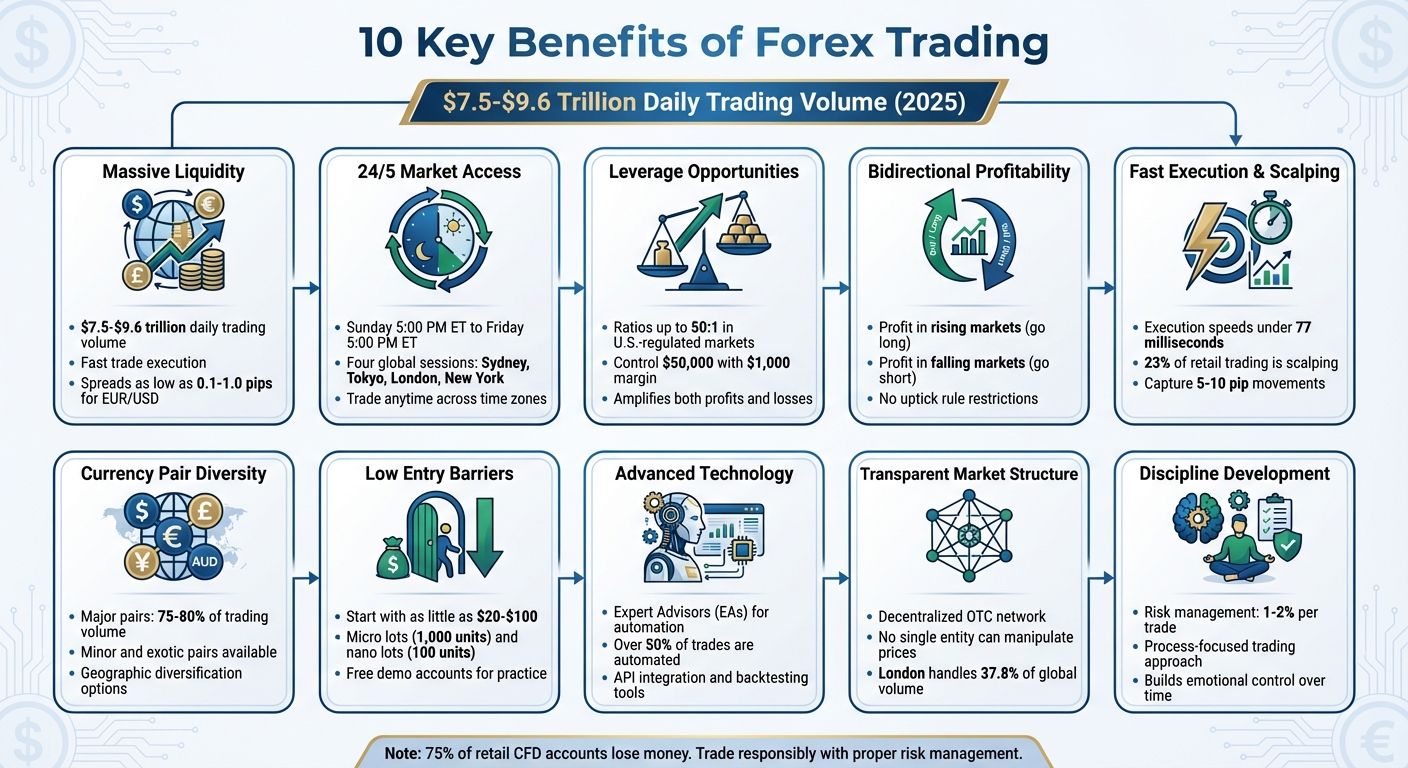
10 Key Benefits of Forex Trading: Market Features and Advantages
7 Benefits of Trading Forex
1. High Liquidity for Fast Trade Execution
With a staggering $7.5 trillion traded daily[8], the forex market offers unmatched liquidity. This constant flow of buyers and sellers ensures trades are executed almost instantly. For example, when trading popular currency pairs like EUR/USD, clicking "buy" or "sell" typically results in immediate order matching.
"Liquidity in forex or any other market refers to how easily a market can absorb and match orders." - Adam Lemon, Chief Analyst and Director of Content, DailyForex [5]
This deep liquidity also means tighter spreads - often ranging from 0.1 to 1.0 pips for EUR/USD, compared to over 2 pips in less liquid markets. As a result, transaction costs can stay below 0.1% [7][5]. Major players like Citi, JPMorgan, and Deutsche Bank compete fiercely, further driving down costs.
Another advantage of high liquidity is reduced slippage. Even large trades can be executed without significantly moving the market price [6]. This is especially valuable during volatile periods when less liquid markets might struggle with price stability or execution delays.
To fully capitalize on forex liquidity, timing is key. The London-New York session overlap (8:00 AM to 12:00 PM EST) is the most active trading period, accounting for about 45% of daily forex volume [5]. During these hours, traders benefit from the tightest spreads and the most reliable execution. However, keep in mind that just before major economic announcements, liquidity can temporarily dip, causing spreads to widen [5].
This level of liquidity not only ensures smooth trade execution but also plays a crucial role in maintaining flexibility and stability in the forex market.
2. 24/5 Market Access for Flexible Trading
The forex market stands apart from stock exchanges because it operates continuously from Sunday at 5:00 p.m. ET to Friday at 5:00 p.m. ET. This is possible because forex functions as a decentralized over-the-counter (OTC) network rather than relying on a single physical exchange. As one financial center winds down, another is already active or starting up, creating an uninterrupted cycle across the four main trading sessions: Sydney, Tokyo, London, and New York. This setup ensures high liquidity and gives traders unmatched flexibility.
This round-the-clock schedule allows traders to jump in at times that work best for them - whether it’s early in the morning, during a lunch break, or late at night. For instance, a trader based in California can take advantage of the Tokyo session after their workday, while someone on the East Coast might prioritize trading during the London session. This flexibility empowers traders to align their strategies with the market conditions that suit them best.
Each session brings its own dynamics. For example, GBP/USD typically moves about 127 pips during the London session, compared to 92 pips during the Tokyo session [9]. These differences in volatility and activity offer unique opportunities depending on the time of day and the financial centers in play.
"Trading is not an endurance sport; it is a performance sport." - FXNX [10]
While the market is always open, managing trades outside typical hours requires careful planning. Tools like limit orders and automated alerts can help you stay on top of your positions, even when you’re not actively watching the market. This approach helps protect against unexpected price swings during times when you’re sleeping or busy with other commitments.
One crucial tip: avoid opening new positions around 5:00 p.m. ET. During this time, bank servers reset for the daily rollover, and spreads can widen significantly. Make sure your stop losses account for these temporary spikes to avoid unnecessary risks [10][11].
3. Leverage and Margin Trading for Amplified Positions
Leverage acts as a financial multiplier, letting traders control positions far larger than their initial capital. For instance, with 50:1 leverage, $1,000 can control a $50,000 position by using a small fraction of the total as margin[12][13].
This approach increases capital efficiency. Without leverage, trading one standard lot (100,000 units) of a USD-based currency pair would require $100,000[12][13]. However, leverage comes with a crucial caveat: gains and losses are calculated based on the full position size, not just the margin deposit. This means even minor price changes can lead to significant percentage swings in your investment. While leverage offers the potential for larger returns, it also carries the risk of equally substantial losses.
"Leverage is a double-edged sword and can dramatically amplify your profits. It can also just as dramatically amplify your losses." – FXCM Research Team[16]
At higher levels, such as 100:1 leverage, a mere 1% adverse price movement can wipe out your margin, triggering a margin call. This happens when your account equity falls below the broker's required threshold, forcing you to either deposit more funds or close your positions[12][14][17][18]. Since currency pairs generally fluctuate by 5% to 15% annually, leverage is often used to make small market movements more impactful[12]. However, this same amplification can lead to rapid losses if the market moves against you.
For this reason, traders - especially those just starting out - should approach leverage cautiously. Beginners might find it safer to use lower leverage ratios, such as 2:1 or 5:1, and should always employ stop-loss orders to manage risks. Monitoring margin levels is equally essential. As tastytrade explains: "Leverage is best viewed as a capital efficiency tool rather than a profit-enhancement strategy."[12]
4. Profit Opportunities in Rising and Falling Markets
Forex trading stands out for its ability to generate profits regardless of whether currency values rise or fall. This unique feature stems from the way trades are structured. Each transaction involves buying one currency while simultaneously selling another, making it inherently bidirectional.
When traders anticipate a currency will strengthen, they go long - essentially buying the currency. For instance, purchasing EUR/USD at 1.1256 and later selling it at 1.1266 results in a 10-pip gain, translating to a $100 profit on a standard 100,000-unit lot[19]. On the flip side, traders go short when they expect a currency to weaken. Selling EUR/USD at 1.1256 and buying it back at 1.1246 also nets a $100 profit[19].
"The ability to profit in both rising and falling markets sets forex apart from traditional stock trading." – Investopedia[19]
This dual-directional flexibility is a game-changer. Unlike stock trading, which typically relies on rising prices for gains, forex trading thrives on market volatility. Economic downturns or uncertain conditions that might stall other markets can actually create opportunities for forex traders.
Another advantage is the absence of restrictive rules like the uptick rule or borrowing requirements, which simplifies short-selling in forex[22][3]. Opening a short position is as easy as clicking "sell" instead of "buy." That said, short positions come with unique risks. While a currency's value can theoretically rise without limit, creating unlimited risk for short trades, long positions are capped by the initial investment amount[20][21]. To manage these risks, using stop-loss orders is essential.
5. Fast Execution Speed and Scalping Opportunities
In forex trading, speed isn't just a luxury - it's a necessity, especially for scalpers. Scalping revolves around capturing tiny price movements, typically between 5–10 pips, across numerous trades in a single day. For this strategy, fast execution speeds are non-negotiable.
Leading brokers excel in this area, achieving execution speeds under 77 milliseconds. For instance, IC Markets processes trades in under 66 ms, BlackBull Markets in 72 ms, and Pepperstone in under 77 ms [24]. Why does this matter? A small slippage of just 2 pips on a trade aiming for 5–10 pips can flip a potential win into a loss [25][26].
"Scalping is both execution-sensitive and price-sensitive, so the best brokers for scalping offer a good balance of both good execution and low spreads." – Steven Hatzakis, Global Director of Online Broker Research, ForexBrokers.com [25]
To succeed in scalping, traders need more than just speed; they need robust tools and infrastructure. Professional scalpers often invest heavily, spending $5,000 to $20,000 on high-performance hardware, premium data feeds (costing $50–$200 per month), and stable internet connections [23][26]. Many also use a Virtual Private Server (VPS) located close to their broker's servers, reducing latency from the 30–120 ms range typical for home internet to just 1–5 ms [26]. This setup is especially advantageous for automated strategies, where trades are held for an average of just 2.3 minutes [26].
The impact of these measures is clear. By 2025, scalping made up about 23% of all retail trading activity in North American markets, with 78% of retail scalpers relying on automation to achieve the necessary execution speeds [26]. Additionally, transaction costs for scalpers fell by 34% between 2023 and 2025, thanks to tighter spreads and advancements in trading technology. For traders executing 50 to over 200 trades daily, these improvements significantly enhance profitability. It's no wonder that incorporating a VPS has become a cornerstone for effective scalping strategies.
6. Multiple Currency Pairs for Portfolio Diversification
The forex market offers a broad range of currency pairs, giving traders the flexibility to spread risk across different economies. Unlike markets tied to a single asset class, forex allows you to create a balanced portfolio by combining major pairs (like EUR/USD or USD/JPY), minor pairs (such as EUR/GBP), and exotic pairs (like USD/TRY). This mix not only helps reduce overall exposure but also allows you to take advantage of how different pairs react to global events.
Each currency pair responds differently to market conditions, which can work in your favor. For instance, if EUR/USD weakens due to economic uncertainty in Europe, AUD/USD might strengthen thanks to a rise in commodity prices. By holding positions across various pairs, you avoid putting all your eggs in one basket. Major currency pairs dominate the forex market, making up about 75% to 80% of total trading volume, with EUR/USD alone accounting for nearly 24% [27][28]. Their high liquidity makes them a reliable foundation for your portfolio.
Another advantage lies in managing correlations between currency pairs. Correlation coefficients, which range from -1 to 1, measure how pairs move in relation to each other [30]. For example, EUR/USD and USD/CHF often move in opposite directions, so holding both can help balance losses if one declines. However, it's best to avoid highly correlated pairs, like EUR/USD and GBP/USD, as their similar movements can amplify risk.
Geographic diversification is an additional safeguard. Trading pairs from different regions - such as USD/JPY (Asia-Pacific), EUR/GBP (Europe), and USD/CAD (Americas) - can protect your portfolio from being overly affected by a downturn in any single regional economy. Commodity-linked pairs, like AUD/USD and USD/CAD, also provide exposure to factors like oil and mineral prices, which differ from those driving industrial economies [28][29].
To put this strategy into action, keep your portfolio manageable by focusing on three to four currency pairs. This allows you to monitor your trades effectively without becoming overwhelmed [31]. Allocate more capital to stable major pairs, while using smaller positions (around 0.25–0.5% of your account) for riskier exotic pairs [28]. This approach helps smooth out portfolio fluctuations and promotes steady returns.
7. Low Entry Barriers and Accessibility
One of the standout features of forex trading is how easy it is to get started, even with a small amount of capital. Unlike stock or futures markets, which often require thousands of dollars to begin, forex trading allows you to open a live account with as little as $20 to $100 [2][1]. Some brokers even go as low as $1 for account openings, though the average minimum deposit for retail traders tends to hover around $250 [4][3]. This accessibility has opened the doors to financial markets for individuals who might not have significant savings, a stark contrast to the exclusivity of traditional markets dominated by large banks and institutions.
Another factor that makes forex trading approachable is the availability of micro lots (1,000 units) and nano lots (100 units). These smaller lot sizes enable traders to manage their positions precisely. For example, with micro lots, a one-pip move is worth only $0.10, making it possible to start trading with just $50 to $5,000, depending on your risk tolerance and strategy [3].
"With low entry requirements and markets open 24/7, anyone with a laptop or smartphone can potentially profit in the forex markets." - Investopedia [15]
Transaction costs are also kept in check. Most brokers operate on a no-commission model, earning their profits through the spread. Under normal market conditions, this spread is typically less than 0.1% [3]. For new traders, free demo accounts are another huge advantage. These accounts come loaded with virtual funds, allowing you to test strategies and build confidence without risking a dime of real money [32].
The combination of low starting deposits, flexible lot sizes, and risk-free practice accounts makes forex trading incredibly accessible. It’s a market designed to let you start small, learn the ropes, and gradually scale up as you build both skill and confidence.
8. Advanced Technology and Automation Support
Forex trading has reached new heights with the integration of advanced technology and automation. Beyond fast execution and secure managed VPS hosting performance, modern trading platforms now utilize Expert Advisors (EAs) and bots. These tools execute trades based on predefined rules, removing the influence of emotions from trading decisions entirely. Automated systems can track multiple currency pairs across various time zones, ensuring no opportunities slip through the cracks.
"Our emotional brain is the worst possible trader." - ForexAutomatic [33]
One standout feature of automation is the ability to perform risk-free backtesting on historical data using platforms like MetaTrader 5 and cTrader. This allows traders to refine their strategies before applying them in live markets. Additionally, API integration opens the door for custom solutions, enabling traders to use programming languages like Python or C# to access real-time data and execute trades. When paired with VPS-enabled platforms, these systems ensure uninterrupted market activity and optimal performance.
The numbers speak for themselves: over 50% of forex trades are automated, with algorithmic systems handling more than 66.6% of those trades. High-frequency trading, where every microsecond counts, relies on VPS hosting near broker data centers (e.g., NY4, LD4) to minimize latency and maintain continuous operation.
"In forex trading, milliseconds matter. A delay in trade execution can lead to slippage... impacting profitability." - Finance Monthly [34]
While automation offers significant advantages, such as eliminating emotional decision-making, it doesn’t eliminate all risks. Traders must still prioritize effective money management, which plays a crucial role in achieving long-term success - contributing to at least 50% of a trader’s overall performance [33].
9. Transparent and Decentralized Market Structure
Forex stands out for its decentralized market structure, which supports transparency and a balanced trading environment. Unlike centralized exchanges like the NYSE or CME, the forex market operates as a global electronic network. This setup connects banks, financial institutions, and brokers directly, bypassing the need for a central clearinghouse [36][39][41]. Trading takes place over-the-counter (OTC) through platforms such as Electronic Brokering Services (EBS) and Thomson Reuters Dealing [36][37][40]. This decentralized approach ensures pricing is driven purely by global supply and demand.
At its core, pricing in forex is shaped by the interbank market, where major players like JPMorgan Chase, UBS, and Deutsche Bank dominate, contributing to 51% of all forex transactions [36]. These Tier 1 banks act as primary liquidity providers, setting benchmark rates that ripple through smaller banks, corporations, and retail brokers [37][40]. While broker prices might vary slightly, arbitrage trading keeps rates tightly aligned across the network [36][37]. This decentralized price discovery mechanism ensures consistency and reliability for traders.
"The FX market is sufficiently liquid that significant manipulation by any single entity is all but impossible during active trading hours for the major currencies." - BabyPips [3]
The sheer scale of the forex market further strengthens its decentralized nature. With a staggering $9.6 trillion in daily trading volume as of April 2025 [36][38], no single entity - not even central banks - can dominate pricing. Geographically, London leads the way, handling 37.8% of global turnover, while trading flows seamlessly across key hubs like Tokyo, Singapore, and New York.
Modern technology also plays a role in maintaining fairness. Liquidity aggregators now bring together fragmented markets, offering traders access to multiple venues. Over 80% of customer trades are matched within dealers' internal liquidity pools, a process known as "internalization", which minimizes costs by eliminating exchange fees and clearinghouse charges [38][42]. The competition among thousands of liquidity providers helps ensure tight spreads, keeping the market efficient and fair for participants.
10. Discipline Development Through Market Experience
While technology and market data provide valuable trading support, a trader's discipline is the true foundation of lasting success. Forex trading, with its unpredictable nature, pushes traders to develop emotional discipline. During volatile market conditions, the brain's emotional center, the amygdala, can overpower the rational prefrontal cortex, leading to impulsive choices. However, regular exposure to these situations helps traders recognize such moments and maintain control, avoiding pitfalls like revenge trading after losses or overconfidence after wins[44][48].
Success in trading goes beyond tools and strategies - it's about mastering discipline. Shifting from an outcome-driven mindset to one focused on following a well-structured process builds confidence that lasts. As FXStreet points out:
"Professional traders anchor confidence to process adherence, not outcomes" [45]
This means that losing a trade executed correctly is better than winning one executed poorly[45][48]. Such discipline allows traders to maintain confidence, regardless of recent performance[45].
Risk management plays a critical role in reinforcing discipline. For instance, sticking to a rule of risking only 1% to 2% of total capital per trade helps curb impulsive decisions[46]. Industry data reveals that 75% of retail investor accounts lose money trading CFDs, often because of emotional decisions rather than flawed strategies[46]. Tools like pre-trade checklists also ensure that every trade aligns with a trader's strategy, reducing emotionally driven entries[46].
A trading journal is another essential tool for identifying and addressing cognitive biases, such as sunk-cost bias or overconfidence[43][44][47]. By recording emotional states at both entry and exit points, traders can uncover patterns that harm their performance[46]. Using the 3R Approach - Recognize triggers, Respond proactively (e.g., taking a break), and Review the outcome - helps traders manage impulses and build stronger decision-making habits[44]. This reflective practice not only reduces emotional reactions but also strengthens resilience over time.
With consistent market exposure, deliberate effort eventually turns into automatic habits. Traders begin to view drawdowns as routine business expenses rather than personal failures, fostering a mindset of resilience[43]. As FXStreet explains:
"The real problem is not emotion. It is the absence of systems that prevent emotion from altering execution" [45]
Additionally, maintaining physical well-being through regular exercise and a balanced diet supports emotional stability, even during periods of high market volatility[49].
Using VPS Infrastructure for Better Performance
Technical hiccups like internet outages, power failures, or unexpected computer crashes can throw even the most carefully crafted trading strategies off course. A Virtual Private Server (VPS) helps avoid these pitfalls by hosting your trading platform in a professional-grade data center equipped with redundant power, cooling systems, and network connections. As Polly Cooper from Serverspace explains:
"A VPS will never replace a trading plan, but it can remove a lot of stupid ways to lose money: disconnects, random reboots, and platforms failing unexpectedly." [35]
TraderVPS is designed to tackle these challenges, ensuring reliable and uninterrupted performance through its advanced infrastructure.
Low latency is critical for active traders. TraderVPS delivers lightning-fast execution speeds as low as 0.30ms, thanks to direct fiber cross-connects to broker matching engines located in Equinix facilities like NY4 (New York) and LD4 (London). In contrast, standard VPS providers, which rely on public internet routes, typically offer latency ranging from 50ms to 200ms. For scalpers and high-frequency traders, this difference can lead to costly slippage during volatile markets. To achieve these speeds, TraderVPS uses cutting-edge hardware, including AMD Ryzen 9950X processors, DDR5 memory, 10 Gbps network interfaces, and NVMe storage. This setup ensures that traders can execute their strategies with precision, especially those relying on split-second timing using specialized HFT platforms for scalping.
When choosing a VPS plan, it’s important to match the resources to your trading needs. For a single Expert Advisor and a few charts, a configuration with 2–4 GB of RAM and 1–2 vCPUs works well. However, traders managing multiple terminals or running complex strategies may need 8–16 GB of RAM and 4–8 vCPUs. TraderVPS offers a range of plans to accommodate different requirements:
- VPS Lite: $69/month (4 AMD EPYC cores, 8 GB RAM, 70 GB NVMe)
- Pro Plan: $99/month (ideal for 3–5 charts with dual-monitor support)
- Ultra Plan: $199/month (supports 5–7 charts across four monitors)
- Dedicated Servers: $299/month (12+ AMD Ryzen cores, 128 GB RAM, 2 TB+ NVMe)
Beyond hardware, geographic proximity plays a big role in improving performance. Aligning your VPS location with your broker’s data center - such as LD4, NY4, or TY3 - minimizes latency and ensures smoother trade execution. For instance, if your broker’s servers are in London, connecting through a Tokyo data center would add unnecessary milliseconds to your trades. Combining this physical closeness with 99.99% to 100% uptime guarantees ensures that your automated strategies operate seamlessly without interruptions.
Conclusion
Forex trading offers a range of advantages that set it apart from other markets. Its immense trading volume enables tight spreads and quick execution, while the market's 24/5 schedule allows for flexibility and immediate responses to global events.
However, success in forex isn't just about understanding its features - it's about pairing those benefits with disciplined risk management. For instance, using stop-loss orders and limiting risk to 1–2% per trade can help protect your capital [1]. Starting with major currency pairs like EUR/USD is also a smart move, given their high liquidity. Financial analyst Alexander Bennett captures it well:
"The best way to unlock forex's potential is to combine its systemic benefits with risk management, macroeconomic awareness, and psychological discipline" [2].
Technology plays a key role too. Automated tools and strong VPS infrastructure, like those provided by TraderVPS, can give traders a significant edge. With ultra-low latency and reliable uptime, these tools ensure your strategies execute exactly when needed - especially critical for scalpers and high-frequency traders.
Ultimately, forex trading rewards preparation and consistency far more than luck or impulsive decisions. To build sustainable profitability, focus on steady learning and practice. Spend 6–12 months honing your skills on a demo account, maintain leverage ratios at or below 50:1, and stay informed on technical analysis and macroeconomic trends. The right mix of preparation, discipline, and technology can turn forex trading into a long-term opportunity.
FAQs
What’s a safe leverage level for beginners?
A good starting point for leverage as a beginner is around 10:1 or lower. This level keeps risks manageable while still offering enough room for meaningful trades. By sticking to lower leverage, new traders can build experience without putting themselves at risk of large losses.
When is the best time to trade forex in the U.S.?
The ideal time to trade forex in the U.S. is during the overlap of the London and New York trading sessions, which occurs from about 8:00 AM to 12:00 PM EST. This window is when market activity peaks, providing the highest levels of liquidity and volatility - key factors that create favorable trading conditions.
Do I really need a VPS for automated trading?
A VPS (Virtual Private Server) is a great choice for automated forex trading. It keeps your trading platform running 24/7, free from disruptions caused by power outages, internet issues, or hardware failures. Another big advantage? It offers low latency to broker servers, which speeds up order execution and helps cut down on slippage. This level of stability and accuracy is critical for automated strategies, like Expert Advisors (EAs), to function smoothly and deliver optimal performance.