Premier Python Algo Courses with Certs for 2026
Python continues to dominate algorithmic trading in 2026, with its extensive ecosystem and integration with major brokerages. Certified Python courses are now pivotal for professionals aiming to excel in this competitive field. This article reviews five standout Python certification programs, focusing on their curriculum, practical projects, pricing, and career outcomes:
- Certificate Program in Algorithmic Trading (CPAT): $1,100, 4 months, LIBF-accredited, strong focus on backtesting and infrastructure.
- Executive Programme in Algorithmic Trading (EPAT): ~$5,000, 6 months, 270+ hours, global hiring network, AWS cloud integration.
- Oxford Algorithmic Trading Programme: £2,100, 6 weeks, behavioral finance, Python-based momentum models.
- Certificate in Python for Finance (CPF): €2,999 (~$3,200), self-paced, AI, reinforcement learning, extensive coding resources.
- Financial Trading in Python by DataCamp: $199/year, 4 hours, technical indicators, backtesting basics.
Each course offers unique benefits depending on your goals, from foundational skills to advanced AI applications. Pairing these certifications with tools like TraderVPS ensures smooth algorithm deployment and live trading execution.
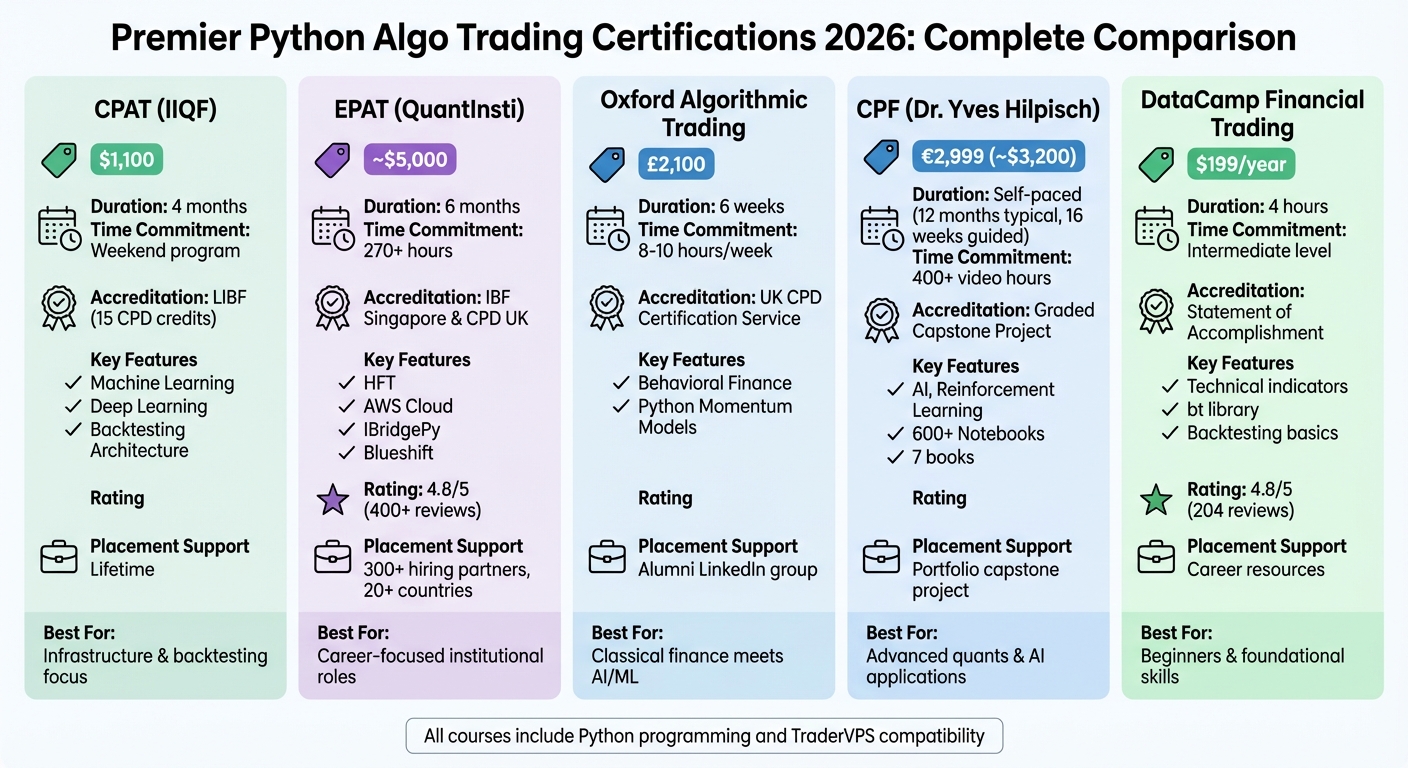
Python Algo Trading Certification Comparison 2026: Price, Duration, and Features
Algorithmic Trading – Machine Learning & Quant Strategies Course with Python
1. Certificate Program in Algorithmic Trading (CPAT) by IIQF
The Certificate Program in Algorithmic Trading (CPAT), offered by the International Institute of Quantitative Finance (IIQF), has been a trusted training ground for quantitative professionals since 2013. At a cost of $1,100.00, this four-month weekend program awards 15 CPD credits accredited by the London Institute of Banking and Finance (LIBF). It covers the entire algorithmic trading lifecycle, from market microstructure and latency considerations to execution algorithms like VWAP and TWAP [6]. With a growing demand for Python-certified trading experts, the program is designed to meet industry expectations.
Curriculum Overview
CPAT’s curriculum tackles the complexities of modern trading with modules on Machine Learning (including regression and classification), Deep Learning (ANN, RNN, LSTM), and Time Series Analysis (ARIMA, GARCH) [5]. Participants gain hands-on experience with Python programming, API integration, and order management system design. A standout feature is Module 303, which focuses on back-testing architecture. Here, students learn to build a back-tester while addressing challenges like look-ahead and survivorship bias [6]. The faculty consists of seasoned professionals, including IIT and IIM alumni, as well as PhD holders from leading global institutions [5]. This blend of theory and practical application ensures a well-rounded learning experience.
Hands-On Learning
CPAT goes beyond theory by emphasizing practical skills. Students work in a simulated trading lab equipped with advanced algorithmic platforms and statistical tools [6]. Unlike courses that rely on pre-built templates, this program requires participants to code trading strategies from the ground up. The capstone project is particularly rigorous, involving the end-to-end development and implementation of a trading strategy [6].
"Interactive lectures prepare participants for Python modeling and quantitative valuation roles." - Shubhaditya Dutta, Quantitative Research, Deloitte [5]
Certification and Career Impact
The LIBF accreditation adds credibility and is highly regarded in the financial sector. Graduates of the program have secured positions at leading firms like Nomura and Morgan Stanley [6]. IIQF also offers lifetime placement and technical support. For instance, Yatish Borole landed a Python Developer role at Tesnatech Pvt Ltd through faculty recommendations [6]. Similarly, Shyam Nayma transitioned from a traditional broking role to a quantitative position at Nomura with the program’s support [6]. This strong industry alignment is further reinforced by technical modules that prepare students for real-world applications.
Focus on Infrastructure
Module 305 delves into Algorithm Trading Infrastructure Setup, covering system architecture and operational requirements for live strategy deployment. This ensures that strategies are optimized for TraderVPS’s stable, Windows-based environment [6]. By bridging backtesting frameworks with live execution, the program equips participants with the tools needed for seamless, reliable deployment.
2. Executive Programme in Algorithmic Trading (EPAT) by QuantInsti
The Executive Programme in Algorithmic Trading (EPAT) by QuantInsti is recognized as the first verified certification in algorithmic trading worldwide. Accredited by the Institute of Banking and Finance (Singapore) and CPD (UK), this six-month course delivers more than 270 hours of instruction and holds an impressive 4.8/5 rating based on over 400 Google reviews [1][7]. With a network of 300+ hiring partners across 20+ countries, EPAT graduates have landed roles at top firms like JP Morgan and Citi-US [1].
Comprehensive Curriculum
EPAT's curriculum stands out for its practical and in-depth approach. Key modules include Statistics & Econometrics, Quantitative Trading Techniques, and Financial Computing [1]. Participants gain hands-on experience with Python programming, utilizing libraries like NumPy, pandas, and matplotlib, while also learning market microstructure and machine learning techniques such as Support Vector Machines, Neural Networks, and Reinforcement Learning [1]. The course also dives into cloud infrastructure and trading desk requirements, covering essential hardware, software, and network setups in Modules 6 and 8 [1]. Additionally, professionals like Certified Financial Risk Managers can earn 30 GARP CPD credit hours through this program [1].
Real-World Applications
EPAT emphasizes practical learning through tools like Blueshift for research and backtesting and IBridgePy for broker integration with platforms such as Interactive Brokers, Alpaca, and TD Ameritrade [1]. Alumni success stories highlight the program's impact: Yash Sarda used the skills he gained to launch his firm, Above Alpha Capital, in India [4], while Parth Shah leveraged EPAT’s placement services to secure a role as a Financial Strategy Analyst at Citi-US [7]. The program also includes a hands-on project component, where students receive mentorship from industry experts to specialize in specific trading domains [1].
Certification Benefits
The value of EPAT certification is reflected in endorsements from industry leaders. Marcus Coleman, Vice President and Applied AI/Machine Learning Lead at JP Morgan, stated:
"After completing the programme, you will have the necessary tools to begin a career in algorithmic/quantitative trading" [7].
Graduates are well-prepared to make an immediate impact in algorithmic trading roles, with lifetime placement assistance and access to alumni chapters in over 90 countries [1]. Jonathan Mathews, Chief Investment Officer at Clim8, praised the program:
"These six months opened my eyes to multiple paths in systematic trading" [7].
For residents of Singapore, IBF-STS funding is available, covering up to 50% of direct training costs, with a cap of S$3,000 [1].
Seamless Trading Execution with TraderVPS
The "Trading Tech, Infra & Operations" module ensures participants are ready for live execution by teaching cloud-based deployment and outlining specific hardware and network requirements [1]. Students learn to use AWS for hosting automated Python strategies, enabling 24/7 operation [1]. The program also covers IBridgePy framework training, ensuring smooth API integration with brokers. Backtested strategies can transition effortlessly to TraderVPS’s environment, providing reliable, continuous execution for trading operations [1].
3. Oxford Algorithmic Trading Programme by Saïd Business School
The Oxford Algorithmic Trading Programme, offered by Saïd Business School, is a six-week online certification course developed in collaboration with the Oxford-MAN Institute of Quantitative Finance [8]. With a cost of £2,100 and a weekly commitment of 8–10 hours, this program is tailored for professionals eager to explore the intersection of classical finance, behavioral finance, and cutting-edge technologies like artificial intelligence and machine learning. The course is accredited by the United Kingdom CPD Certification Service, with upcoming start dates set for January 21 and April 1, 2026 [8].
Curriculum Overview
The program is divided into six modules, covering everything from the basics of systematic trading to emerging trends in the field. Participants delve into how behavioral biases can create market inefficiencies, challenging traditional efficient market theories [9]. Modules 3 and 5 focus on practical skills, guiding learners through building and evaluating a time series momentum model in Python, using metrics like Sharpe, Sortino, and Calmar ratios [8].
The course also tackles modern industry challenges, such as the growing role of robo-advisers, which managed $2.5 trillion in assets by 2023, and the fact that 70–80% of financial trading is now algorithm-driven [10][11]. While the core content is accessible and non-technical, optional Python-based exercises in an integrated development environment allow participants to gain hands-on coding experience. The comprehensive curriculum equips learners with both theoretical knowledge and practical tools, paving the way for new career opportunities.
Certification and Career Support
Graduates of the program earn an official certificate from Oxford and gain access to a dedicated alumni LinkedIn group [8]. Additionally, enrollees benefit from unlimited access to 2U's Career Engagement Network, providing ongoing professional resources and support [11].
Stephen Olayiwola, a Quant Analyst and Algo Trader at Virgin Money, shared his experience:
"The programme provided the essential knowledge to develop my algo skills. I recommend it to anyone starting in algo trading." [11]
Another participant, a Quant Strategist at Fasanara Capital, highlighted the program's transformative impact:
"The course was a turning point in my career. Using what I'd learned from the content... I opened my own investment firm." [8]
Seamless Integration with TraderVPS
This program is ideal for technologists working on automated trading systems [8]. Module 4 focuses on assessing trading models in live market conditions, emphasizing the importance of stable connectivity. Strategies developed in Modules 3 and 5 can be effortlessly deployed on TraderVPS, enabling 24/7 live execution. With the program’s integrated Python modeling environment, participants can transition their backtested strategies directly to the TraderVPS platform, ensuring smooth and uninterrupted trading performance [8].
4. Certificate in Python for Finance (CPF)
The Certificate in Python for Finance (CPF) is a self-paced program led by Dr. Yves J. Hilpisch, a trailblazer in Python for finance and an accomplished author [2]. The program costs €2,999 (around $3,200) and offers lifetime access to its core modules, along with bonus materials [2]. While self-paced learners typically complete the course in 12 months, guided cohorts are structured to finish in 16 weeks [2].
Curriculum Overview
The CPF curriculum is built on four key pillars:
- Foundational Modules: These cover mathematics, Python fundamentals, and essential tools like Git, Docker, and Linux.
- Core Applications: Focused on algorithmic trading and asset management.
- Artificial Intelligence Track: Includes topics like machine learning, reinforcement learning, and natural language processing.
- Extensions: Explores areas such as cryptocurrency and generative AI for trading [2].
With over 400 hours of video content, 600+ notebooks, 100,000+ lines of code, and 3,000 pages of documentation, the program is packed with resources. It also includes a digital library featuring seven books authored by Dr. Hilpisch [2][12].
Dr. Hilpisch describes the program's mission:
"Finance is being redefined by automation. The CPF curriculum turns ambitious analysts into Super Quants by merging deep market knowledge, fluent Python engineering, and cutting-edge AI literacy" [2].
Hands-On Learning
The CPF takes a practical, coding-focused approach. Its algorithmic trading module walks students through the entire strategy lifecycle, from design and backtesting to deployment, monitoring, and cloud automation [2]. Students work with static datasets and versioned codebases to ensure reproducible research across data pipelines and testing environments [2]. The program's Quant Platform further simplifies experimentation by allowing students to instantly launch notebooks in their browsers, removing technical hurdles [2].
Andreas, a portfolio manager, shared his thoughts:
"The holistic approach, from the basics of financial markets to concrete Python implementation, is unique" [2].
Certification Benefits
To earn the CPF certificate, students must complete a capstone project in Jupyter Notebook format. This project, which involves original research, is evaluated directly by Dr. Hilpisch, who provides detailed feedback. The completed project doubles as a portfolio piece, showcasing the student's skills to potential employers [2]. The certification is held by participants from over 70 countries and is valued by finance employers as evidence of production-ready Python engineering expertise [2][12].
One CPF graduate, Konstantinos, described the program as:
"The holy grail of algorithmic trading education. Real code, real projects, and phenomenal support" [2].
The program's emphasis on technical rigor ensures that the knowledge gained translates seamlessly into real-world applications.
TraderVPS Integration
The CPF program also covers key technologies like Docker, Linux, and cloud automation, making it compatible with TraderVPS environments [2]. Students learn to deploy their backtested strategies to production systems with ease. By focusing on reproducible research and production-grade engineering, the program equips graduates to manage automated trading systems effectively. This alignment with TraderVPS ensures that strategies can be deployed with precision and reliability [2].
5. Financial Trading in Python by DataCamp
If you're diving into Python for algorithmic trading, Financial Trading in Python by DataCamp is a solid, hands-on option. This intermediate-level course, taught by Chelsea Yang, a quantitative finance expert, spans 4 hours and is available through DataCamp Premium or Teams subscriptions. In late 2025, these subscriptions were offered at a 50% discount [13][14]. With a stellar 4.8/5 rating from 204 reviews and access to a platform of over 18.7 million users, this course has garnered attention for its practical approach [13].
Curriculum Highlights
The course delves into essential technical analysis tools, including Moving Averages (SMA and EMA), ADX, RSI, and Bollinger Bands [13][14]. You'll learn to develop two key trading strategies: trend-following using EMA crossovers and mean reversion based on RSI signals [13][14]. Beyond strategy creation, the program emphasizes evaluating risk-adjusted performance metrics like the Sharpe ratio, Sortino ratio, Calmar ratio, and maximum drawdown [13][14]. As Chelsea Yang explains:
"Generally, a technical trader analyzes historical patterns of trading data, and implements trading strategies based on indicators, signals, and rules in order to profit from possible future price movement" [15].
Hands-On Learning
The course integrates Python's bt library for backtesting and refining strategies using real-world data from stocks, forex, and cryptocurrencies [13][14]. To make trading concepts more accessible, it also includes lessons on data visualization. You'll explore tools like time series line charts and interactive candlestick charts using plotly.graph_objects [13]. Rushnan, an MBA student, shared their experience:
"I find this course very helpful. As an MBA student with a science background, I could catch the concept explained here easily" [13].
Certification and Career Impact
Upon completion, learners earn a Statement of Accomplishment, which can be added to LinkedIn profiles or resumes [13]. While this 4-hour course isn't a full professional certification, it demonstrates practical skills like backtesting with bt and implementing technical indicators in Python [13]. Raul Romero, Product Manager III at eBay, highlighted its value:
"DataCamp is a cost-effective way to upskill and stay relevant with data and AI. It's structured, practical, and lets you apply what you learn immediately" [13].
This course’s focus on real-world applications makes it an excellent complement to tools like TraderVPS for deploying live trading strategies.
TraderVPS Compatibility
While the course doesn’t specifically cover VPS configurations, the skills you gain - like Python-based backtesting and strategy optimization - are directly applicable to managing automated trading systems on platforms like TraderVPS [13].
Pros and Cons
Every course brings its own set of strengths and limitations. Let’s break down the key offerings of each program to help you decide which one fits your needs.
EPAT by QuantInsti has earned a stellar 4.8/5 rating from over 400 Google reviews, thanks to its extensive focus on infrastructure, including High-Frequency Trading (HFT) paradigms [1][4]. The program offers lifetime placement services through more than 300 hiring partners and provides 30 GARP CPD credit hours [1]. However, with a price tag of approximately $4,999–$5,000, it’s one of the more expensive options [3]. Its emphasis on end-to-end desk setup and AWS cloud infrastructure ensures smooth deployment in TraderVPS environments [4]. While its infrastructure coverage is impressive, it may not delve as deeply into technical content as some other programs.
Certificate in Python for Finance (CPF) offers an expansive curriculum, boasting over 400 video hours, 600+ Jupyter Notebooks, and seven integrated textbooks for €2,999 [2]. Dr. Yves J. Hilpisch highlights its transformative potential:
"The CPF curriculum turns ambitious analysts into Super Quants by merging deep market knowledge, fluent Python engineering, and cutting‐edge AI literacy" [2].
The course’s focus on AI, Large Language Models (LLMs), and reinforcement learning equips learners for advanced applications, including cloud automation for TraderVPS. However, the graded Capstone project demands a significant time investment.
Financial Trading in Python by DataCamp is the most budget-friendly option, priced at $199 per year. It has a 4.8/5 rating from 204 reviews and offers a concise, 4-hour format that teaches practical skills like backtesting with the bt library and using technical indicators [13]. While it lacks the depth of EPAT and CPF, it provides foundational skills that are directly applicable to TraderVPS deployment. However, the Statement of Accomplishment it offers holds less professional weight compared to the certifications from EPAT or CPF.
Here’s a side-by-side comparison of these courses to give you a clearer picture:
| Course | Curriculum Depth | Practical Applications | Certification Value | TraderVPS Compatibility | Price |
|---|---|---|---|---|---|
| EPAT | High; HFT, Options, Econometrics [1] | End-to-end desk setup, IBridgePy, Blueshift [1][4] | GARP CPD credits, IBF accredited [1] | High; AWS deployment expertise [4] | ~$4,999–$5,000 [3] |
| CPF | High; AI, LLMs, Derivatives [2] | 600+ Notebooks, DX Analytics [2] | Graded Capstone by Dr. Hilpisch [2] | High; Docker and cloud automation [2] | €2,999 [2] |
| DataCamp | Medium; Technical indicators, backtesting [13] | bt library, real-world data [13] |
Statement of Accomplishment [13] | Medium; foundational Python skills | $199/year [13] |
For those seeking an alternative, the Coursera Machine Learning for Trading specialization offers a unique angle. With a 3.9/5 rating from 1,119 reviews and over 41,000 enrolled students, it focuses on serverless deployment using Google Cloud Platform (GCP) [16]. Though not part of the main course lineup, its GCP emphasis makes it fully compatible with TraderVPS infrastructure [16].
Conclusion
Choosing the right course depends on your experience level and career goals. If you're a beginner, foundational programs like AlgoTrading101 are a great starting point. This course is designed to help newcomers code their first trading robot in as little as three days [17]. For career-focused traders aiming for institutional roles, EPAT offers a comprehensive 6-month program with 120+ hours of live lectures and access to 300+ hiring partners across 90+ countries [1]. Meanwhile, advanced quants looking to dive deep into AI and machine learning should consider CPF, which provides over 400 video hours and 600+ Jupyter Notebooks geared toward production-level engineering [2].
However, success in algorithmic trading doesn't end with certifications. Translating theoretical knowledge into real-world market execution requires a strong, reliable infrastructure. This is where TraderVPS becomes essential.
TraderVPS offers high-performance computing tailored for intensive backtesting and live trading. Its AMD EPYC cores and NVMe storage are built to handle complex tasks like Monte Carlo simulations and multi-strategy testing, ensuring stability and efficiency that local hardware often can't provide.
For advanced cloud setups, TraderVPS brings 24/7 automated operations, DDoS protection, continuous execution, and automatic backups. This level of reliability mirrors the infrastructure used by the 97% of Foreign Portfolio Investors who rely on algorithmic execution [18].
Combining robust certifications with a dependable infrastructure like TraderVPS gives you a competitive edge in markets where algorithmic trading accounts for 60% to 85% of total volume in developed economies [18]. With ultra-low latency, TraderVPS ensures your orders execute at the lightning-fast speeds that modern markets demand.
FAQs
What are the career advantages of earning a Python algorithmic trading certification?
Earning a Python algorithmic trading certification highlights your skills in programming, quantitative analysis, and finance - three areas in high demand across traditional financial institutions and tech-driven trading firms. This type of certification proves your ability to create, test, and implement automated trading strategies, setting you apart in a competitive job market.
With this credential, you’ll be well-prepared for roles like quantitative analyst, systematic trader, or algorithmic developer. It can also enhance your earning potential and connect you with industry professionals through valuable networking opportunities. Certifications like these show employers that you’re ready to tackle today’s trading challenges and contribute to cutting-edge strategies.
What are the key differences in cost and content among Python algorithmic trading courses?
Python algorithmic trading courses come in a range of formats, content focuses, and price points. For instance, the Executive Programme in Algorithmic Trading (EPAT) delivers a 120-hour live curriculum guided by industry professionals. This course dives into topics from idea generation to live execution, incorporating mentorship and advanced areas such as machine learning and high-frequency trading. While specific costs aren’t publicly shared, early-bird discounts are often available.
Another option is the Certified Algorithmic Trading & ML Strategies with Python, which places a strong emphasis on machine learning. This program includes hands-on projects, such as sentiment analysis and intraday trading strategies. On the other hand, the Certificate in Python for Finance (CPF) offers a wealth of resources, including video tutorials and Jupyter notebooks, for an in-depth learning experience. For those seeking flexibility, the self-paced Algorithmic Trading Certificate (ATC) fits around individual schedules. Meanwhile, Quant Science stands out for its practical, project-based approach, featuring workshops and coding exercises.
Since many providers don’t disclose tuition fees upfront, reaching out directly to inquire about pricing and enrollment details is the best way to get accurate information.
What skills will I learn from Python algorithmic trading courses with certification?
Python algorithmic trading courses are designed to teach you practical skills that can directly apply to your career. You'll dive into Python's core libraries to handle tasks like data collection, cleaning, and feature engineering. From there, you'll move on to creating and testing trading strategies, ranging from straightforward rule-based models to more advanced approaches, including machine learning and AI-driven methods.
These courses also provide hands-on experience with broker APIs, allowing you to connect and interact directly with trading platforms. You'll learn how to run backtests that account for real-world transaction costs and set up automated trading systems. Other essential topics include risk management, portfolio allocation, and deploying your strategies to the cloud. By the time you finish, you'll have the skills needed for roles such as quantitative analyst, algo-trading developer, or even an independent trader.