All-in-One Forex Prop Firm Directory
Forex prop firms provide traders with access to large trading capital without risking personal funds. Here's how they work: traders pay an evaluation fee to prove their skills through challenges or funding programs. Successful traders gain access to accounts ranging from $5,000 to $4 million, keeping 80–95% of profits, while firms absorb any losses.
Key points:
- Evaluation Models: 1-step, 2-step, 3-step, or instant funding options, with fees from $100–$1,000.
- Profit Splits: Ranges from 80% to 100%. Some firms increase splits or account sizes through scaling plans.
- Risk Rules: Daily loss limits (3–5%) and maximum drawdowns (8–12%) are standard.
- Payouts: Methods include bank transfers, PayPal, and crypto, with some firms offering payouts in under 24 hours.
- Top Firms: FTMO, The5ers, FundedNext, and others, each offering unique rules, platforms, and funding models.
Choosing the right firm depends on your trading style, strategy, and risk tolerance. Focus on firms that align with your goals, offer reliable payouts, and provide tools to support your trading performance.
The Best Forex Prop Firm in 2025? | The5ers vs FTMO vs Alpha Capital Review

What Are Proprietary Trading Firms?
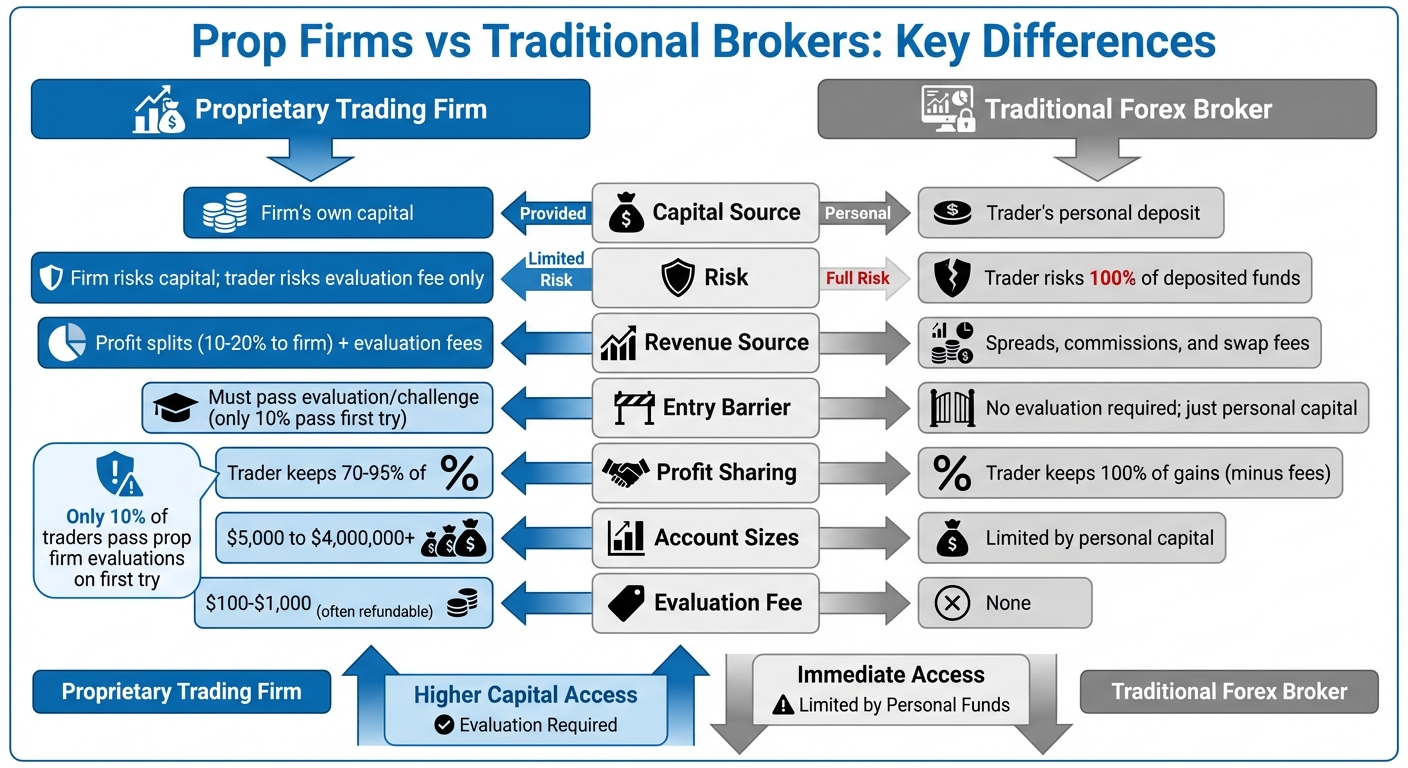
Prop Firms vs Traditional Brokers: Key Differences Comparison
A proprietary trading firm, or "prop firm", is a private company that provides traders with its own funds to trade in Forex markets. Instead of trading with your own money, you use the firm's capital. In exchange, the firm keeps a percentage of the profits - usually between 10% and 20% - while you retain the lion's share, typically 80% to 90% [7]. This arrangement is what sets prop firms apart from traditional brokers.
The way prop firms operate is quite different from brokers. Brokers make their money through spreads and commissions on client deposits. Prop firms, on the other hand, earn revenue through evaluation fees, profit-sharing agreements, and rebates from liquidity providers based on trading volume [6]. To trade with a prop firm, you usually pay an upfront fee (ranging from $100 to $1,000) to enter a challenge that assesses your trading skills [7]. Passing this challenge grants you access to a funded account. However, you must follow strict risk management rules, like a 5% daily loss limit and a 10% maximum drawdown [8].
Since the firm supplies the trading capital, it bears the market risk, limiting your financial exposure to just the evaluation fee [7]. If you lose the funded account, the firm absorbs the losses. This structure allows traders to manage accounts ranging from $5,000 to over $4,000,000 without risking their own money.
Prop Firms vs. Brokers: Key Differences
When comparing prop firms to traditional brokers, the main difference comes down to who provides the capital and who takes on the risk. With a traditional broker, you trade with your own money, risking 100% of your funds, but you keep all the profits (minus spreads and commissions) [7]. There's no evaluation process - just your own capital at stake.
In contrast, prop firms require you to pass an evaluation or challenge to prove you can follow risk management rules and generate consistent returns [7]. Once approved, you trade with the firm's money, splitting profits if you're successful. If you fail, the firm absorbs the losses, and you're only out the evaluation fee. It's worth noting that passing these evaluations isn't easy. FTMO reports that only 10% of traders pass on their first try [7], and FundedNext revealed that over 80% of traders failed the first phase in 2023 [8].
Here’s a quick comparison of how prop firms and brokers differ:
| Feature | Proprietary Trading Firm | Traditional Forex Broker |
|---|---|---|
| Capital Source | Firm's own capital [6] | Trader's personal deposit [7] |
| Risk | Firm risks capital; trader risks fee [7] | Trader risks 100% of deposited funds [7] |
| Revenue Source | Profit splits and evaluation fees [6] | Spreads, commissions, and swap fees [6] |
| Entry Barrier | Must pass an evaluation/challenge [7] | No evaluation; requires personal capital [7] |
| Profit Sharing | Trader keeps 70%–95% of gains [7] | Trader keeps 100% of gains (minus fees) |
Why Trade with Prop Firms?
Trading with a prop firm offers several advantages, especially for traders looking to access more capital and reduce personal financial risk.
First, prop firms let you trade with much larger amounts of money than you might otherwise afford. Instead of starting with a few thousand dollars, you could manage $50,000, $100,000, or even millions, depending on your performance [12][10].
Second, your financial risk is limited to the evaluation fee. This means you avoid the stress of risking your personal savings while still having the opportunity to earn significant profits.
Third, prop firms provide access to professional tools and enforce strict risk controls, like daily loss limits and maximum drawdown rules. These measures not only protect the firm's capital but also help traders develop discipline and avoid impulsive decisions [11]. Some firms even refund your evaluation fee after your first successful profit withdrawal [7].
"Prop firms can fast-forward trading careers by giving individuals access to capital they may not otherwise have." - Huzefa Hamid, Senior Analyst, DailyForex.com [9]
How Evaluation and Funding Work
Prop firms have a rigorous evaluation process for traders to access their capital. Most firms use a multi-phase system to test if you can hit profit targets while staying within strict risk limits. To participate, you'll typically pay an upfront fee ranging from $100 to $1,000, depending on the account size. This fee is often refundable after your first successful payout [13][14]. The process reflects the disciplined approach required of prop traders, as discussed earlier.
The evaluation process is challenging. Over 80% of traders fail Phase 1 [8], and only about 7% pass the entire challenge [16]. On average, traders spend around $4,000 on challenge fees before becoming consistently profitable [16]. Understanding these evaluations and picking the right funding option for your trading style can save both time and money.
1‑Step, 2‑Step, and Instant Funding Options
Prop firms offer several evaluation paths, each with unique timelines, costs, and difficulty levels.
- Two‑step evaluations are the most common. In Phase 1 (the Challenge), traders aim for an 8% to 12% profit target within a set period, often 30 days, while adhering to daily and total drawdown limits [13][15]. Phase 2 (Verification) typically requires a smaller profit target, around 5%, over 30 to 60 days to prove consistency [13][15]. For example, a $100,000 two‑step challenge usually costs between $300 and $700 [16].
- One‑step evaluations streamline the process into a single phase with aggressive profit targets (8% to 12%) and strict drawdown limits. This option allows experienced traders to secure funding in as little as 30 days but offers less room for recovery from losses.
- Three‑step models divide the process into multiple stages with progressively lower profit targets, focusing on long-term discipline [13]. These evaluations often take 90 days or more and tend to be more affordable, appealing to traders who value methodical progress over speed.
- Instant funding skips the evaluation entirely. Traders pay a higher upfront fee - sometimes double that of a standard challenge - and gain immediate access to capital [13][14]. For instance, a $25,000 instant account might cost $249, compared to $150–300 for a multi-step challenge [14]. However, these accounts come with stricter rules, such as drawdown limits of 4% to 8%. This option is ideal for seasoned traders who want to bypass the testing phase and start earning payouts right away.
"Prop challenges represent a pivotal opportunity for skilled traders to demonstrate their abilities and secure backing that far exceeds their personal capital constraints." - Funding Frontier [13]
Some firms have relaxed their 30-day time limits, allowing traders unlimited time to meet profit targets as long as they adhere to drawdown rules [1]. These structured evaluations enforce clear performance standards, including profit targets and risk limits.
Profit Targets, Drawdowns, and Time Limits
Each evaluation comes with specific rules you must follow to qualify for funding. Even minor mistakes can disqualify your account.
- Profit targets for Phase 1 typically range from 6% to 12%, while Phase 2 targets are usually around 5% [18][19]. For a $100,000 account, this means earning $6,000 to $12,000 in Phase 1 and $5,000 in Phase 2. Some firms even offer a 15% profit share during the evaluation phase [18].
- Maximum drawdown is the total allowable loss from your starting balance, usually capped between 8% and 12% [18][19]. For example, a $100,000 account with a 10% drawdown limit means you can't lose more than $10,000. Firms may use static drawdowns (fixed to your initial balance) or trailing drawdowns (which adjust as your equity grows). Trailing limits are generally harder to manage [16][18].
- Daily loss limits restrict how much you can lose in a single trading day, typically between 3% and 5% of your account value [18][19]. On a $100,000 account, a 5% daily limit means trading stops after a $5,000 loss in one session.
Many firms also require a minimum number of trading days - usually between 3 and 10 - to ensure results aren't based on a few lucky trades [13][14]. Some firms enforce consistency rules, where no single day can account for more than 30% to 40% of your total profit target [15][18].
"The drawdown is the single biggest reason why traders fail. It's a mechanism to ensure you manage risk tightly." - LiquidityFinder [18]
Another key rule is avoiding trades during restricted windows around high-impact economic releases, as trades executed 2 to 10 minutes before or after these events can lead to disqualification [15][16]. Always check the firm's news calendar to steer clear of these periods, as many funded accounts have been lost this way.
Before attempting any challenge, it's smart to backtest your strategy over at least 100 trades. Ensure your strategy's maximum historical drawdown stays well below the firm's limits [13]. For example, if the daily loss limit is 5%, your strategy should ideally not exceed a 3% loss in a single session. This buffer can help you navigate unexpected volatility without breaking the rules.
Profit Splits and Payout Systems
This section highlights how profit splits and payout systems keep prop trading both rewarding and disciplined.
Once you pass the evaluation phase, profit splits determine how earnings are shared. Most firms use a profit-sharing model where traders keep a percentage of their profits, with the firm taking the rest. Typically, splits start at 80/20, but some firms offer higher percentages - 90%, 95%, or even 100% - through scaling plans or performance milestones[22]. Payment schedules also vary, ranging from monthly cycles to bi-weekly, weekly, or even on-demand withdrawals, depending on the firm's policies[22].
Withdrawals are processed through various methods, including bank wires (2–5 business days), fintech services like Rise, Wise, or PayPal (1–2 days), and cryptocurrencies such as USDT or Bitcoin (processed within hours)[22]. Some firms, like FunderPro and FTMO, process payouts in under 8 hours, while FundedNext completes them within 24 hours and even offers $1,000 compensation if delays occur[22].
"FundedNext processes payouts within 24 hours of when a trader initiates a payout request... If, for any reason, the 24-hour timeframe is not met, traders will receive $1,000 compensation added to the payout." - FundedNext[23]
To qualify for payouts, traders must meet strict requirements. Firms often require all trades to be closed, a minimum number of trading days to be completed, and adherence to consistency rules - such as limiting any single trading day’s profit to 30–40% of the total[26][27]. Breaking rules like trading during high-impact news (2–5 minutes before or after releases) or ignoring minimum trade durations (often 2 minutes) can lead to forfeited profits or denied payouts[26]. Additionally, some firms use trailing drawdowns that adjust upward with equity, reducing the buffer for future losses[26].
Profit Split Percentages and Account Scaling
Profit splits vary widely among firms, directly affecting trader earnings. For example, firms like Apex Trader Funding and Topstep allow traders to keep 100% of their first $10,000–$25,000 in profits before transitioning to a 90% split, maximizing early gains[22]. Forex-focused firms like FTMO typically offer an 80% starting split, which can increase to 90% through scaling plans. FTMO’s scaling plan boosts account size by 25% every four months, up to a set cap[5].
FundedNext offers a 40% account increase every four months, with a cap of $4 million, while BrightFunded provides unlimited scaling with 30% increases and the potential for 100% profit splits[5]. The5ers takes a unique approach by adding monthly salaries for consistent performers[20][21].
| Prop Firm | Starting Split | Max Split | Scaling Details |
|---|---|---|---|
| Apex Trader Funding | 100% | 90% | 100% of first $25,000 profit[22] |
| FTMO | 80% | 90% | 25% increase every 4 months; cap at $2M[5] |
| FundedNext | 60%–80% | 95% | 40% increase every 4 months; cap at $4M[5] |
| BrightFunded | 80% | 100% | 30% increase every 4 months; unlimited scaling[5] |
| The5ers | 80% | 100% | Up to 100% + Monthly Salary[20][21] |
Next, let’s break down the rules that can directly influence your payout structure.
Rules That Affect Your Payouts
Specific firm rules can impact your payouts, even if you hit your profit targets. One key factor is the type of drawdown. Static drawdowns remain fixed based on your starting balance, while trailing drawdowns increase with your equity, reducing your margin for error as profits grow[26].
Violating rules like trading during restricted news windows (2–5 minutes around high-impact events) or failing to use required stop-losses can result in forfeited profits or account termination[26][27].
"The data is clear: established firms with years of operation and transparent payout records are the safest choice." - Prop Firm Payout Analysis 2026[22]
Before requesting a payout, traders must meet all conditions, such as closing all positions and completing the minimum number of active trading days[24][25]. Some firms, like FXIFY, require third-party KYC verification via services like Rise before processing payouts[26]. Additionally, accounts inactive for 30–60 days are often terminated, making consistent trading essential[26]. To safeguard your earnings, verify payout proof through public leaderboards or third-party audits, especially since 80–100 firms collapsed in 2024 due to liquidity issues[22].
Directory of Top Forex Prop Firms
Here’s a closer look at the funding models, evaluation processes, and payout structures of some of the leading Forex prop firms. This guide builds on earlier discussions about evaluation and funding, offering firm-specific details to help traders identify the best fit for their strategies.
FTMO has paid out over $450 million and uses a rigorous two-step evaluation system, offering account sizes up to $200,000. Their scaling plan allows balances to grow by 25% every four months, with a cap at $2 million. Traders also gain access to proprietary tools like Account MetriX and a Trading Journal. However, as of 2025, FTMO no longer accepts U.S. traders, and only about 20% of participants successfully pass their evaluation [28].
The5ers provides three pathways: Bootcamp, Hyper Growth, and High Stakes. Their "2x growth" model doubles account sizes at each milestone, scaling up to $4 million. Top performers can achieve profit splits as high as 100% and even receive monthly salaries. Despite being highly rated on platforms like Trustpilot and Myfxbook, The5ers has also stopped accepting U.S. traders [43, 44].
FXIFY offers flexible challenges with one-, two-, or three-phase options, including a rapid 7-day Lightning Challenge. They support a variety of assets, including cryptocurrency and futures, with funding up to $400,000. Evaluation fees start as low as $39, and traders can use MT5 or DXTrade platforms. Unlike some competitors, FXIFY remains open to U.S. traders [29].
FundedNext paid out $85.5 million in 2024 alone and guarantees payouts within 24 hours, offering an additional $1,000 if delays occur. They stand out as one of the few firms that provide profit sharing during the evaluation phase [28].
FundingPips has supported 1.3 million traders across 195 countries, distributing over $145 million in payouts by 2026. Entry-level accounts start at just $29 for $5,000 in funding [28].
Funded Trading Plus emphasizes simplicity with its "Experienced" (one-phase), "Advanced/Premium" (two-phase), and "Instant Master" (no evaluation) programs. They also allow the use of expert advisors (EAs) and news trading.
"Our 5 Star Promise isn't just meaningless words on a page, it's a reflection of our dedication to providing an exceptional experience." - Simon Massey, CEO, Funded Trading Plus [28]
Other notable firms include Blue Guardian, which has distributed over $20 million in verified payouts, Aqua Funded, with $2.9 million paid to more than 42,000 traders, and Goat Funded Trader, which offers a "Pay Later" model. This unique approach lets traders pay an initial fee of $5 and the full fee only after successfully passing the evaluation [45, 46].
Each firm has its own evaluation criteria and drawdown models, so traders should align their strategies accordingly to maximize their chances of success.
| Firm | Max Scaling | Profit Split | Evaluation | U.S. Traders | Ratings |
|---|---|---|---|---|---|
| FTMO | $2M | 80%–90% | 2-Step | No | 4.8/5 (27,000+ reviews) |
| The5ers | $4M | 50%–100% | 1, 2, or 3-Step | No | 4.9/5 |
| FXIFY | $4M | 75%–90% | 1, 2, or 3-Step | Yes | N/A |
| FundedNext | $4M | 90%–95% | 1, 2, or Instant | Yes | 4.6/5 (39,000+ reviews) |
| FundingPips | $2M | 80%–100% | 1, 2, or Instant | No | 4.5/5 (23,000+ reviews) |
| Funded Trading Plus | $2.5M | 80%–100% | 1, 2, or Instant | Yes | 4.7/5 |
Next, let’s explore the trading platforms and tools these firms offer, which play a critical role in execution and risk management.
Trading Platforms and Tools
The technology and platforms provided by these firms are just as important as their funding models. The right platform can significantly enhance a trader’s ability to execute strategies effectively.
FTMO supports MT4, MT5, cTrader, and DXTrade, along with proprietary tools such as Account MetriX and a Trading Journal for real-time tracking and post-trade analysis. The5ers primarily relies on cTrader, with MT4 and MT5 as alternatives, making it a good option for scalpers who need detailed market depth and one-click execution.
FundedNext offers a wide range of platforms, including MT4, MT5, cTrader, Match-Trader, Tradovate, and NinjaTrader, catering to both Forex and Futures traders. FXIFY uses MT5 and DXTrade, with the latter being particularly appealing to U.S. traders. Funded Trading Plus and Goat Funded Trader have adopted modern web-based platforms like Match-Trader and TradeLocker, which feature built-in risk controls and mobile-friendly interfaces.
Automation is a key feature for many traders. MT4 and MT5 are popular for their extensive support for Expert Advisors (EAs) and third-party tools. Meanwhile, cTrader attracts algorithmic traders with its cAlgo framework and C# coding environment. Increasingly, firms are moving beyond MetaTrader, incorporating platforms like DXTrade, TradeLocker, and Match-Trader to address evolving regulatory requirements and provide broader market access. The platform you choose can directly impact your ability to meet the risk management criteria discussed earlier.
How to Pick the Right Prop Firm
What to Look For: Rules, Reliability, and Trading Style
Choosing the right prop firm is just as important as perfecting your trading strategy. Your trading style needs to align with the firm's rules to increase your chances of success. Broker-backed firms are often a safer choice since they operate under regulated environments and earn revenue from spreads and commissions, not just challenge fees [1]. On the other hand, independent firms may offer more aggressive scaling opportunities but often work in less transparent, simulated environments [1].
Pay close attention to drawdown limits, which can range from 3–5% daily and 6–10% overall. The type of drawdown - static or trailing - also matters, especially for your strategy [1][8]. Swing traders, for instance, should confirm whether the firm allows holding positions overnight or over the weekend. Firms like Blueberry Funded and Blue Guardian support this approach [4]. Scalpers, however, need firms with raw spreads, fast execution, and minimal restrictions on short hold times.
Payout reliability is another key factor. Look for firms with verified payout certificates on forums and review sites [30]. Avoid companies that retroactively change rules or delay trade reviews [32]. Some firms now promise payouts within 24 hours and even offer a $1,000 penalty if they miss the deadline [31].
"Prop firms backed by established brokers tend to be the most dependable in the industry. They operate within regulated environments, offer direct access to the markets, and maintain competitive cost structures." - Propfirmforex [1]
Before committing to a large-scale challenge, start small. Test the firm's dashboard, trade execution, and support responsiveness [30]. Send a technical support question to evaluate their response time and clarity [33]. Also, check for an active community, like a public Discord. Firms that rely on slow ticket systems and limit trader interaction often lack accountability [32].
These steps are essential for aligning your trading style with the firm's requirements, ensuring a smoother path forward.
Matching Your Risk Tolerance to Firm Requirements
Once you've assessed reliability, the next step is to match your risk tolerance with the firm's funding model. Evaluation challenges are great for traders with limited capital, as they allow you to prove yourself under timed conditions with entry fees ranging from $100 to $1,000. Instant funding, on the other hand, is better suited for experienced traders but comes with higher fees and stricter rules [3][4][7].
Be cautious of firms advertising unrealistic profit targets, like a 10% target with only a 5% maximum drawdown. These setups often encourage risky, undisciplined trading [32]. Instead, opt for firms with more balanced ratios, such as a 5–8% profit target paired with a similar drawdown limit [32].
For perspective, professional traders who risked less than 2% per trade achieved an average account growth of 18% per quarter in 2024 [7]. If your strategy involves trading during volatile news events, make sure the firm doesn’t restrict trades around high-impact releases. Firms like Blue Guardian and Blueberry Futures impose such restrictions on funded accounts [31]. Also, check whether the firm calculates drawdown at the end of the day (EOD) or intraday. EOD models provide more flexibility for handling intraday fluctuations [17][31].
Before diving in, demo your strategy to ensure it consistently meets profit targets and aligns with the firm's rules [7]. Keep in mind that only 10% of traders pass evaluations on their first try, and fewer than 20% remain profitable over the long haul [7][8]. The right firm, matched to your strategy, can help improve those odds significantly.
Technical Setup for Prop Trading Success
When it comes to prop trading, the right technical setup can make or break your performance. Tight drawdown limits and precise execution thresholds demand a reliable infrastructure. Home setups, while convenient, often fall short with 7–18 days of annual downtime. In contrast, professional VPS systems offer significantly better reliability, with annual downtime ranging from just 53 minutes to 8.8 hours (99.9–99.99% uptime).
Home setups typically operate at 95–98% uptime, whereas professional VPS solutions guarantee 99.9% or higher. These professional setups come with features like redundant power, battery backups, and multiple ISPs with automatic failover. Such capabilities ensure smoother trade execution and more consistent performance, as explored below.
Low-Latency Trading Environments
In trading, execution speed is directly tied to profitability. This is especially critical during volatile markets or when using scalping strategies. Home setups often experience latency in the range of 100–400ms, which can lead to slippage and less favorable fill prices. On the other hand, professional VPS solutions slash latency to a mere 0.3–5ms. Over hundreds of trades, this difference can add up significantly.
The physical location of your server is also key. A VPS located in the same data center as your broker can achieve under 1ms latency, virtually eliminating slippage. Servers in the same city typically offer 1–5ms latency with minimal impact, while same-region setups provide 5–20ms, which is still acceptable for most prop firms. However, cross-continental connections can result in latency between 100–300ms, negating the benefits of using a VPS. If your broker’s servers are in major hubs like New York or London, your VPS should ideally be in the same region to optimize performance.
While low latency enhances execution speed, pairing it with high uptime and robust backup systems ensures uninterrupted trading.
Server Uptime and Backup Systems
Uptime is a critical factor in maintaining a reliable trading system, especially during evaluations or funded trading phases. A 99.9% uptime rate equates to about 8.8 hours of downtime annually, which is sufficient for entry-level challenges. However, professional prop traders often require 99.99% uptime (roughly 53 minutes of downtime per year), while high-frequency trading operations demand 99.999% uptime (just 5.3 minutes annually).
To maintain accessibility during market hours, look for features like DDoS protection, automatic backups, and NVMe storage. Multiple ISP connections with automatic failover are also essential to prevent internet disruptions from impacting open trades. For beginners testing single accounts, budget VPS options costing $8–$25 per month typically offer 99.9% uptime. Mid-tier plans priced at $25–$60 per month provide 99.99% uptime, making them suitable for most prop traders aiming to pass challenges. For those managing multiple funded accounts, professional VPS setups costing $60–$120 per month deliver 99.999% uptime, ensuring maximum reliability.
Conclusion
Your journey into Forex prop trading hinges on aligning evaluation processes, profit splits, and technical setups with your unique trading style. The key isn’t about finding the "best" firm - it’s about finding the one that fits YOU.
Each firm in this directory offers different evaluation structures, profit-sharing models, payout speeds, and trading rules. For example, a scalper focused on lightning-fast execution will have vastly different needs than a swing trader holding positions over weekends. Your trading style, risk tolerance, and financial goals should guide every decision.
Start by ensuring the firm's rules align with your strategy. If you trade news events, confirm they’re allowed. If you rely on Expert Advisors, check whether automation is permitted. Pay close attention to drawdown policies - static drawdowns are more forgiving than trailing ones, which adjust with your account balance and can be challenging during pullbacks.
A solid technical setup is just as important. A great profit split means little if poor connectivity disrupts your trades. As mentioned earlier, professional VPS setups with 99.9% uptime or better provide a more reliable connection than home setups. Pair this with low-latency connections to your broker’s servers to ensure smooth execution.
Even the most favorable evaluation metrics lose their value without a stable trading environment. Test the firm's platform through a demo account to assess spreads, slippage, and execution speeds. Look closely at consistency rules - manual reviews or profit caps (often 40–45% of gains) can interfere with high-volatility strategies [17][2]. Automated rule enforcement is another factor to consider; delayed notifications of breaches can lead to unexpected account losses.
"Top forex prop firms serve different types of traders so the best completely depends on your trading strategy." - Noam Korbl, Co-Founder and Trader [3]
Use this directory as a starting point. Cross-check firm features with your trading goals, verify their reputation through trusted reviews, and focus on transparency over flashy promises. The right prop firm can elevate your trading performance, while the wrong one can set you back. By aligning your strategy, risk tolerance, and technical needs with a firm’s criteria, you’ll position yourself for success in the competitive world of Forex prop trading.
FAQs
How do I know if a prop firm’s drawdown is static or trailing?
To figure out whether a prop firm's drawdown is static or trailing, take a close look at their rules and policies. A static drawdown is a set limit that remains unchanged throughout the trading period. On the other hand, a trailing drawdown moves along with your account equity as it grows, which can provide added flexibility. Look for terms like "static" or "trailing" in the firm's rulebook or challenge guidelines to understand their specific policy.
What rules most often cause traders to fail evaluations or lose payouts?
Traders frequently miss the mark in evaluations or lose payouts because of risk management violations, rather than flawed strategies. Common pitfalls include taking on oversized positions, surpassing daily loss limits, or engaging in revenge trading to recover losses. Another major issue is failing to thoroughly understand and comply with firm-specific rules, like drawdown limits or designated trading hours. Achieving success demands unwavering discipline, meticulous risk management, and strict adherence to all program guidelines.
Do I need a VPS to pass a prop firm challenge reliably?
Using a VPS (Virtual Private Server) can make a big difference during a prop firm challenge, especially if your trading depends on fast execution or a steady connection. A VPS provides a stable trading environment, helping to minimize risks like internet outages or technical hiccups. While it's not a requirement, it's a smart choice for traders dealing with unreliable internet or strategies that demand accuracy. That said, your ultimate success still hinges on your discipline and trading approach.