Trading CPUs 2026: Ryzen AMD vs Intel
When it comes to futures trading in 2026, choosing the right CPU can significantly impact your performance. Whether you're scalping for quick order execution or running complex backtesting strategies on NinjaTrader 8.1, the CPU's single-thread and multi-thread capabilities matter.
- Intel CPUs: Known for their high single-core speeds, Intel processors like the Core i9-14900K (6.0 GHz, $462) excel in low-latency tasks like scalping and live order execution. They also offer lower Deferred Procedure Call (DPC) latency, making them ideal for tick-level data processing during high-volatility markets.
- AMD CPUs: AMD's Ryzen 9 9950X (16 cores, 5.7 GHz, $559.98) shines in multi-threaded workloads, making it better for backtesting, strategy optimization, and managing multiple data streams. AMD's 3D V-Cache technology further boosts performance for data-heavy tasks, with lower power consumption and better thermal efficiency for VPS hosting plans.
Quick Comparison
| CPU | Cores/Threads | Max Clock Speed | Best For | Price |
|---|---|---|---|---|
| Intel Core i9-14900K | 24/32 | 6.0 GHz | Low-latency scalping, fast execution | $462.00 |
| AMD Ryzen 9 9950X | 16/32 | 5.7 GHz | Backtesting, multi-platform trading | $559.98 |
| Intel Core Ultra 9 285K | 24/24 | 5.7 GHz | Balanced trading, AI acceleration | $519.99 |
| AMD Ryzen 7 9800X3D | 8/16 | 5.2 GHz | Entry-level automated trading | $476.99 |
Intel dominates single-thread performance, while AMD leads in multi-threaded tasks and power efficiency. Your choice should align with your trading style - Intel for scalping and AMD for strategy-heavy trading.
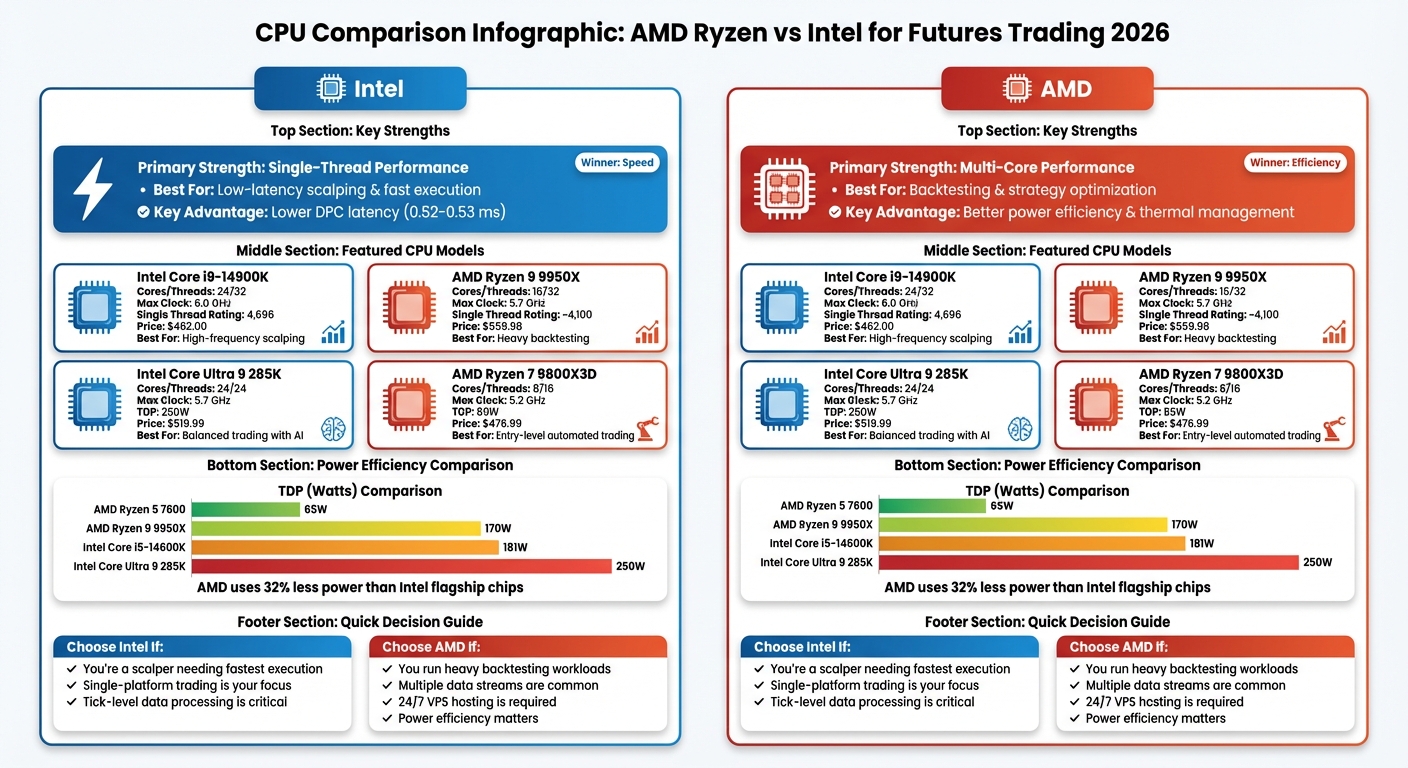
AMD Ryzen vs Intel CPU Comparison for Futures Trading 2026
Performance Benchmarks: Ryzen vs Intel for Trading
Multi-Core vs Single-Threaded Performance
When it comes to single-threaded performance, Intel's Core i9-14900K takes the lead with a Single Thread Rating of 4,696 - about 14.3% higher than AMD's competing processor [3]. This advantage translates into quicker chart rendering and more responsive indicator updates in platforms like NinjaTrader, particularly when processing tick-level data during high-volatility market conditions. With its turbo speed reaching 6.0 GHz, this processor provides a low-latency edge that's especially valuable for scalpers.
On the flip side, AMD's Ryzen 9 9950X shines in multi-threaded tasks. With 16 cores and 32 threads, it leverages its Zen 5 architecture to deliver a 16% IPC uplift, making it highly efficient for handling complex models and multiple data streams simultaneously. In comparison, Intel's Core Ultra 9 285K features 24 physical cores but lacks Hyper-Threading, limiting it to 24 threads. This design choice can hinder performance in workloads that benefit from heavy parallelization, such as multi-feed data analysis.
For traders with extreme multi-core demands, AMD's Threadripper PRO 9995WX stands out. Offering a staggering 96 cores and 192 threads, it beats Intel's Xeon w9-3595X in multi-threaded benchmarks like Cinebench by up to 125% [4]. This powerhouse is ideal for intensive tasks like massive backtesting and managing complex automated trading strategies.
These differences in performance set the stage for understanding how each CPU handles real-world trading scenarios.
Trading Workload Benchmarks
Now let’s dive into how these processors perform under actual trading workloads. NinjaTrader's Strategy Engine requires a mix of high single-thread speeds for live execution and robust multi-core performance for backtesting. For instance, the Ryzen 9 9950X, priced around $559.98, is a strong option for traders who frequently optimize strategies using large datasets. On the other hand, the Core i9-14900K, with a price tag of roughly $462.00, is an excellent choice for scalpers prioritizing quick execution over extensive backtesting.
| CPU Model | Cores / Threads | Max Clock Speed | Single Thread Rating | Price | Best For |
|---|---|---|---|---|---|
| Intel Core i9-14900K | 24 / 32 | 6.0 GHz | 4,696 | $462.00 | High-frequency scalping & order execution |
| AMD Ryzen 9 9950X | 16 / 32 | 5.7 GHz | ~4,100 (est.) | $559.98 | Strategy optimization & heavy backtesting |
| Intel Core Ultra 9 285K | 24 / 24 | 5.7 GHz | ~4,500 (est.) | $519.99 | Balanced trading with AI acceleration |
| AMD Ryzen 7 9800X3D | 8 / 16 | 5.2 GHz | ~4,300 (est.) | $476.99 | Entry-level automated trading |
For algorithmic traders managing multiple data streams and automated strategies, the Ryzen 9 9950X's 32 threads ensure smooth multitasking without compromising responsiveness. Meanwhile, Intel chips excel in scenarios where high clock speeds and single-threaded performance are critical. Thanks to NinjaTrader's multi-threaded architecture, AMD processors often reduce computation times significantly during strategy optimization, making them a go-to option for traders focused on heavy backtesting workloads.
Latency and Efficiency for Live Trading
Latency in NinjaTrader Environments
In live trading, especially for scalpers dealing with tick-level data during volatile markets, every millisecond can make a difference. Intel processors often have a slight edge in responsiveness, thanks to their lower DPC (Deferred Procedure Call) latency. For example, user benchmarks comparing the Intel i9-13900K to the AMD Ryzen 5950X show Intel achieving lower average DPC latency. AMD systems typically register around 0.52–0.53 ms, while Intel’s figures are slightly better [6]. Additionally, Ryzen systems exhibit a minor 10-nanosecond lag compared to Intel in some tests [6].
"The Intel one surely is more responsive with less DPC latency than AMD." - Tuhin Lavania, User/System Tester [6]
For scalpers who rely on latency-sensitive execution, Intel’s architecture is often preferred for its low execution latency. On the other hand, Ryzen systems excel in handling multi-application scenarios, offering a more balanced performance [1].
However, Ryzen users have occasionally reported micro-stutters, which are often linked to the chiplet design or fTPM settings. Disabling fTPM in the BIOS has been a reliable fix for these latency spikes in Windows setups, making it a key tip for traders evaluating the best VPS providers for futures trading for 24/7 operations [7].
Next, let’s explore how these performance characteristics translate to power consumption and thermal management in VPS hosting environments.
Power and Thermal Efficiency for VPS Hosting
In addition to latency, efficient power consumption and thermal management are critical for long-term VPS operations. Continuous trading demands stable thermal performance to avoid overheating and throttling. Here, AMD Ryzen processors shine, delivering better power efficiency compared to Intel. For instance, models like the Ryzen 5 7600 and Ryzen 7 5700X operate at just 65W TDP [5]. In contrast, Intel’s high-end chips require significantly more power - such as the Core Ultra 9 285K and Core Ultra 7 265K, both rated at 250W TDP. Even the Intel Core i5-14600K, a mid-range option, consumes 181W and is known for generating higher thermal output under load [5].
AMD’s flagship Ryzen 9 9950X, with a TDP of 170W, consumes 32% less power compared to Intel’s 250W flagship chips [5]. This lower power draw means reduced cooling requirements and lower operational costs, which are vital for maintaining stability during extended trading sessions. For VPS hosting environments that run 24/7, AMD’s lower thermal output minimizes the risk of throttling, ensuring uninterrupted performance during high-volatility events - an essential factor for automated trading strategies.
| CPU Model | TDP (Watts) | Thermal Output | Best VPS Use Case |
|---|---|---|---|
| AMD Ryzen 5 7600 | 65W | Low | Entry-level 24/7 automated trading |
| AMD Ryzen 9 9950X | 170W | Moderate | Heavy backtesting with continuous operation |
| Intel Core i5-14600K | 181W | High | Short-session scalping environments |
| Intel Core Ultra 9 285K | 250W | Very High | Dedicated servers with advanced cooling |
"That smaller process node [2nm] should enable AMD to deliver increased computing performance while keeping power consumption in check." - Harsh Chauhan, Contributing Analyst, The Motley Fool [2]
For traders who prioritize uptime and stability over maximum performance, AMD Ryzen processors offer a strong advantage. They deliver quieter operation, better thermal consistency, and reliable execution - key factors for overnight trading and global market hours.
TraderVPS CPU Recommendations by Plan
Best CPUs for Entry-Level VPS Plans
The TraderVPS Lite and Pro plans are designed with AMD EPYC processors, offering a balance of single-thread performance and efficiency - perfect for running charts on NinjaTrader. The Lite plan, priced at $69/month, includes 4 AMD EPYC cores and 8GB RAM, making it ideal for basic chart rendering and order entry. For $99/month, the Pro plan upgrades to 6 cores and 16GB RAM, supporting multiple charts and moderate indicator use.
If you're focused on execution speed, the Intel Core i5-13600K stands out for its single-thread performance, making it an excellent choice for scalping. Meanwhile, the AMD Ryzen 5 7600X shines in multitasking, handling research tools or spreadsheets alongside trading charts with ease.
"For a trader running just one or two platforms or charting packages then the Intel i5 10600KF is a really strong option, especially when you take the price into account." – Darren, TraderSpec
Intel processors are a go-to for low-latency, single-platform scalping, whereas AMD processors excel at managing multiple applications simultaneously. These entry-level plans provide a solid foundation for traders who may later upgrade to high-performance Ultra or Dedicated Server configurations.
Best CPUs for High-Performance and Dedicated Servers
For traders with more demanding needs, the TraderVPS Ultra plan offers robust processing power at $199/month, powered by AMD EPYC processors. With 24 cores and 64GB RAM, this plan is well-suited for managing 5–7 charts and running complex automated strategies. For even more intensive workloads, the Dedicated Server plan, priced at $299/month, features 12+ AMD Ryzen cores, 128GB RAM, and over 2TB of NVMe storage - ideal for backtesting and multi-account management.
These plans cater to advanced trading strategies on NinjaTrader. Algorithmic traders working with large historical datasets will appreciate AMD Ryzen's efficient multi-threading capabilities. On the other hand, high-frequency scalpers seeking ultra-fast execution speeds will benefit from Intel's single-thread dominance, particularly with processors like the Core i9-14900K.
"The AMD 5950X is obviously a beast in any type of workload, so for serious multi-taskers, backtesting workloads, or any trading wanting the absolute best that money can buy then this is where to look." – Darren, Trading Computer Specialist
TraderVPS ensures ultra-low latency, achieving an impressive 0.52 ms to the CME Group matching engines in Chicago. AMD's larger L3 cache minimizes memory bottlenecks during high-volatility events, while Intel's hybrid core design excels in latency-sensitive tasks like order routing.
Comparison Table: TraderVPS Plans and CPU Suitability
| Plan | Monthly Price | CPU Type | Cores | RAM | Best For | Intel Alternative | AMD Advantage |
|---|---|---|---|---|---|---|---|
| VPS Lite | $69 | AMD EPYC | 4× | 8GB | 1–2 charts, basic orders | Core i5-12500 | Lower power draw and efficient multitasking |
| VPS Pro | $99 | AMD EPYC | 6× | 16GB | 3–5 charts, automated strategies | Core i7-13700K | Better value per core |
| VPS Ultra | $199 | AMD EPYC | 24× | 64GB | 5–7 charts, live data feeds | Core i9-13900K | Superior multi-core performance |
| Dedicated Server | $299 | AMD Ryzen | 12+ | 128GB | 7+ charts, heavy backtesting | Core i9-14900K | Optimized for intensive backtesting |
Choosing the right CPU depends on your trading style. Scalpers benefit from Intel's top-tier single-thread speeds, while algorithmic traders and multitaskers will find AMD's core-heavy architecture better suited to their needs.
Final Verdict: AMD Ryzen vs Intel for 2026 Futures Trading
Key Takeaways from the Comparison
Intel shines in single-threaded performance, which is essential for quick order execution, while AMD leads the way in multi-core operations, making it a strong choice for backtesting. Intel’s lower latency is a clear advantage for scalping and processing tick-level data. On the other hand, AMD Ryzen processors, such as the Ryzen 9 9950X with 16 cores and a maximum boost clock of 5.7 GHz, are built for handling tasks like backtesting automated strategies, running multiple trading platforms simultaneously, and managing heavy optimization tasks. The Ryzen 9 9950X3D, with its 128MB L3 cache, further enhances performance when working with large historical datasets [5].
Both brands have also improved power efficiency. Intel’s Core Ultra 9 285K runs cooler and uses less power compared to its 14th Gen predecessors, while AMD’s Ryzen 9000 series maintains lower thermal output, which is especially important for uptime reliability when using VPS hosting.
As shown in previous benchmarks, the trade-offs between single-threaded speed and multi-core efficiency are crucial when choosing the right CPU for your trading style. These findings directly inform the tailored CPU recommendations for TraderVPS plans.
Best CPU for NinjaTrader on TraderVPS
Based on these benchmarks, here’s a breakdown of the best CPU options for each TraderVPS plan. For entry-level plans like VPS Lite and Pro, AMD EPYC processors strike a solid balance for basic to moderate trading tasks, priced at $69/month and $99/month, respectively.
For higher-tier plans like VPS Ultra and Dedicated Server, the CPU choice depends largely on your trading approach. High-frequency scalpers will benefit from Intel’s Core i7-14700K, which excels at low-latency order execution. Meanwhile, algorithmic traders conducting resource-heavy backtesting will find AMD’s Ryzen 9 9950X, with its 16 cores, to be a better fit due to its strong multi-thread performance.
"Swing traders, algorithmic traders, and multitaskers who run multiple applications, backtesting tools, and browser-based research may find AMD Ryzen to be more efficient and responsive under load." – Business Money [1]
TraderVPS ensures ultra-low latency (0.5–1 ms to CME Group matching engines), meaning your CPU choice has a direct impact on your trading performance. Whether you prioritize single-thread speed for scalping or multi-threaded power for backtesting, Intel and AMD both bring unique advantages to optimize your NinjaTrader experience.
Best Trading Computer Setup for 2026 Revealed!
FAQs
Which CPU is more power-efficient for trading: AMD Ryzen or Intel?
When it comes to power efficiency, AMD Ryzen CPUs often have the edge over Intel processors, especially during demanding tasks. AMD processors are designed to deliver more performance per watt, which makes them an excellent option for traders running setups around the clock. Whether you're backtesting strategies, engaging in live trading, or executing automated systems, these chips use less energy, helping to cut down on electricity bills while maintaining steady thermal performance over time.
Intel’s latest processors, however, show slightly better power efficiency when idle. But once you put them under heavy workloads, they tend to draw more power compared to AMD chips. This can lead to higher energy consumption during resource-intensive trading activities. For traders who require consistent performance over extended periods, AMD's ability to stay efficient under load makes it a smarter choice for balancing performance and operating costs.
Which CPU is best for scalping in high-volatility trading markets?
For navigating high-volatility markets with scalping strategies, Intel Core Ultra processors, like the i7-14700K, stand out as a top option. These processors deliver outstanding single-core performance and ultra-low latency - key features for executing trades swiftly and accurately in fast-paced environments.
Whether you're using platforms like NinjaTrader or relying on automated trading strategies, the Intel Core Ultra series ensures seamless performance. From live trading to backtesting, these processors handle demanding tasks with ease, offering the reliability and speed traders need when precision is non-negotiable.
Why is multi-thread performance crucial for backtesting trading strategies?
When it comes to backtesting, multi-thread performance is a game-changer. By enabling your computer to run multiple simulations at the same time, it drastically cuts down on the time it takes to analyze intricate, data-intensive strategies. The faster you can backtest, the more scenarios you can explore, helping you fine-tune strategies and make smarter, quicker decisions.
For traders leveraging advanced platforms or automated systems, strong multi-thread performance ensures smooth handling of massive datasets. This is crucial for maintaining precision and dependability, particularly when dealing with time-sensitive or high-frequency trading models where every millisecond counts.