Prop Firms for Stock Trading
Proprietary trading firms, or "prop firms", offer traders access to significant capital without risking personal funds. Here's how they work:
- Funding: Traders pass an evaluation to access firm capital, paying fees starting at $32 for smaller accounts and up to $1,469 for larger ones.
- Profit Splits: Traders keep 60%-90% of profits, depending on the firm and account type.
- Tools & Platforms: Firms provide professional platforms (e.g., MetaTrader, TradingView) and resources for trading stocks, indices, forex, and more.
- Evaluation: Passing requires meeting profit targets and adhering to strict loss limits, with some firms removing time restrictions for flexibility.
Key firms include SuperFunded, FundedNext, Earn2Trade, and TraderVPS. Each offers unique features like scaling programs, diverse asset access, or advanced trading infrastructure. Your choice depends on trading goals, risk tolerance, and platform preferences.
Quick Comparison:
| Firm | Funding Range | Profit Split | Key Features |
|---|---|---|---|
| SuperFunded | $3,000 - $200,000+ | 70%-90% | Offers multiple challenges, TradeLocker platform |
| FundedNext | Up to $300,000 | 60%-90% | Flexible evaluations, fast payouts |
| Earn2Trade | $25,000 - $400,000 | 80%-100% | Focus on futures, growth-focused programs |
| TraderVPS | N/A (Infrastructure) | N/A | High-speed servers, ultra-low latency |
Each firm caters to different trading needs, from funding and mentorship to infrastructure support. Choose the one that aligns with your trading style and goals.
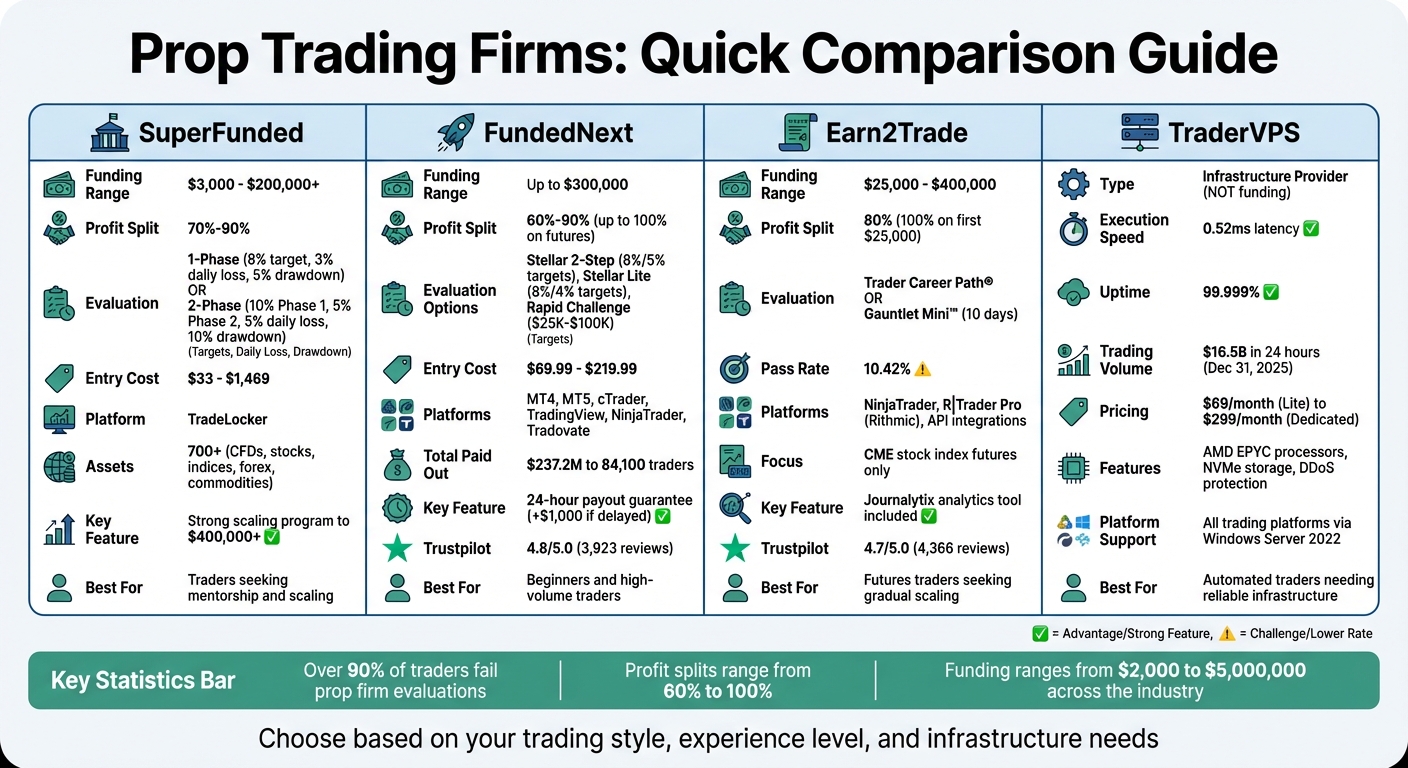
Prop Trading Firms Comparison: Funding, Profit Splits, and Key Features
I Tried Every Prop Firm (so you don't have to)
1. SuperFunded
SuperFunded, an Estonia-based firm, offers traders funding ranging from $3,000 to $200,000 through two distinct evaluation challenges. In the 1-Phase Challenge, traders aim for an 8% profit target while adhering to a 3% daily loss limit and a 5% total drawdown cap. The 2-Phase Challenge is more rigorous, requiring a 10% profit target in Phase 1 and a 5% target in Phase 2, with a 5% daily loss cap and a 10% total drawdown limit throughout both stages [3].
Funding Options
The cost to participate varies based on the account size, starting at $33 for a $3,000 account and going up to $1,469 for a $200,000 account [3]. SuperFunded operates on the TradeLocker platform, giving traders access to a vast selection of over 700 assets, including CFDs on stocks, indices, forex, and commodities [2][3]. Leverage differs depending on the challenge: 1:30 for the 1-Phase Challenge and 1:50 for the 2-Phase Challenge [3].
Profit Splits
Once traders successfully complete the evaluation and gain access to a funded account, they can retain between 70% and 90% of their profits. However, staying within the strict drawdown limits is crucial for maintaining their funded status [2].
Trading Platforms
SuperFunded relies on the TradeLocker platform, which features a user-friendly dashboard with real-time performance metrics. Partnering with Eightcap, the platform ensures low-latency execution for trades. While it primarily supports CFDs and forex, traders can also access major indices and a broad range of global assets, making it versatile for various trading strategies.
2. FundedNext

FundedNext has built a solid presence in the trading community, with over 325,900 accounts and $237.2 million paid out to 84,100 traders so far [4]. The platform specializes in stock trading through Stock CFDs (offered under the Stellar and Evaluation models) and Equity Index Futures, including E-mini S&P 500, Nasdaq 100, and Dow Jones contracts. Let’s take a closer look at their funding structures and options.
Funding Options
FundedNext offers several challenge models tailored to different trading styles.
- Stellar 2-Step: Traders need to hit an 8% profit target in Phase 1 and 5% in Phase 2, while adhering to a 5% daily loss limit and a 10% maximum overall loss.
- Stellar Lite: This model sets an 8% profit target for Phase 1 and 4% for Phase 2, with a slightly tighter 4% daily loss cap and 8% total drawdown limit.
- Rapid Challenge: Designed for futures traders, account sizes range from $25,000 (with a $1,250 profit target) to $100,000 (with a $6,000 profit target) [4]. Fees for these accounts vary, starting at $69.99 for a $25,000 account and going up to $219.99 for a $100,000 account [4].
These challenges not only test trading skills but also set the stage for profit-sharing opportunities.
Profit Splits
Once traders pass the evaluation phase, they can earn 60% to 90% of their profits on CFD accounts [6]. For futures trading, profit splits can go as high as 100%, depending on the account tier [5]. Additionally, FundedNext provides a 15% profit share from earnings generated during the evaluation phase [5][6]. To sweeten the deal, the firm offers a "Guaranteed Performance Reward" - an extra $1,000 if they fail to process a payout request within 24 hours [4].
Trading Platforms
FundedNext supports a variety of trading platforms:
- For futures trading: NinjaTrader, Tradovate, and TradingView [4][5].
- For Stock CFD trading: MetaTrader 4, MetaTrader 5, cTrader, TradingView, MatchTrader, and DXtrade [6].
The company’s reputation is reflected in its 4.8/5.0 Trustpilot rating, based on 3,923 reviews [6]. This high rating underscores the trust and satisfaction of its growing trader base.
3. Earn2Trade
Earn2Trade focuses solely on stock index futures traded on the CME. Unlike other prop firms that dabble in multiple asset classes like stocks, options, forex, cryptocurrency, and CFDs, Earn2Trade zeroes in on futures trading, making it a niche choice for traders in this area [7].
Funding Options
Earn2Trade offers two evaluation programs tailored to futures traders:
- Trader Career Path®: This program is designed for traders aiming to scale their accounts gradually. It starts with virtual account sizes of $25,000, $50,000, or $100,000 and allows growth up to $400,000 while maintaining a fixed drawdown. Currently, this program is available at a 60% discount.
- Gauntlet Mini™: For those seeking quicker funding, this option qualifies traders in just 10 days.
The firm reports a pass rate of 10.42% for these evaluations and has facilitated over 600 funded live accounts [7].
These funding pathways are designed to streamline the process for traders, offering efficiency and access to advanced tools.
Trading Platforms
Earn2Trade supports popular trading platforms like NinjaTrader and R|Trader Pro (Rithmic), along with API integrations for additional platform options [8]. Participants in the evaluation programs receive a free NinjaTrader license, adding value to the experience.
For tracking performance and managing risk, Earn2Trade includes Journalytix, a tool that logs, categorizes, and analyzes trades. The platform also boasts a 4.7/5 TrustScore on Trustpilot, based on 4,366 reviews. Many users appreciate the structured challenges and responsive customer support.
"The challenges are structured perfectly, especially with the option to pay monthly, so that means there is no stress on how much time it takes to pass" [7].
4. TraderVPS
When it comes to prop trading, having access to cutting-edge infrastructure is just as important as funding and evaluations. While many firms concentrate on providing capital and testing traders' skills, TraderVPS steps in to offer the robust trading infrastructure needed for success. In the fast-paced world of trading - especially when using automated strategies or juggling multiple positions - reliable uptime and lightning-fast execution are non-negotiable. TraderVPS ensures traders have the tools to meet these demands.
VPS Infrastructure for Stock Trading
TraderVPS specializes in Virtual Private Servers (VPS) built specifically for trading. Their servers are equipped with direct fiber-optic cross-connects to major exchanges like CME Group, achieving execution speeds as low as 0.52 milliseconds. This ultra-low latency is critical for traders working under strict metrics like slippage and execution quality. The servers run on AMD EPYC processors with NVMe storage, offering top-tier performance. Plus, built-in DDoS protection safeguards against disruptions during peak trading hours, ensuring a seamless experience.
Performance and Uptime
TraderVPS boasts an impressive 99.999% uptime [9], keeping automated trading systems running around the clock. On December 31, 2025, the platform supported $16.5 billion in trading volume over a single 24-hour period [10]. This level of reliability is vital for traders adhering to tight drawdown rules during active market sessions.
Pricing Plans
TraderVPS offers four distinct pricing tiers to suit different trading needs:
- VPS Lite ($69/month): Includes 4× AMD EPYC cores, 8GB DDR4 RAM, and 70GB NVMe storage.
- VPS Pro ($99/month): Features 6× AMD EPYC cores, 16GB DDR4 RAM, 150GB NVMe storage, and support for up to 2 monitors.
- VPS Ultra ($199/month): Comes with 24× AMD EPYC cores, 64GB DDR4 RAM, 500GB NVMe storage, and support for up to 4 monitors.
- Dedicated Server ($299/month): Offers 12×+ AMD Ryzen cores, 128GB RAM, 2TB+ NVMe storage, and support for up to 6 monitors.
Every plan includes Windows Server 2022, unmetered bandwidth, and automatic backups. These features align perfectly with the operational standards expected by most prop firms, ensuring traders have the reliability and performance they need to succeed.
Advantages and Disadvantages
Each trading firm tailors its offerings to suit different trading styles. The table below provides a snapshot of how they compare in terms of funding, profit-sharing, platform support, and standout features:
| Firm | Max Funding | Profit Split | Platform Support | Key Advantages | Main Disadvantages |
|---|---|---|---|---|---|
| SuperFunded | Scales to $400,000+ | 70%-90% | MT5, TradingView | Strong scaling program, institutional-grade data feeds | Higher entry requirements for top-tier accounts |
| FundedNext | Up to $300,000 | 70%-80% | MT5, custom platforms | Flexible risk management, 24/7 support | Limited stock inventory compared to specialized firms |
| Earn2Trade | Starts at $25,000 | 80% (first $25,000 at 100%) | Multiple platforms | Educational resources, mentorship programs | Stricter evaluation phases |
| TraderVPS | N/A (Infrastructure) | N/A (Infrastructure) | Windows Server 2022, all trading platforms | 99.999% uptime, 0.52ms latency, DDoS protection | Not a funding provider; requires separate prop firm partnership |
Let’s break down these differences further to understand what sets each firm apart and where they might fall short.
Funding and Profit-Sharing
The funding opportunities and profit-sharing arrangements vary greatly across the industry. Profit splits can range from 50% to 100%, often improving as traders hit performance milestones. Funding amounts start as low as $2,000 for entry-level accounts and can grow to $5,000,000 for top performers in certain programs. Some firms, like Earn2Trade, offer unique incentives, such as a 100% profit split on the first $25,000 earned, which can be especially appealing to new traders.
Platform Support and Technology
A firm’s platform and technology offerings play a huge role in a trader’s success. While funding and profit-sharing terms differ, reliable trading infrastructure is a universal priority. As Black Eagle Financial Group explains, "Proprietary trading firms... leverage advanced technology and data analytics to make informed decisions, often outpacing traditional investment methods" [11]. Whether you prefer MT5, TradingView, or custom platforms, the right tools can make all the difference in executing trades effectively.
For those relying on automated strategies or managing multiple positions, robust infrastructure is non-negotiable. TraderVPS, for instance, specializes in providing the kind of high-performance trading environment that prop traders demand. With 99.999% uptime, lightning-fast execution speeds of 0.52 milliseconds, and DDoS protection, TraderVPS ensures seamless operations, even during high-pressure trading sessions.
Each firm brings something unique to the table, and your choice will depend on your trading goals, preferred tools, and risk tolerance. Whether you’re seeking funding, mentorship, or cutting-edge infrastructure, there’s a firm tailored to meet your needs.
Conclusion
As we've explored, the combination of funding options and trading technology plays a crucial role in determining success in proprietary trading. Choosing the right prop firm depends on your experience, trading style, and priorities - whether that's funding, education, or infrastructure. Here's a quick summary of what each firm brings to the table:
FundedNext caters to beginners and high-volume traders. It stands out with low evaluation fees and challenges that have no time restrictions, creating a low-pressure environment. This is especially important given that over 90% of traders fail these evaluations [1]. Additionally, FundedNext guarantees payouts within 24 hours - offering an extra $1,000 if they miss the deadline - and allows news trading [5].
Earn2Trade is tailored for futures traders aiming for gradual account growth. With an 80% profit split and the Trader Career Path program, traders can scale up to $200,000 by meeting performance milestones [8]. However, its monthly subscription fees (ranging from $150 to $550) and stricter evaluation phases make it more suitable for experienced traders with a proven track record.
SuperFunded takes a "grown, not bought" approach, focusing on fostering disciplined trading habits [2]. Offering profit splits between 70% and 90% alongside dedicated coaching, it provides a structured environment for traders who thrive under guided mentorship.
TraderVPS, while not a funding provider, delivers the technological backbone essential for successful prop trading. With ultra-low latency and exceptional uptime, TraderVPS ensures your automated strategies and manual trades execute seamlessly. Reliable technology paired with outsourced funding creates a well-rounded trading strategy.
Ultimately, selecting the right funding partner and reinforcing your trading approach with dependable, high-performance infrastructure can set you on the path to success in proprietary trading.
FAQs
What should I look for when choosing a prop trading firm for stock trading?
When choosing a proprietary trading firm, it's essential to start by assessing its reputation and transparency. Look for firms with strong reviews, a solid track record, and clear regulatory compliance. These factors help ensure your funds are secure and your interests are safeguarded.
Next, take a close look at the firm's profit-sharing model, payout policies, and risk management rules. Aim for firms offering high profit splits - ideally 80% or more - along with flexible drawdown limits and fair payout terms. Also, be mindful of trading costs like spreads and commissions, as they can eat into your profits.
Make sure the firm matches your trading style and objectives. This includes offering account sizes and funding options that suit your needs, as well as a transparent evaluation process with clear profit targets and no hidden fees. Lastly, consider the firm's support system - things like educational tools, responsive customer service, and the ability to scale your capital as your skills improve. These elements can make a big difference in your growth and success as a trader.
How do profit splits work in proprietary trading firms?
Profit splits are the way proprietary trading firms divide earnings with traders who use the firm’s capital to generate returns. Once a trader meets the firm’s conditions - like adhering to risk limits or hitting profit targets - the net profit is shared. Typically, traders receive a percentage of the profit, which often falls between 70% and 90%, while the firm retains the rest to cover costs such as capital, technology, and support.
Some firms stick to fixed splits, offering higher percentages for larger accounts or stronger performance. Others use a tiered approach, where traders earn a higher percentage on their initial profits and a slightly lower rate on additional gains. Payouts are generally made in U.S. dollars on a set schedule - weekly, bi-weekly, or monthly - and come with clear statements that break down gross profit, the firm’s share, and the trader’s earnings. This setup allows traders to concentrate on their performance, knowing exactly how much of their profit they’ll take home.
How do trading platforms and technology support prop trading firms?
Trading platforms and technology are the backbone of modern prop trading firms. They provide traders with quick market access, low-latency order execution, and real-time data feeds, all of which are critical for executing stock trading strategies with precision. These platforms often feature user-friendly dashboards that highlight essential metrics like equity drawdown, risk exposure, and position sizing. This allows traders to stay focused on their strategies rather than getting tangled up in overly complicated software.
Technology also plays a key role in how firms evaluate and fund traders. Many firms rely on simulated trading challenges to gauge a trader’s consistency, ability to meet profit targets, and risk management skills before providing real capital. These simulations mimic live market conditions, enforce strict rules like daily loss limits, and automatically generate detailed performance reports. By combining advanced tools and robust risk controls, prop trading technology ensures that both traders and firms can operate efficiently while safeguarding capital and encouraging growth.