Optimal CPUs for Bots and Analysis: AMD vs Intel
Choosing the right CPU is essential for trading bots and analysis. AMD and Intel offer distinct advantages based on your trading needs:
- AMD CPUs: Great for multitasking, backtesting, and running multiple trading platforms simultaneously. Ryzen 9 7950X, with 16 cores and 32 threads, is ideal for handling complex workloads like strategy optimization and algorithmic trading.
- Intel CPUs: Best for single-thread performance and real-time execution. The Core i9-13900K, with turbo speeds up to 5.8 GHz, excels in scalping and high-frequency trading where speed is critical. This is particularly important when minimizing latency in HFT environments.
Key Takeaways:
- AMD Strengths: Multi-core performance, energy efficiency, and large cache for data-heavy tasks.
- Intel Strengths: Superior single-thread speed, essential for rapid order execution and tick-level data processing.
- Recommendations: Choose AMD for multitasking and backtesting. Opt for Intel if your focus is on fast, real-time execution.
Quick Comparison:
| Feature | AMD Ryzen 9 7950X | Intel Core i9-13900K |
|---|---|---|
| Cores / Threads | 16C / 32T | 24C / 32T (16P + 8E) |
| Turbo Speed | 4.5+ GHz | Up to 5.8 GHz |
| Cache | 80 MB | 30 MB |
| Best For | Backtesting, multitasking | Scalping, real-time trading |
Your choice depends on whether you prioritize multitasking or single-core speed for your trading setup.
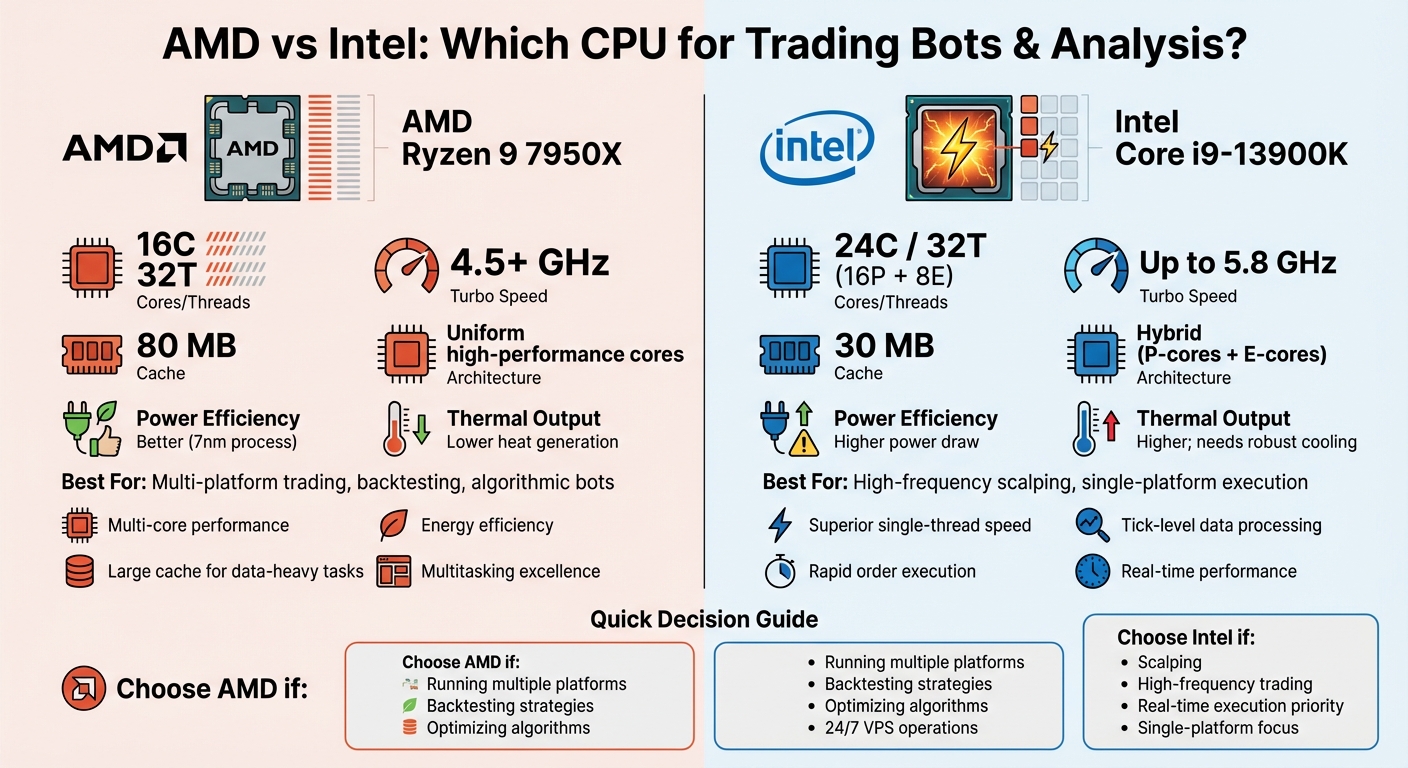
AMD vs Intel CPU Comparison for Trading Bots and Analysis
Best CPU for Trading 2025 - The ONLY Ones You Should Consider Today
AMD CPUs for Trading Bots and Analysis
AMD Ryzen and EPYC processors deliver outstanding performance for multi-strategy trading. The Ryzen 9 7950X, for example, boasts 16 cores, 32 threads, and 80MB of total cache, with clock speeds exceeding 4.5 GHz [1]. This makes it a top choice for quantitative analysis, where heavy multitasking and processing power are essential.
Let’s dive into how AMD processors shine in multi-threading, thermal management, and platform compatibility.
Multi-Threading Performance for Trading Bots
AMD's Zen 3 and Zen 4 architectures are designed to handle parallel workloads exceptionally well. Their high core counts are especially useful for tasks like walk-forward analysis, strategy optimization, and backtesting. The Ryzen 9 5950X, for instance, led PassMark benchmarks at its release, excelling in both single-thread and multi-core performance [4].
"The AMD 5950X is obviously a beast in any type of workload, so for serious multi-taskers, backtesting workloads, or any trading wanting the absolute best that money can buy then this is where to look." – Darren, Expert at TraderSpec [4]
For traders running multiple instances of platforms like NinjaTrader or MetaTrader, AMD's higher core counts allow for seamless multitasking across multiple screens [4][3]. When paired with DDR5 RAM and PCIe Gen 4 NVMe storage, these CPUs minimize bottlenecks during demanding optimization runs [1].
These multi-threading capabilities also contribute to energy efficiency and compatibility, which we’ll explore next.
Power Efficiency and Thermal Performance
AMD processors are known for generating less heat while maintaining top-tier performance - an essential feature for trading systems that operate 24/7 on VPS providers for futures trading [3]. For example, TraderVPS uses dedicated Ryzen 9 7950X cores in its infrastructure to avoid the throttling issues common in shared cloud environments [1]. In some AMD-based VPS locations, like those in Chicago, network latency can reach as low as 0.52 ms to the CME Group exchange [6].
NinjaTrader and Trading Platform Compatibility
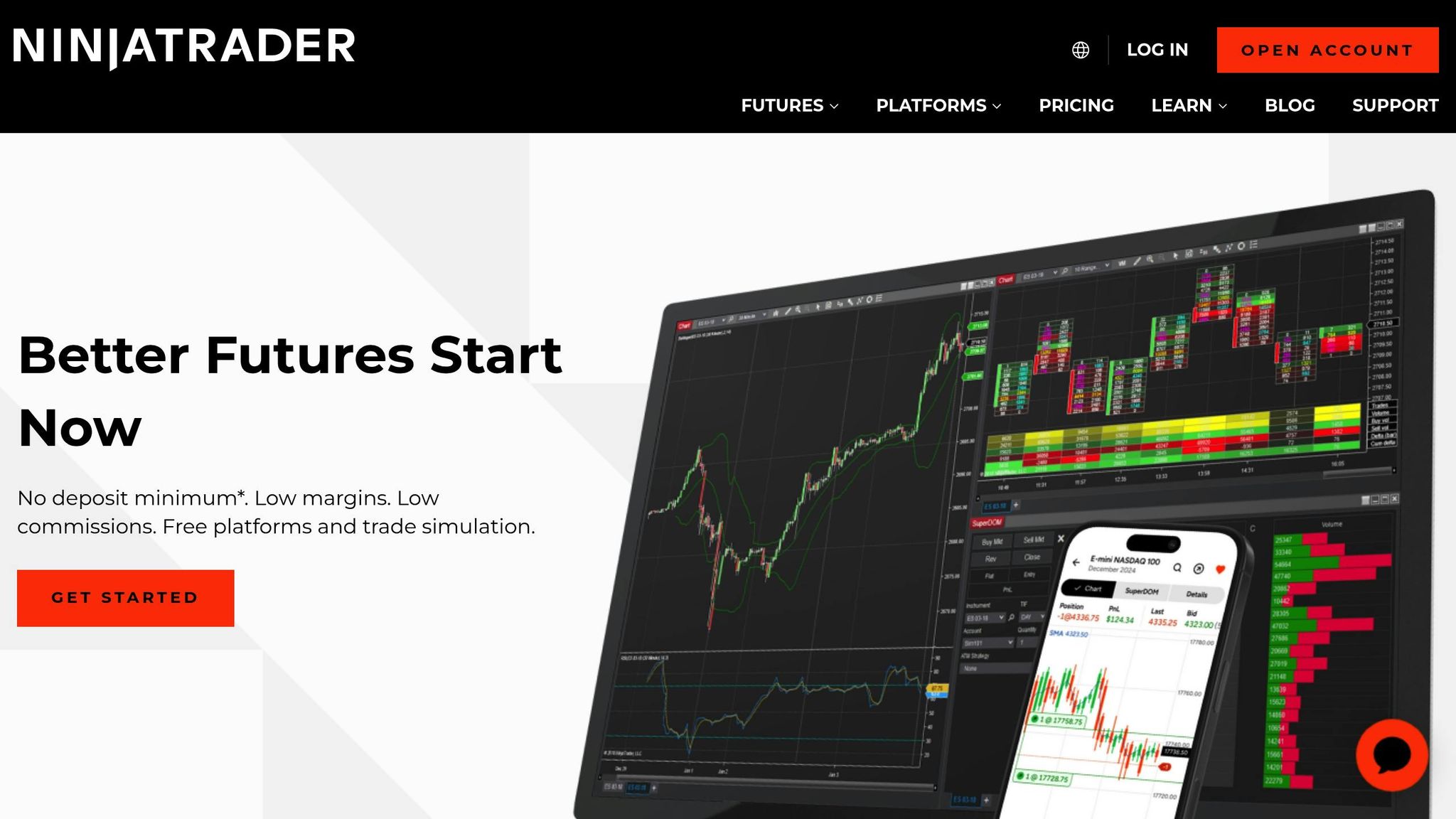
AMD Ryzen processors are fully compatible with NinjaTrader 8.1, which is optimized for Windows-native architecture. The Ryzen 9 7950X supports advanced instruction sets like AVX2 and AVX-512, boosting performance for high-frequency trading workloads [1]. Additionally, the CPU handles NinjaTrader’s DirectX rendering via Microsoft WARP, reducing the need for a dedicated GPU in VPS setups [1].
However, older Zen 2 processors like the 3900X or 3950X are less ideal due to weaker single-thread performance, which can lead to bottlenecks in real-time chart rendering [4]. To ensure smooth performance when working with large historical tick data files for futures analysis, pairing your AMD CPU with at least 16GB of DDR5 RAM is highly recommended [1].
Intel CPUs for Trading Bots and Analysis
Intel processors shine when it comes to single-threaded, real-time execution - an essential feature for trading platforms like NinjaTrader. Take the Intel Core Ultra 9 285K, for example. As of December 26, 2025, it scored an impressive 5,092 on PassMark's single-thread benchmark, ranking among the best desktop processors available, often used by dominant HFT firms [7]. While AMD is known for its multi-threading capabilities, Intel's strength lies in its ability to handle rapid sequential processing, which is critical for real-time trading.
Most trading applications rely heavily on a single CPU core for calculations [2], making high clock speeds a top priority. Intel's Core i9-14900KS, with turbo frequencies reaching up to 6.2 GHz [7], and the i9-13900K, clocking in at up to 5.8 GHz [2], are excellent examples of processors that can boost order execution speed and improve chart responsiveness during volatile market periods.
Another key advantage is Intel's large onboard cache, which allows faster data access and enhances overall performance. The Core Ultra 9 285K, for instance, features 36 MB of Intel Smart Cache and 40 MB of L2 cache, enabling data access speeds up to 100 times faster than standard system RAM [8]. Additionally, many trading software developers use Intel-optimized compilers to take full advantage of these architectural features [2]. This combination of speed and efficiency puts Intel's single-core performance in a league of its own.
Single-Thread Speed for Real-Time Processing
High single-thread performance is crucial for ensuring trading bots respond quickly to market fluctuations. Even on multi-threaded platforms like NinjaTrader, many execution tasks run on a single core [2]. For example, the Core Ultra 7 265K scores 4,925 in single-thread benchmarks, outperforming the i5-14600K's score of 4,272 [7]. These differences can be game-changing for scalping or high-frequency trading strategies, where every tick matters. Intel's "K" and "KF" models are particularly popular for trading setups, with "KF" variants offering better heat management by omitting integrated graphics.
"Most trading applications won't use many of the cores on your CPU. Instead, they pipe most of the calculations through one core... This may limit the need for a high core count in your trading computer." – TradingComputers.com [2]
To maximize Intel's hybrid architecture - which features Performance-cores and Efficient-cores - traders should consider using Windows 11. Unlike Windows 10, Windows 11 can intelligently assign demanding trading tasks to high-performance cores while allocating background processes to efficient cores [2].
Power Usage in VPS Environments
In addition to speed, Intel has made strides in power efficiency, especially in VPS setups. The latest Arrow Lake processors, like the Core Ultra 7 265K and Ultra 9 285K, offer improved thermal performance compared to older Raptor Lake models [9]. Previous high-end processors, such as the Core i7-14700K and i9-14900K, were known for their high power consumption and tendency to overheat, often requiring large liquid coolers to maintain stability [9]. In contrast, the Core Ultra series uses a 3 nm process, compared to the 7 nm process found in the 14th Gen i5-14600K, and operates with a Thermal Design Power of 250 watts [9]. This efficiency makes the Ultra series ideal for 24/7 automated trading systems, as they consume less power and generate less heat, reducing the risk of thermal throttling.
Standard VPS environments often rely on Intel Xeon processors running at 2.0–3.0 GHz, which can limit the performance of trading platforms like NinjaTrader [1]. For specialized trading VPS setups, consumer-grade CPUs such as the Core i9-14900K, i9-13900K, and i7-13700K are preferred for their superior speed and efficiency [2].
NinjaTrader and Trading Platform Compatibility
Intel's high clock speeds offer a direct advantage for trading platforms like NinjaTrader, improving chart updates and order execution. For scalping and high-frequency trading, a CPU with a minimum clock speed of 3.5 GHz - ideally 4.0 GHz or higher - is recommended [1]. NinjaTrader relies on Microsoft WARP, a software-based DirectX rendering system that runs on the CPU. As a result, a processor's single-thread performance significantly impacts the speed of chart updates and order execution. The Core i9-13900K/KF, with a turbo frequency of up to 5.8 GHz, is one of the fastest options available for handling tick-level data [2].
"Intel still holds an edge in certain trading scenarios where maximizing single-core speed is more important than running many concurrent apps." – Business Money [3]
For traders using setups with four or more charts, the i5-13600K provides solid performance at a reasonable price. However, those running complex automated strategies or conducting heavy backtesting may benefit from upgrading to i7 or i9 models. While live execution tasks remain single-threaded, NinjaTrader can utilize multi-threading for loading historical data and optimizing strategies, making higher core count CPUs a smart choice for quantitative analysis [2].
AMD vs Intel: Performance Comparison for Trading
When deciding between AMD and Intel for trading, your choice should align with the specific demands of your trading activities. Intel processors shine in single-thread performance, with speeds reaching up to an impressive 5.8 GHz[2]. This makes them a strong choice for scalpers and high-frequency traders who rely on rapid tick-level data processing.
On the other hand, AMD's Ryzen 9 7950X offers exceptional multi-core performance, featuring 16 cores, 32 threads, and clock speeds surpassing 4.5 GHz[1]. This makes AMD a great fit for traders who juggle multi-platform setups or conduct resource-intensive backtesting. While Intel focuses on maximizing single-thread speeds, AMD leans into multi-core power, catering to different trading needs.
Power efficiency is another area where these two brands diverge. AMD's 7nm lithography process allows Ryzen processors to operate with greater energy efficiency compared to Intel's 10nm and 14nm chips[10]. This not only reduces heat output but also lowers cooling requirements, which is particularly beneficial for secure managed VPS hosting environments that run continuously. In contrast, Intel's high-end models, like the i9 series, consume more power and demand advanced cooling systems[3][10].
"Swing traders, algorithmic traders, and multitaskers who run multiple applications, backtesting tools, and browser-based research may find AMD Ryzen to be more efficient and responsive under load." – Business Money[3]
For tasks like quantitative analysis and backtesting, AMD processors stand out thanks to the 80 MB cache in the Ryzen 9 7950X, which provides quicker access to large datasets. Intel's hybrid architecture, while optimized for prioritizing critical tasks, can't match this cache size for such data-heavy operations[1][2][3].
Performance Metrics Comparison Table
| Feature | AMD Ryzen 9 7950X | Intel Core i9-13900K |
|---|---|---|
| Cores / Threads | 16C / 32T | 24C / 32T (16P + 8E) |
| Base / Turbo Speed | 4.5+ GHz | 3.0 GHz / 5.8 GHz |
| Total Cache | 80 MB (L2+L3) | 30 MB |
| Architecture | Uniform high-performance cores | Hybrid (P-cores + E-cores) |
| Power Efficiency | Better (7nm process)[10] | Higher power draw[3] |
| Thermal Output | Lower heat generation[3] | Higher; needs robust cooling[10] |
| Best For | Multi-platform trading, backtesting, algorithmic bots[3] | High-frequency scalping, single-platform execution[3] |
| VPS Latency | 0.5ms–1ms to CME[1] | Comparable with proper setup |
| NinjaTrader Compatibility | Excellent for multi-threaded tasks[1] | Optimized for single-thread execution[2] |
Ultimately, your decision boils down to what you value more: Intel's unmatched single-thread speed for real-time execution or AMD's superior multi-core efficiency for managing multiple strategies at once. Both options deliver high-caliber performance, so aligning your CPU choice with your trading workflow and infrastructure is essential.
CPU Recommendations for TraderVPS Plans
CPUs for VPS Lite and VPS Pro Plans
TraderVPS Lite and Pro plans utilize AMD EPYC processors, offering strong multi-threading performance at an affordable price point. The VPS Lite plan features 4 dedicated AMD EPYC cores, paired with 8GB DDR4 RAM, for $69/month. This setup is ideal for running 1–2 NinjaTrader charts smoothly. For those needing more power, the VPS Pro plan steps up with 6 dedicated cores and 16GB RAM for $99/month, supporting 3–5 charts and up to 2 monitors seamlessly.
If you're building your own trading system in an environment similar to TraderVPS, consider processors like the AMD Ryzen 5 5600G or Intel Core i5-12500 as a starting point. According to TradingComputers.com, "The Core-i5 12500 is the minimum processor that a trading PC should have. It provides enough power and speed to get the job done, making it ideal for beginner traders, hobbyists, and those on a budget" [2]. The Ryzen 5 5600G offers similar performance but with enhanced multi-core efficiency, making it, as TradingComputers.com puts it, "an excellent choice for new traders who are building their first trading setups" [2].
For users running multiple platforms or performing moderate backtesting, upgrading to the AMD Ryzen 7 7700X or Intel Core i7-13700K is recommended. These CPUs bring more cores and turbo speeds exceeding 5.0 GHz, ensuring smooth operation for background tools and multiple chart windows. However, steer clear of older AMD Zen 2 processors like the 3900X, as their weaker single-thread performance can lead to delays in order execution.
Now, let’s explore the high-performance CPU options available for the VPS Ultra and Dedicated Server plans.
CPUs for VPS Ultra and Dedicated Server Plans
For traders with demanding workloads, the higher-tier plans provide cutting-edge processing power. The VPS Ultra plan, priced at $199/month, includes 24 dedicated AMD EPYC cores with 64GB DDR4 RAM, capable of supporting 5–7 charts and up to 4 monitors. On the next level, the Dedicated Server plan, at $299/month, boasts 12+ AMD Ryzen cores, 128GB DDR4/5 RAM, and over 2TB of NVMe storage, making it perfect for running 7+ charts and up to 6 monitors.
For maximum computational performance, the AMD Ryzen 9 7950X is a standout choice. With 16 cores, 32 threads, and clock speeds exceeding 4.5 GHz, this processor is excellent for backtesting and managing multiple algorithmic bots simultaneously. Its ability to maintain high clock speeds during volatile market conditions ensures reliability under pressure [1].
On the Intel side, the Core i9-14900K and i9-13900K deliver exceptional single-thread performance, with turbo speeds reaching up to 5.8 GHz. These processors are ideal for traders focused on minimizing latency during high-frequency order execution. Both AMD and Intel configurations pair effectively with PCIe Gen 4 NVMe SSDs, offering blazing-fast read speeds of up to 7,000 MB/s for quick data access and smooth performance.
Conclusion
Deciding between AMD and Intel ultimately comes down to your trading style and the demands of your workload. Intel’s Core i9 processors from the 13th and 14th generations shine with their unmatched single-thread speeds - reaching up to 5.8 GHz. This makes them a top pick for high-frequency scalpers who need lightning-fast order execution during volatile market swings [2]. If your focus is on tick-level data and rapid order entry on a single platform, Intel’s single-core performance gives you a clear advantage.
On the other hand, AMD Ryzen 9 processors, such as the 7950X, are a standout choice for traders managing multiple tasks simultaneously. With 16 cores, 32 threads, and clock speeds over 4.5 GHz, these processors excel at handling multi-threaded workloads like strategy optimization, backtesting, and running automated bots - all while being energy-efficient [1].
"The AMD 5950X is obviously a beast in any type of workload, so for serious multi-taskers, back-testing workloads, or any trader wanting the absolute best that money can buy then this is where to look" [4].
TraderVPS has optimized its infrastructure to leverage these strengths effectively. Their lower-tier plans utilize AMD EPYC cores, while upper-tier plans feature high-performance Ryzen processors, ensuring stable and reliable performance during market volatility.
When selecting a CPU, aim for clock speeds of at least 3.5 GHz for real-time execution tasks. Core count becomes more critical for resource-heavy activities like backtesting or trading across multiple platforms [5]. Pair your processor with at least 16GB of DDR4 or DDR5 RAM and NVMe SSD storage to prevent data bottlenecks. Whether you need Intel’s blazing single-core speed for rapid order execution or AMD’s efficiency for multi-threaded tasks, the right CPU will align seamlessly with your trading needs.
FAQs
What are the key differences between AMD and Intel CPUs for trading tasks?
When it comes to CPUs, AMD and Intel both bring unique strengths to the table, catering to different trading requirements. Intel processors, such as the Core i9 series, shine in single-core performance, making them a top choice for traders focused on ultra-low latency tasks like scalping or rapid order execution. On the other hand, AMD processors, like the Ryzen series, are equipped with higher core and thread counts, making them ideal for traders managing multiple platforms, running back-testing algorithms, or handling heavy workloads all at once.
Another factor to consider is energy efficiency. AMD chips are known for being more power-efficient and running cooler under demanding conditions. This not only helps lower electricity costs but also ensures stable performance during long trading sessions. Intel, meanwhile, often stands out with better integrated graphics and superior idle power efficiency. For those watching their budget, AMD typically offers more cores for the price, while Intel’s premium models cater to traders willing to invest in top-tier performance.
In short, Intel is the go-to for speed and low latency, while AMD is better suited for multitasking, energy savings, and overall value.
Why is single-thread performance crucial for high-frequency trading?
When it comes to high-frequency trading, single-thread performance is absolutely critical. Many latency-sensitive tasks - like executing orders, processing real-time data, updating charts, and calculating indicators - depend on a single core to function. The faster each core operates, the fewer delays traders face, which can make all the difference in seizing opportunities in rapidly changing markets.
In environments where every millisecond matters, having a CPU with strong single-thread performance ensures operations run smoothly and responses are lightning-fast. This level of speed is essential for staying competitive in the fast-paced world of high-frequency trading.
Why is power efficiency important when choosing a CPU for trading systems?
Power efficiency is a key factor when choosing a CPU for trading systems. It directly affects operating costs, system stability, and overall performance. An efficient processor generates less heat, helping to maintain consistent performance during extended trading sessions or when running a VPS around the clock. This is especially important for avoiding thermal throttling, which can slow down order execution - a critical concern for traders who depend on speed and reliability.
AMD CPUs, particularly the Ryzen series, are popular choices due to their multi-core performance and lower power consumption during demanding tasks. These qualities make them well-suited for activities like back-testing and algorithmic trading. On the other hand, while Intel processors are efficient when idle, they tend to produce more heat under heavy load. Opting for a power-efficient CPU not only cuts down on electricity costs but also reduces cooling needs, ensuring smoother operation - whether you're working with an on-premise setup or a VPS for your trading activities.