2026 Low-Cost Futures Brokers and Tools
Futures trading in 2026 offers affordable options, but true costs go beyond commissions. Key factors like exchange fees, margin requirements, and platform features significantly impact traders. Here's a breakdown of six platforms to help you decide:
- NinjaTrader: Low commissions starting at $0.09 per micro contract (Lifetime license required). Offers advanced tools like backtesting and automation but has a steep learning curve.
- MetroTrade: Flat $0.29 per micro contract with no platform fees or minimum deposits. Great for beginners but lacks advanced features.
- Interactive Brokers (IBKR): Competitive rates ($0.25 per micro contract, tiered pricing for high volume). Offers global market access but requires a $10,000 minimum deposit.
- Optimus Futures: Transparent pricing ($0.25 per micro contract) and advanced tools like Trade Copier. Setup may feel complex for new traders.
- TraderVPS: VPS hosting for uninterrupted trading. Plans start at $69/month for low-latency automation.
- Webull: User-friendly platform with $0.25 per micro contract and free market data. Limited advanced tools.
Quick Takeaway: Beginners can start with MetroTrade for simplicity, while active traders may benefit from NinjaTrader's cost efficiency or IBKR's global access. For automation, pairing a platform with TraderVPS ensures smooth operations.
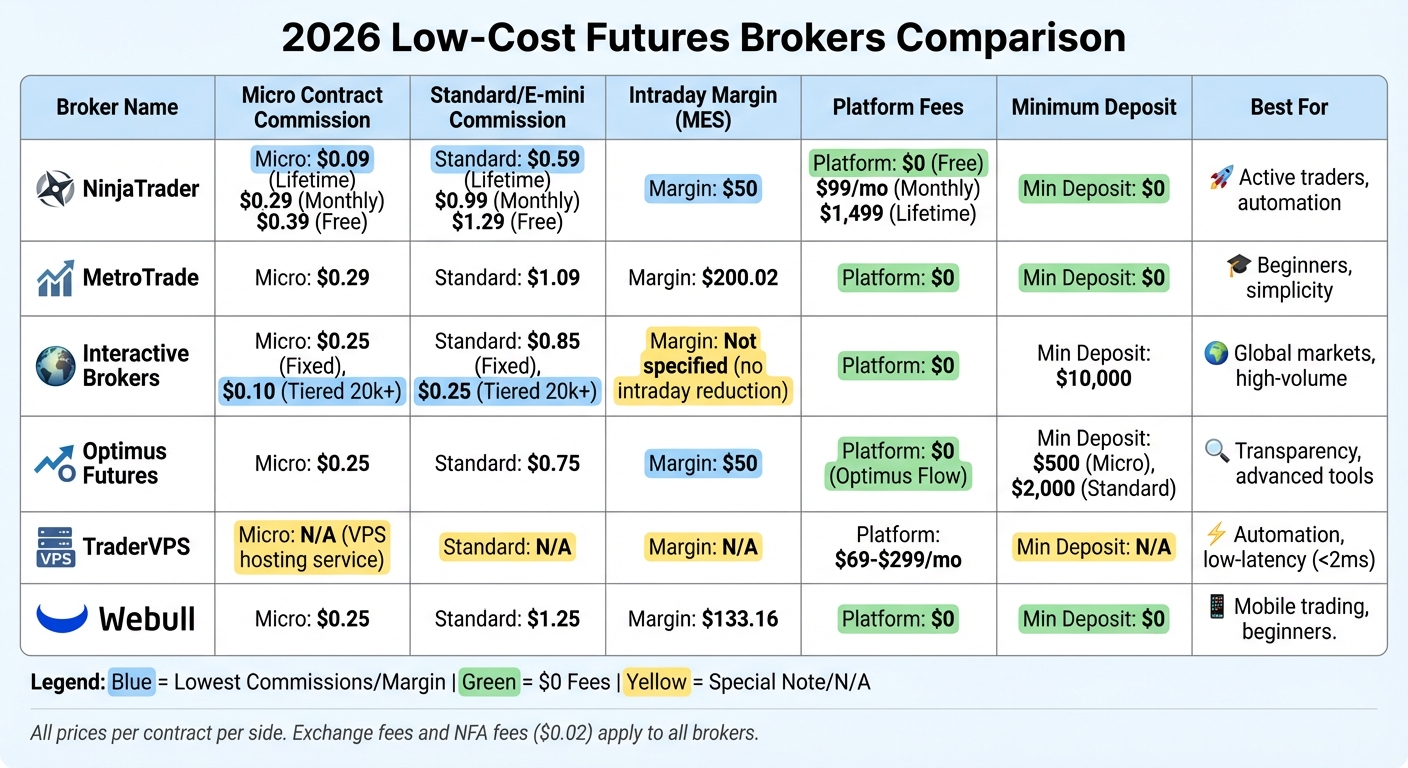
2026 Futures Brokers Comparison: Commissions, Margins, and Features
10 Best Futures Trading Brokers | For Low Costs, US, Europe, UK & Small Accounts
1. TraderVPS
TraderVPS offers VPS hosting tailored specifically for futures traders, ensuring constant connectivity and ultra-low latency to trading exchanges. While brokers execute your trades, a VPS keeps your trading platform online 24/7, even during local network disruptions [11].
Platform Features
TraderVPS focuses on proximity to CME matching engines by hosting its servers in Chicago or Aurora, Illinois, achieving latencies of under 2 ms. For algorithmic traders, speeds can drop to sub-1 ms, significantly reducing execution delays - up to 90% faster than trading from a home setup [11]. The service uses high-performance AMD EPYC processors (3.5 GHz to 3.7+ GHz clock speeds), NVMe storage, and 1 Gbps+ unmetered connections. Combined with its hardware and strategic server locations, TraderVPS ensures reliable performance and reduced delays.
Additional Services
TraderVPS minimizes latency fluctuations (jitter) compared to regular internet connections and supports 24/7 automation, allowing algorithmic strategies to run without interruptions or dependence on local hardware [11]. Pricing begins at $69/month for the VPS Lite plan (suitable for 1-2 charts) and goes up to $299/month for dedicated servers capable of supporting 7+ charts and up to 6 monitors. All plans include DDoS protection, automatic backups, and Windows Server 2022 for added security and stability.
2. NinjaTrader

NinjaTrader is a broker-platform hybrid that combines professional-grade tools with tiered pricing, making it a standout choice for high-volume traders. Its pricing model ties your trading costs to your level of commitment, offering flexibility and cost savings for those who trade frequently.
Commission Rates
NinjaTrader offers three pricing tiers to suit different trading needs:
- Free Plan: $0.39 per micro contract and $1.29 per standard contract per side.
- Monthly Plan ($99/month): Reduces rates to $0.29 for micro contracts and $0.99 for standard contracts.
- Lifetime Plan ($1,499 one-time): Lowers costs further to $0.09 for micro contracts and $0.59 for standard contracts [4][6].
For comparison, traditional brokers like Charles Schwab charge $2.25 per side, while E*Trade charges $1.50 per side, regardless of contract size [5][1]. If you trade 5,000 micro contracts, the Lifetime plan pays for itself compared to the Free plan, and every trade afterward saves you $0.30 per side [6]. However, keep in mind additional costs like exchange fees (around $0.19 per contract) and order routing fees ($0.25 per contract for CQG or Rithmic) [6][13].
Margin Requirements
NinjaTrader’s margin requirements are another highlight, offering some of the lowest in the industry. Intraday margins start at just $50 for Micro E-mini S&P 500 (MES) contracts and $100 for Micro Nasdaq-100 (MNQ). Standard E-mini contracts require $500 for the S&P 500 (ES) and $1,000 for the Nasdaq-100 (NQ) [4][14]. These low margins allow traders to manage their capital efficiently. However, be aware that margins can increase up to four times during major economic events [6].
Platform Features
NinjaTrader’s desktop platform is packed with tools designed for serious traders. The Strategy Analyzer offers backtesting, multi-objective optimization, and even an experimental AI feature for strategy development [6]. The Market Replay tool lets you simulate past market conditions, enabling you to test strategies by playing, pausing, or rewinding tick-by-tick data. All plans include unlimited simulated trading, so you can practice without risking real money.
The platform also features the NinjaTrader Ecosystem, a community-driven marketplace with over 1,000 third-party indicators and automated strategies [4][6]. Traders can create custom strategies using the C#-based NinjaScript Editor or the no-code Strategy Builder. Additionally, the Risk Manager tool helps protect your capital by setting daily and weekly profit/loss limits, automatically locking trading once your thresholds are reached.
Additional Services
For enhanced functionality, NinjaTrader integrates with TradingView for $9.99/month, allowing direct order routing from TradingView charts to your brokerage account [6]. The Multi-Broker Add-on ($99/month) enables you to connect NinjaTrader 8 to external brokers like Interactive Brokers, simplifying the management of multiple accounts [6]. Funded accounts also enjoy free CME market data, cutting costs for active traders [6].
Support services include a 24-hour emergency trade desk for live orders and account issues, as well as 24/5 technical support [4][14]. However, the desktop software is Windows-only, meaning Mac users will need virtualization tools like Parallels to run it [6]. For those automating strategies, pairing NinjaTrader with a VPS ensures continuous operation and minimizes latency, making it a reliable choice for round-the-clock trading.
3. Optimus Futures
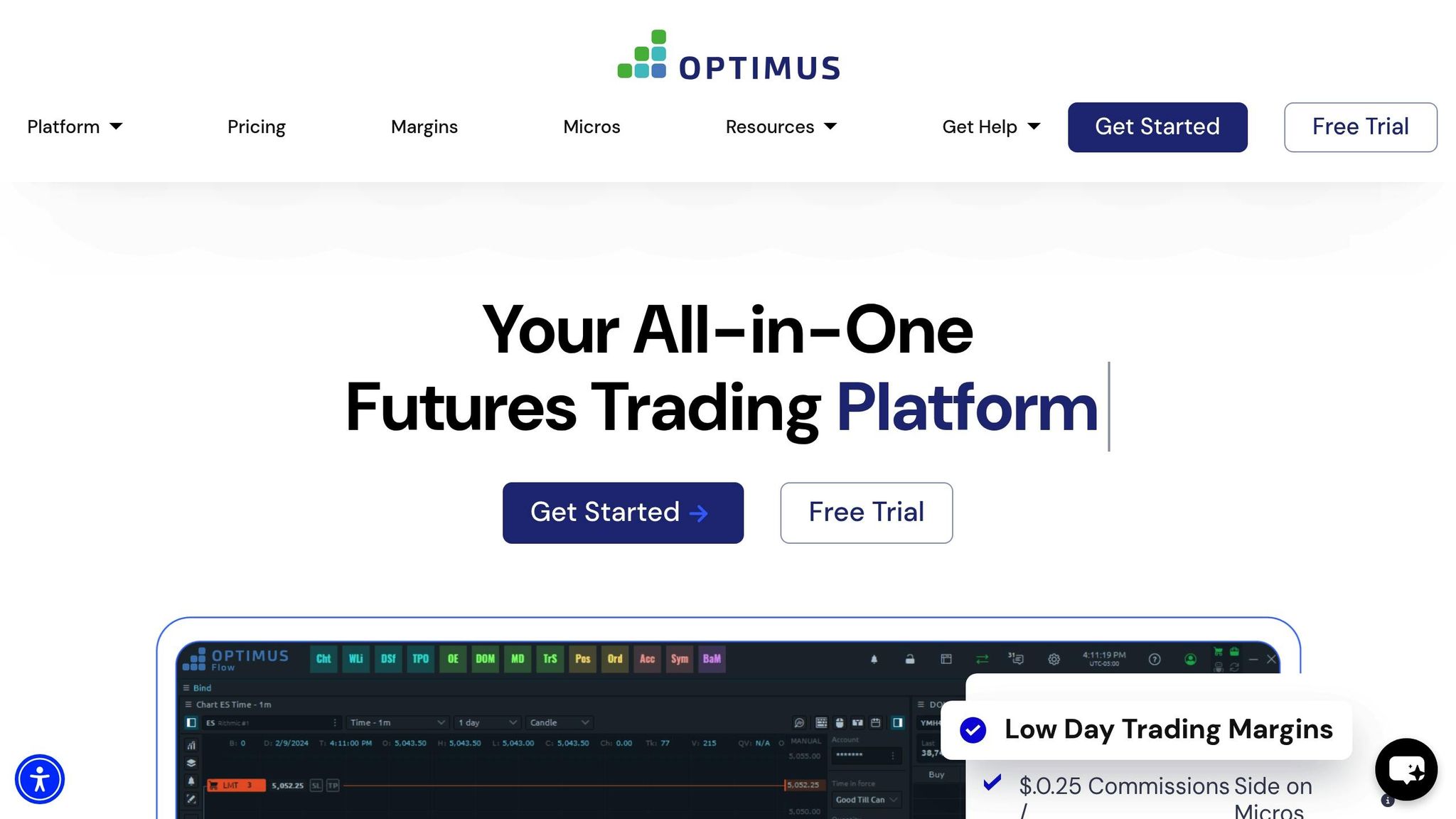
Optimus Futures offers a straightforward pricing model that includes exchange, clearing, and regulatory fees, making costs transparent for traders. Their tiered commission structure is designed to reward active traders. Rates start at $0.25 per side for Micro contracts and $0.75 per side for standard E-mini contracts, with high-volume traders enjoying discounts as low as $0.05 per side [15][17].
Commission Rates
The pricing for commissions is both clear and competitive. Micro contracts are priced at $0.25 per side, while standard E-mini contracts cost $0.75 per side. When factoring in clearing fees through Ironbeam - $0.09 per side for Micros and $0.25 per side for E-minis - the overall costs remain appealing. Minimum account balances are set at $500 for Micro contracts and $2,000 for E-mini or standard contracts [15][16][17]. These rates align well with their efficient margin requirements.
Margin Requirements
For day traders, margins begin at $50 for MES, MYM, and M2K contracts, and $100 for MNQ contracts. Standard contracts require $500 for ES, YM, and R2K, while NQ contracts are set at $1,000. Liquidation fees apply at $25 per Micro-Stock Index contract and $50 for others [15][16][18].
Platform Features
Optimus Futures enhances its competitive pricing with the Optimus Flow platform, which has no monthly fees. The platform is packed with advanced tools like DOM Trader, TPO Charts, and DOM Surface Heatmaps. It also includes a Trade Copier feature, enabling users to replicate trades across multiple accounts with ease. Additional tools such as footprint charts, bid-ask delta tools, and Market Replay for backtesting are also available. Traders who complete at least 10 trades per month can access CME Level 1 market data for free; otherwise, it costs $3 per month [15][17][18].
Additional Services
Optimus Futures goes beyond trading by offering a free automated trading journal for performance tracking and Optimus News for real-time market updates. The broker supports over 20 trading platforms, including TradingView, Sierra Chart, and Bookmap. To ensure seamless algorithmic trading, Optimus Futures collaborates with QuantVPS. These VPS setups, located near CME servers in Aurora, Illinois, deliver latencies as low as 0.52 milliseconds. VPS plans range from $50 to $100 per month and allow for continuous operation of scripts and algorithms. Additionally, Optimus Futures provides 24-hour trade desk support and personalized onboarding to help traders get started [11][15][17].
4. Interactive Brokers
Interactive Brokers (IBKR) has earned a reputation as a leader in affordability within the futures trading market, offering two pricing models: Fixed and Tiered. The Fixed model charges $0.25 per contract for E-micro futures and $0.85 per contract for standard futures, all without platform fees or account minimums. Meanwhile, the Tiered model benefits high-volume traders, with rates dropping to $0.10 per contract for E-micros and $0.25 per contract for standard futures when monthly trading volume exceeds 20,000 contracts [19][21]. These pricing options highlight IBKR's strong focus on cost efficiency.
Commission Rates
IBKR's pricing remains clear and competitive across various futures categories. For E-mini FX futures, the Fixed plan charges $0.50 per contract, while Tiered pricing ranges from $0.15 to $0.50 based on trading volume. CME Bitcoin futures (BRR) cost $5.00 per contract for Fixed users and between $2.60 and $5.00 for Tiered users, depending on volume [19]. In January 2026, StockBrokers.com named IBKR the industry's cost leader, emphasizing their low margin rates and attractive yields on idle cash [20].
"The industry's cost leader: Interactive Brokers continues to set the benchmark for cost efficiency, offering margin rates and high yields on idle cash that consistently outperform the competition." - StockBrokers.com [20]
These competitive rates are just the beginning of what IBKR brings to the table.
Platform Features
IBKR complements its pricing with powerful tools designed to optimize trading. The Trader Workstation (TWS) platform offers over 100 order types and algorithmic strategies, catering to professional-level traders. The Risk Navigator provides real-time portfolio monitoring, allowing users to perform scenario-based analyses across different asset classes. For those who prefer a more modern interface, IBKR Desktop combines institutional-grade functionality with a simplified design.
One standout feature is IB SmartRouting, which scans exchanges and dark pools to find the best available prices while factoring in transaction costs and rebates [20][22]. Additionally, IBKR users can access over 150 markets across 40 countries through a single account [2].
Additional Services
IBKR goes beyond trading tools with services like the Investors' Marketplace, connecting users to third-party providers offering VPS hosting, trade copying software, and advanced charting tools [23]. For traders interested in automation, the platform supports APIs in REST, Python, Java, and C++, providing flexibility for custom solutions [24].
Educational resources are another strong point. IBKR Campus and Traders' Academy offer free courses on topics like futures trading and risk management, making it easier for users to enhance their skills. On top of that, IBKR's margin loan rates are highly competitive, standing at 5.14% for a $25,000 balance as of February 2026 - well below the industry average [20].
5. MetroTrade
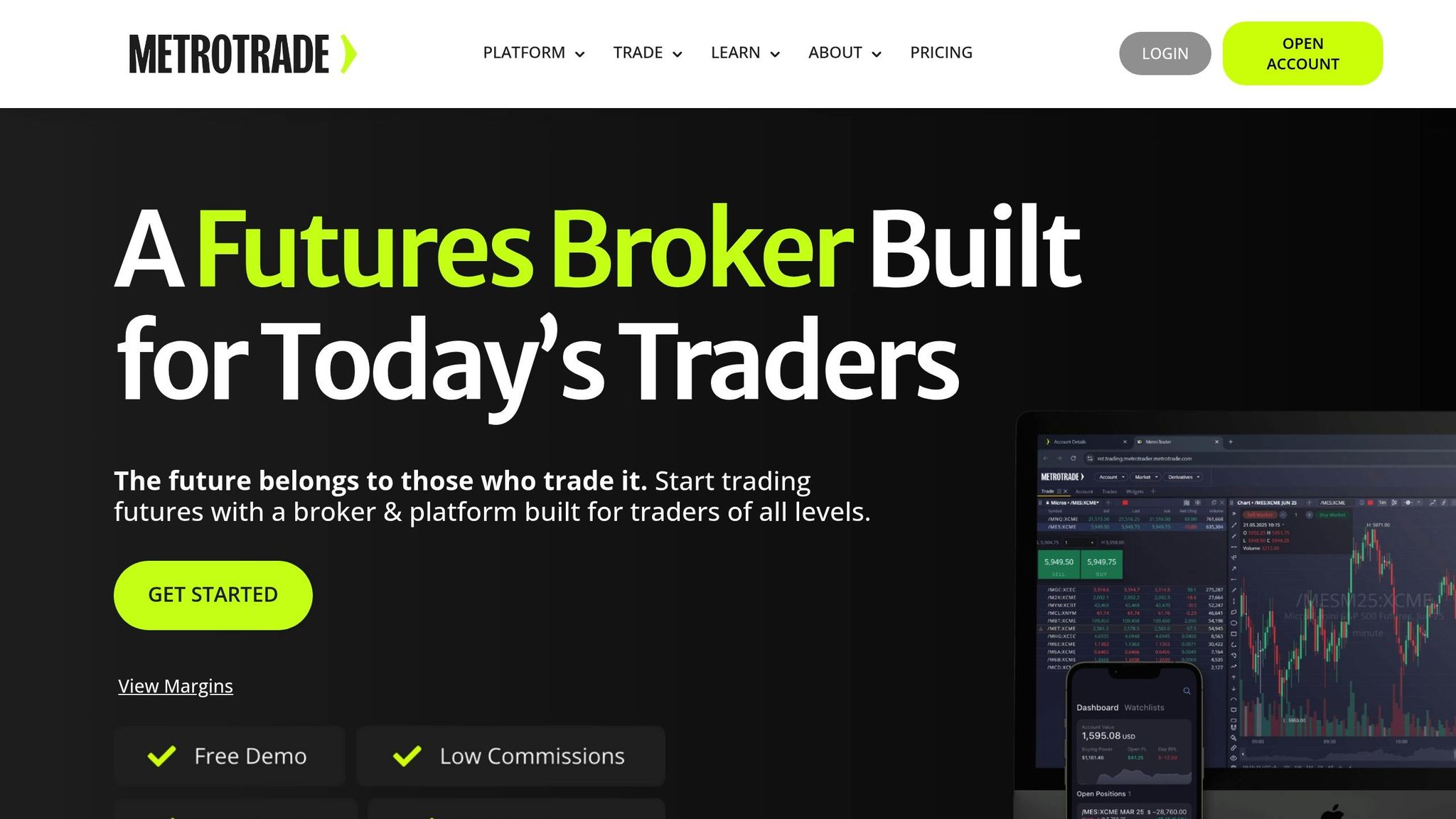
MetroTrade stands out as a simple and budget-friendly choice for traders. The broker charges $0.29 per side for micro contracts and $1.09 per side for E-mini and full-size contracts [1][5]. Unlike many competitors, MetroTrade avoids hidden fees - there are no monthly platform charges or CME Level 1 market data costs [1][5]. Plus, there’s no minimum deposit required to open or maintain an account [1][27].
Commission Rates
MetroTrade's pricing advantage becomes clear when you compare costs. For 100 round-turn micro trades, the total commission is $58 with MetroTrade, compared to $450 at a traditional broker [5]. Beyond the contract commission, the only other costs are standard exchange fees (ranging from $0.05 to $3.15 depending on the product) and the $0.02 NFA regulatory fee [1][26].
"Traders using big-name platforms and brokers may be overpaying by 2–3x per trade." - MetroTrade [5]
MetroTrade is a regulated Introducing Broker (IB) clearing through StoneX and is registered with both the NFA and CFTC [25][27]. In addition to its competitive commission structure, MetroTrade also offers appealing margin requirements.
Margin Requirements
MetroTrade provides some of the lowest intraday margin requirements in the industry, making futures trading more accessible. For instance, the Micro E-mini S&P 500 (MES) requires an intraday margin of $200.02, while the Micro E-mini Russell 2000 (M2K) is just $83.78 [28]. Cryptocurrency futures like Micro Bitcoin (MBT) need $2,220.90, and Micro Ether (MET) requires $96.80 [28]. These low margins allow retail traders to participate in futures markets without committing significant capital. However, it’s important to note that auto-liquidation fees are $15 per Micro contract and $25 per E-mini contract if margin requirements aren’t met [1][28].
Platform Features
The MetroTrader platform complements its cost advantages with robust functionality. Fully browser-based, it offers chart trading with drag-and-drop tools, over 75 built-in technical indicators, and customizable workspaces that sync across both web and mobile devices [29]. The mobile app keeps traders connected with real-time position tracking and price alerts. For those who prefer specialized trading tools, MetroTrade integrates seamlessly with third-party platforms like CQG, Rithmic, Sierra Chart, and Quantower [30]. Additionally, new users can take advantage of a 30-day demo account loaded with $5,000 in simulated funds to test strategies in live market conditions without financial risk [29].
6. Webull
Webull stands out in the futures trading space with its competitive pricing and user-friendly features. The broker charges $0.25 per contract for Micros, $0.70 for Minis, and $1.25 for standard contracts. Plus, traders benefit from free CME market data and zero platform fees [31].
Commission Rates
Webull's low commission rates are a key draw for traders. With Micros priced at just $0.25 per contract, it offers substantial savings compared to many industry competitors [31]. Mini contracts are $0.70 each, while standard contracts come in at $1.25 [31]. Additional costs include standard exchange fees and a $0.02 NFA regulatory fee - a straightforward and transparent pricing model.
Margin Requirements
Webull also provides reduced intraday margins, available from 9:00 AM to 4:15 PM EST [32]. For example:
- Micro E-mini S&P 500 (MES): $133.16 intraday margin vs. $2,663.10 overnight [32].
- Micro E-mini Russell 2000 (M2K): $81.93 intraday margin [32].
- Micro Crude Oil (MCL): $118.80 intraday margin [32].
These lower intraday margins make it easier for traders to allocate their capital efficiently. However, positions must be closed or meet the full initial margin by 4:15 PM EST to avoid liquidation [32]. Webull complements this flexibility with advanced tools that support execution and risk management [31][33].
Platform Features
Webull's platform is packed with tools to enhance trading precision. The TurboTrader feature allows for quick order entry using a price ladder [31][33]. For technical analysis, the platform offers 56 technical indicators, 19 drawing tools, and a historical replay mode that lets traders review price action step by step. To cut through market noise, AI-powered news summaries provide curated updates [34].
Webull's commitment to education and practice is evident in its unlimited paper trading simulator, which earned it the #1 ranking for Paper Trading in 2026 [34]. StockBrokers.com rated the platform 3.5/5 in January 2026, with Jessica Inskip, Director of Investor Research, noting:
"Webull's mobile experience is best-in-class, packing institutional-grade features like 56 technical indicators... into a handheld interface" [34].
Advantages and Disadvantages
Selecting the right futures broker involves balancing costs, features, and ease of use. Each platform has its own strengths and challenges, and understanding these can help you make an informed decision.
NinjaTrader stands out with its low per-contract rates, starting at just $0.09 for micro contracts when using its Lifetime License. However, this comes with an upfront cost of $1,499. While advanced tools like SuperDOM and NinjaScript automation are available, beginners may find the platform's steep learning curve and lack of native Mac support frustrating. To break even on the Lifetime License fee, traders would need to complete about 5,000 micro contract trades [6].
MetroTrade simplifies things with a subscription-free pricing model, eliminating platform and data fees. It charges a flat $0.29 per micro contract, which could save traders approximately $392 per month when executing 100 round-turn micro contracts compared to higher-cost brokers. However, the platform lacks the advanced customization and technical tools that professionals often require [1][5].
Interactive Brokers offers access to over 30 global market centers, making it an excellent choice for traders seeking international diversification. On the flip side, the platform requires a $10,000 minimum deposit and doesn’t provide intraday margin reductions, which can be a drawback for day traders. As Jessica Inskip points out, "The TWS platform is designed for intermediate to advanced traders... it may be difficult for beginners to grasp because of its complexity" [3][10][35].
Webull provides competitive micro commissions at $0.25 and features an easy-to-use mobile interface. However, it falls short in offering specialized analytics and has limited contract options. This makes Webull a better fit for traders who value simplicity over advanced futures capabilities [1].
Optimus Futures offers a solid middle ground with low-cost intraday margins and a professional-grade trading platform. That said, its setup process may feel overwhelming for those new to futures trading [10]. Ultimately, choosing the right platform depends on aligning its features with your trading approach and financial goals.
Conclusion
Aligning your trading style with the right cost structure is crucial. If you're a beginner, simplicity and low barriers are key. MetroTrade's subscription-free model, featuring $0 platform fees and a clear $0.29 per micro contract pricing, eliminates the hassle of monthly subscriptions. Meanwhile, NinjaTrader's browser-based platform ensures an easier start by sidestepping the complexities of traditional desktop interfaces. Both platforms allow you to begin trading without minimum deposits or confusing fee structures.
For active traders, cost efficiency should take center stage. For instance, trading 100 micro round-turns at MetroTrade could save you roughly $392 per month compared to pricier brokers like Charles Schwab [5]. If you're using automated strategies or need advanced order-flow tools, NinjaTrader's desktop platform offers the flexibility you need, with intraday margins for micros starting as low as $50 [7].
High-volume traders need to consider break-even points and advanced platform features. NinjaTrader’s Lifetime License costs $1,499 upfront, but it reduces micro commissions to $0.09 per side, breaking even at around 5,000 micro contracts [7]. Similarly, Interactive Brokers provides tiered discounts for professionals trading over 1,000 contracts and includes institutional-grade tools like Risk Navigator [7][2].
Understanding your trading volume and specific needs is essential before making a commitment. Start by testing your strategy with simulation tools to avoid risking real capital [2][8]. Leveraging Micro and Nano contracts can also help you manage risk more precisely as you gain experience [2][9].
For traders relying on continuous automated strategies, pairing your platform with a reliable VPS service is non-negotiable. Low-latency VPS solutions are vital for automation, and TraderVPS offers plans starting at $69/month, optimized for NinjaTrader. These plans include ultra-low latency, automatic backups, and multi-monitor support - critical features for algorithmic traders who can't afford disruptions during market hours.
FAQs
What fees matter besides commissions?
When trading futures, it's not just about commissions. You also need to factor in exchange fees, clearing fees, and platform fees. These extra costs can stack up quickly, impacting your total trading expenses. Make sure you go over all the associated fees carefully to get a clear picture of the full cost of trading futures.
How do I choose a broker for day trading vs. overnight holds?
When picking a broker, it's crucial to consider trading costs, platform capabilities, and risk management tools that align with your trading approach. If you're into day trading, look for brokers offering low commissions, lightning-fast execution, and platforms designed for rapid transactions. On the other hand, if you prefer holding positions overnight, focus on brokers with competitive margin rates, effective stop-loss features, and minimal holding fees. Your choice should reflect your trading frequency, risk appetite, and whether you favor intraday trades or longer-term positions.
Do I need a VPS for automated futures trading?
A VPS is an excellent choice for automated futures trading. It provides ultra-low latency, round-the-clock uptime, and the stability needed to execute automated strategies seamlessly. These benefits are especially critical during volatile market periods, helping ensure consistent performance and minimizing the chances of disruptions that could affect your trades.