Futures Trading Perks: Distinct Advantages Explored
Futures trading offers unique benefits that set it apart from stocks, ETFs, and options. Here's what you need to know:
- Leverage: Control large positions with minimal upfront capital (3%-12% of contract value), unlike stocks requiring 50% margin.
- Liquidity: High daily trading volumes (e.g., $339.675B for E-mini S&P 500 futures) and nearly 24/5 market access enable efficient trading.
- Tax Efficiency: U.S. futures are taxed at a 60/40 split (60% long-term, 40% short-term), lowering tax burdens compared to stocks.
- Portfolio Diversification: Access commodities, financial indices, currencies, and interest rates, offering tools for risk management across various markets.
Futures trading provides cost-effective exposure, favorable tax treatment, and broad market access. However, it requires careful risk management due to amplified gains and losses from leverage. Micro E-mini contracts can be a beginner-friendly option.
1. Futures Trading
Leverage
Futures trading lets you control large contract values with relatively small upfront capital. This upfront amount, known as the initial margin or performance bond, typically ranges between 3% and 12% of the contract's total value [10][8]. This low margin amplifies results: for example, a 2% change in the S&P 500 could lead to a 20% gain - or loss - on your margin deposit.
Beyond leverage, the high liquidity of futures markets adds another layer of efficiency for traders.
Liquidity
Futures markets are known for their high liquidity, thanks to standardized contracts and active participation from both hedgers and speculators [11][12][13]. Take the E-mini S&P 500 futures contract, for instance - it boasts an average daily trading value of $339.675 billion [12]. This deep liquidity ensures quick execution of market orders, allowing traders to enter or exit significant positions without causing major price shifts [3][8].
"Deep liquidity [means] tighter pricing and lower costs, which means more efficiency." - CME Group [5]
The global futures market has seen massive growth, with trading volume jumping from 12.1 billion contracts in 2013 to 29.2 billion in 2023 [13]. With nearly 24/5 trading hours, these markets allow traders to react swiftly to global events [12][5]. For short-term traders, front-month contracts - those nearing expiration - tend to offer the most trading activity and liquidity [11].
This liquidity advantage is further complemented by the tax benefits of futures trading.
Tax Efficiency
Futures traded on U.S. exchanges qualify as Section 1256 contracts, providing distinct tax perks [14][16][18]. No matter how long you hold a position, gains are taxed using a 60/40 split: 60% at the long-term capital gains rate and 40% at the short-term rate [14][15][19]. This results in a maximum effective tax rate of around 26.8%, compared to the potential 37% for short-term stock trades [15][19].
Futures also use mark-to-market accounting, which treats all open positions as if they were closed on December 31 [15][16][18]. Unlike stocks, futures are not subject to wash sale rules, meaning you can deduct losses even if you repurchase the same contract immediately [15][17][18]. Additionally, net losses can be carried back up to three years to offset prior gains, potentially leading to tax refunds [15][16][17][19]. All trading activity is consolidated on IRS Form 6781, streamlining year-end reporting compared to the detailed trade-by-trade reporting required for stocks [15][18][19].
Portfolio Diversification
Futures trading also opens doors to a wide range of asset classes. You can trade commodities like gold and crude oil, financial indices, currencies, and interest rate products - all through standardized contracts on regulated exchanges. This variety allows you to hedge or gain exposure to sectors that might be difficult to access otherwise. Plus, the ability to take both long and short positions adds flexibility for managing portfolio risk in various market environments.
2. Stocks, ETFs, and Options
Leverage
Stocks offer leverage through margin trading, allowing investors to borrow funds at a 2:1 ratio under Federal Reserve Regulation T [2]. However, this comes with the cost of accruing interest on the borrowed amount. Standard ETFs, on the other hand, don't involve borrowing, which limits potential losses strictly to the initial investment [20]. Options provide another way to amplify exposure, enabling traders to control a large asset value for a relatively small premium. For American-style options, this also includes the flexibility to exercise at any time before expiration [11]. It's worth noting that margin trading for stocks comes with additional rules, like the $25,000 minimum balance required under the Pattern Day Trader rule [21].
Liquidity
Liquidity plays a huge role in trading success, ensuring smooth trade execution. Stocks and ETFs are limited to market hours (9:30 a.m.–4:00 p.m. EST), which can restrict trading opportunities outside this window. Among ETFs, the SPY ETF stands out as the most liquid equity instrument in the U.S., with daily trading volumes around $32 billion [22]. However, stock spreads are often much wider than those of ETFs or futures. As Phil Mackintosh, Chief Economist at Nasdaq, points out:
"Stock spreads are more than 10-times the spreads that popular ETFs and futures trade."
For smaller stocks, the difference can be even more pronounced. For example, the average crossing spread for Russell 2000 small-cap stocks is about 33 basis points, compared to less than 1 basis point for a similar ETF basket [22].
Tax Efficiency
Tax treatment varies significantly across these asset classes. Stocks held for less than a year are taxed at short-term capital gains rates, which can climb as high as 37% for those in the top tax bracket [21]. ETFs follow similar rules, with gains taxed based on the holding period [12]. Futures, however, benefit from a 60/40 tax break, which applies consistently regardless of the holding period, making them more tax-efficient compared to stocks and ETFs [21].
Portfolio Diversification
Building diversification with stocks often requires multiple trades, while ETFs simplify the process by offering instant exposure to various sectors, countries, or investment themes. However, certain ETFs, like those based on futures, may incur roll costs, which traditional stocks and ETFs avoid [20]. Phil Mackintosh highlights this difference:
"The fact that futures are leveraged and need to be rolled often usually makes them more suitable for institutional investors, while the simplicity of buying and holding an ETF works for individual investors."
Options add another layer to diversification by providing targeted hedging strategies, though their value can diminish over time due to time decay [12]. While stocks and ETFs are excellent for equity diversification, accessing uncorrelated markets - like currencies or interest rates - typically requires futures contracts [7]. Each asset class brings unique strengths to the table, catering to different trading objectives and strategies.
12 Reasons To Trade Futures Over Stocks and Options
Pros and Cons
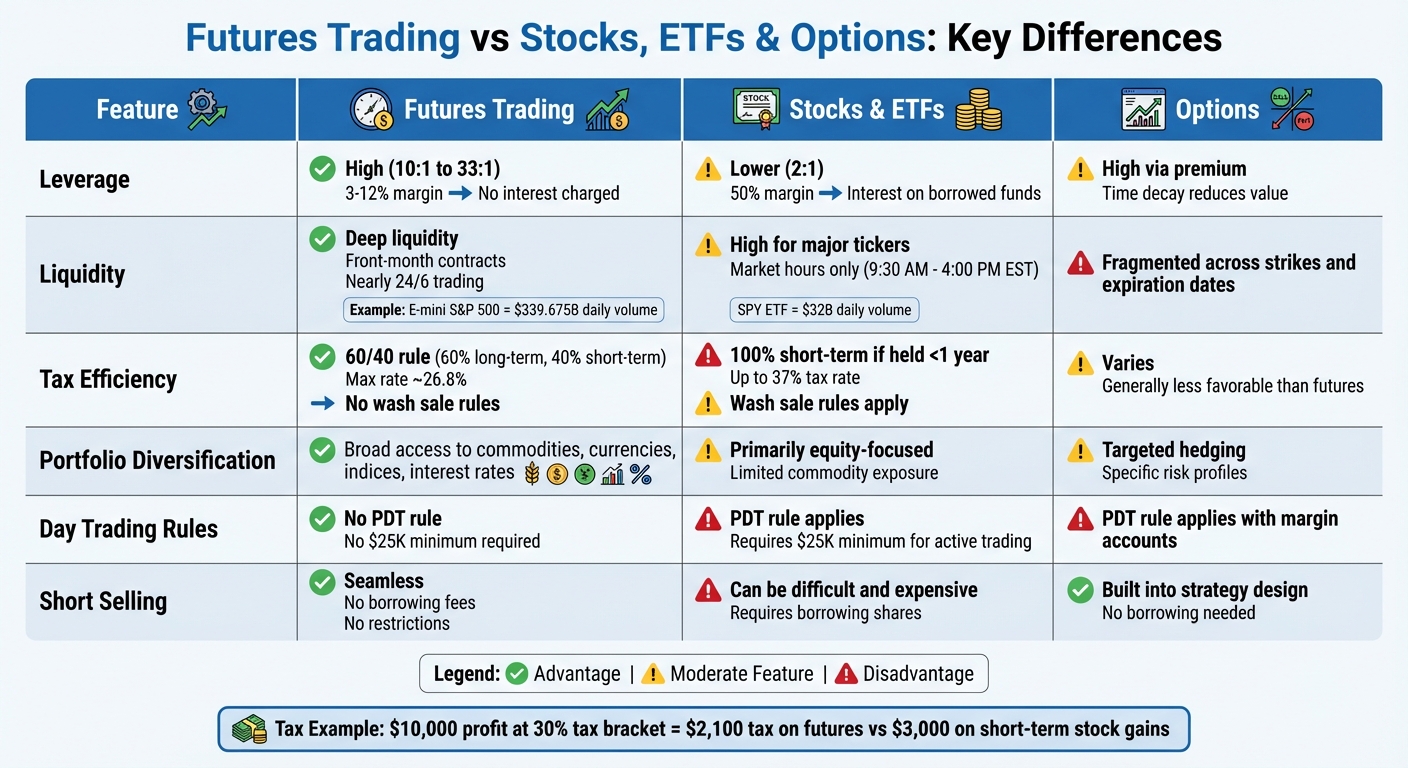
Futures vs Stocks ETFs Options: Leverage, Liquidity, Tax Efficiency Comparison
Futures trading stands out for its leverage, liquidity, and tax advantages, but it also comes with its own set of challenges. To better understand its strengths and weaknesses, let’s compare futures with stocks, ETFs, and options across key dimensions.
| Feature | Futures Trading | Stocks & ETFs | Options |
|---|---|---|---|
| Leverage | High (10:1 to 33:1); 3-12% margin; no interest charged [4][2] | Lower (2:1); 50% margin with interest on borrowed funds [4][2] | High via premium; time decay reduces value |
| Liquidity | Deep; concentrated in front-month contracts; nearly 24/6 trading [11][5] | High for major tickers during market hours (9:30 a.m.–4:00 p.m. EST) | Fragmented across multiple strikes and expiration dates |
| Tax Efficiency | 60/40 rule regardless of holding period; no wash sale rules [21][6] | 100% short-term if held under one year; wash sale rules apply | Varies; generally less favorable than futures |
| Portfolio Diversification | Broad access to commodities, currencies, indices, and interest rates [9][8] | Primarily equity-focused; limited direct commodity exposure | Targeted hedging; specific risk profiles |
| Day Trading Rules | No PDT rule; no $25,000 minimum required [21] | PDT rule applies; requires $25,000 minimum for active trading [21] | PDT rule applies with margin accounts |
| Short Selling | Seamless; no borrowing fees or "hard to borrow" restrictions [3][21] | Can be difficult and expensive; requires borrowing shares [3] | Built into strategy design; no borrowing needed |
Key Advantages of Futures Trading
One of the standout features of futures trading is the performance bond structure. Unlike stock margin accounts that involve borrowing funds and paying interest, futures margins represent money set aside for potential losses. This allows traders to access higher leverage without incurring interest charges [4].
Tax treatment is another major advantage. As NinjaTrader explains:
"One of the most substantial benefits of trading futures vs. stocks is the tax advantages... 60% of gains are taxed as long-term, and 40% of gains are taxed as short-term" [21].
To put this in perspective, a trader in a 30% tax bracket with a $10,000 profit would owe approximately $2,100 in taxes on futures, compared to $3,000 on short-term stock gains [14]. This difference can significantly impact overall profitability.
Challenges to Consider
Despite its benefits, futures trading has some limitations. A notable drawback is the fixed expiration dates of futures contracts. To maintain exposure, traders must roll their positions, which adds complexity and cost - something stocks and ETFs don’t require [1][2].
Additionally, while leverage can amplify profits, it also magnifies losses. This makes effective risk management an absolute necessity [3][6]. Without proper strategies in place, the potential for significant losses increases dramatically.
Understanding these pros and cons is essential for traders to align futures trading with their financial goals and risk tolerance. Balancing the advantages with the inherent risks will ensure a more informed approach to this dynamic market.
Conclusion
Futures trading offers a range of benefits that set it apart from traditional markets. Features like high leverage without interest charges, nearly 24-hour market access, and a tax structure that can be more appealing than those for stocks or ETFs create opportunities that are hard to replicate elsewhere. These advantages, as discussed earlier, make futures a compelling option for certain traders.
For experienced traders and active hedgers, futures provide powerful tools for managing portfolios and optimizing capital. The ability to short sell without borrowing fees and access to deep global liquidity enhances trading flexibility. With high daily trading volumes, executing large positions with minimal slippage becomes more feasible, adding another layer of efficiency.
That said, risk management cannot be overstated. Futures leverage can amplify both gains and losses, making it essential for beginners to tread carefully. Micro E-mini contracts, which are just one-tenth the size of standard contracts, provide a more accessible starting point for those new to the market [6]. However, success in futures trading requires understanding contract specifications, margin requirements and risk management, and the disciplined use of stop-loss orders to guard against sudden market swings [3][9].
FAQs
How much money do I need to start trading futures?
To begin trading futures, you'll generally need anywhere from $500 to $10,000 in your trading account. The exact amount depends on your broker and the strategy you plan to use. Many brokers set their minimum account requirement between $500 and $2,500, so it's essential to check the specific terms of your chosen broker. Make sure you have enough funds to comfortably support your trading plan and potential risks.
How do margin calls work in futures trading?
In futures trading, a margin call occurs when the equity in your account drops below the required maintenance margin due to unfavorable price changes. Essentially, it means you no longer have enough collateral to back your open position.
To address this, you’ll need to either add more funds to your account or reduce the size of your position. If you don’t take action, your broker might step in and liquidate your position to limit risk and cover potential losses.
How do I roll a futures contract before it expires?
Rolling a futures contract is a way to maintain your market exposure while avoiding the risks associated with delivery or expiration. It involves closing your current position and opening a new one with a later expiration date - a process known as a rollover.
To do this, you’ll need to:
- Keep an eye on expiration dates: Knowing when your current contract expires is crucial.
- Close your existing contract: Sell or offset your current position to exit it.
- Open a new contract: Enter a new position in a contract with a later expiration date. You can do this through separate transactions or by using a spread order.
Many trading platforms provide tools to help you manage the timing and execution of rollovers, making the process more efficient.