Copy Trading in Forex: 2026 Copier Mechanics
Copy trading in 2026 has become a fast, automated way to mirror professional Forex trades without manual effort. Modern systems use AI, secure cloud relays, and advanced risk controls to ensure precise execution, even across global accounts. Key features include proportional trade sizing, latency reduction, and safeguards like stop-copy functions. Here's what you need to know:
- How it works: Trades from a master account are instantly replicated to follower accounts using encrypted signals.
- Key advancements: AI-driven trader selection, real-time execution under 2 seconds, and tools for managing risk like drawdown circuit breakers.
- Risk controls: Proportional sizing, symbol mapping, and hard equity stop-losses help align trades with your account size and protect capital. This is especially critical when using high-leverage forex brokers to ensure margin requirements are met.
- Technology: Low-latency VPS setups, API-driven systems, and webhook integrations minimize delays and optimize trade performance.
Copy trading combines automation with expert strategies, making it accessible even for beginners. However, success depends on choosing reliable signal providers, diversifying strategies, and maintaining robust setups for consistent results.
How does copy trading work and how do you choose a strategy provider?
How 2026 Forex Trade Copiers Work
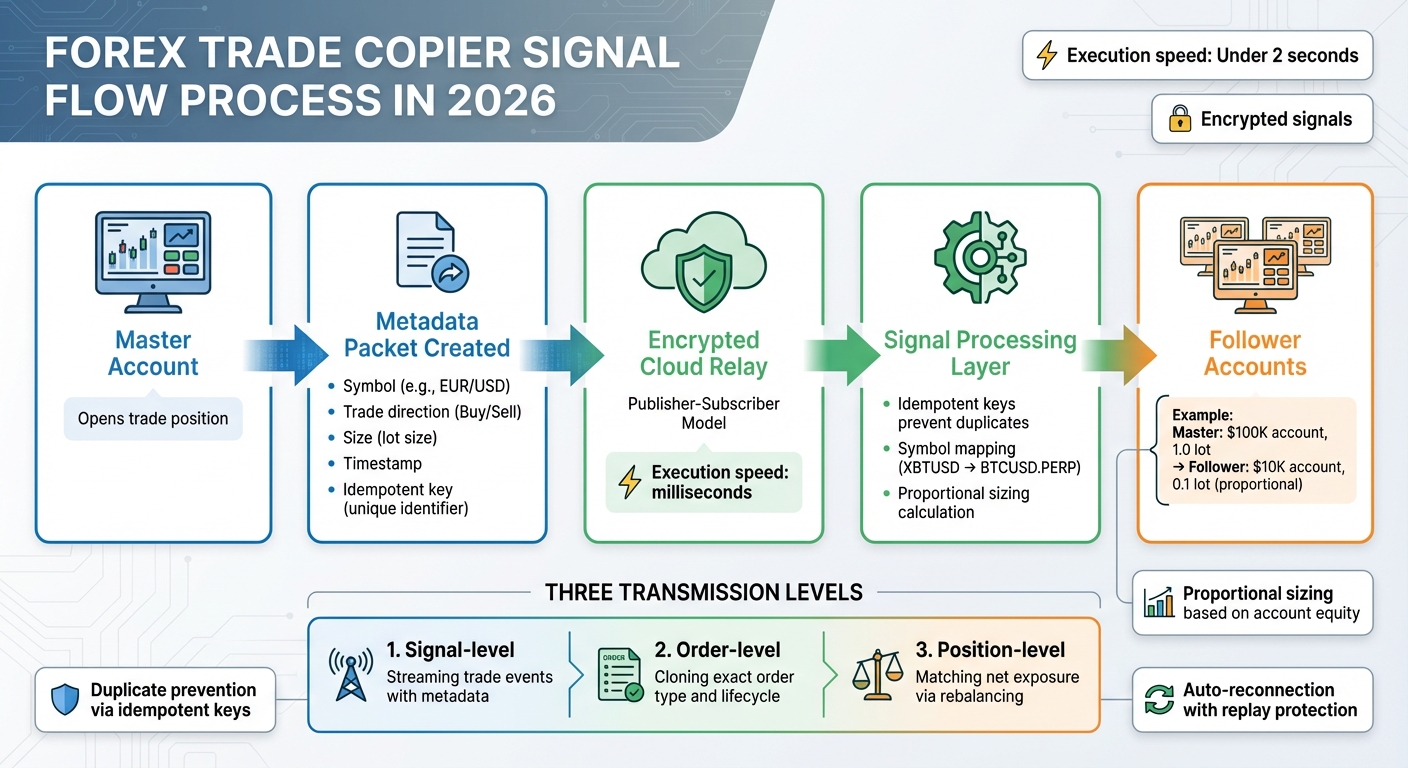
How Forex Trade Copiers Work in 2026: Signal Flow and Execution Process
Modern trade copiers operate using a publisher-subscriber model, where the master account monitors trading actions and sends encrypted signals via a secure cloud relay. This setup ensures that all communications are protected and prevents accidental reverse copying [6]. By 2026, these systems have evolved into highly secure, real-time architectures that prioritize reliability and speed.
"The system uses a publisher‑subscriber model over a secure cloud database... Master only sends; Client only receives."
- Edmore Masina, Trading Systems Expert [6]
Master-Slave Account Mechanics
When the master account initiates a trade, the copier immediately converts the action into a metadata packet. This packet contains key details like the symbol, trade direction, size, and timestamp [1][5]. The information is then relayed to all connected follower accounts through the cloud. Advanced systems in 2026 boast execution speeds measured in milliseconds, even when accounts are spread across top VPS providers or continents [6].
To maintain accuracy, the system employs idempotent keys, which are unique identifiers assigned to each trade. This prevents duplicate orders. For example, if the follower account experiences a network interruption, the copier replays recent signals upon reconnection but skips trades that have already been executed, avoiding errors like double entries [5]. A mapping layer further ensures compatibility by converting broker-specific symbols (e.g., XBTUSD to BTCUSD.PERP) and adjusting for differences in lot sizes or tick values [5].
Once the instructions are processed, the copier translates them into executable orders using various transmission models.
Signal Transmission and Proportional Sizing
Forex trade copiers work on three levels of copying:
- Signal-level: Streaming trade events with detailed metadata.
- Order-level: Cloning the exact order type, including its lifecycle events.
- Position-level: Matching the net exposure through periodic rebalancing [5].
Proportional sizing is a critical feature that adjusts trade sizes based on the follower's account size. For instance, if the master risks 2% of a $100,000 account by opening a 1.0 lot EUR/USD trade, a follower with a $10,000 account would scale the trade to 0.1 lots [8][10]. This adjustment can be done using equity matching, predefined lot multipliers, or fixed fractional risk methods [9][6].
"When you copy a trader, your positions mirror theirs in proportion to the amount you allocate. For example, if the signal provider opens a trade worth $10,000 and you've allocated 10% of that, your trade will be sized at $1,000."
- Steven Hatzakis, Global Director of Online Broker Research, ForexBrokers.com [8]
These transmission techniques are integrated into a broader automation framework, ensuring smooth and accurate execution of trades.
Execution and Automation Features
Modern automation has introduced several advanced features. For example, stale trade protection ignores signals that experience entry delays longer than five minutes. Another feature, multi-TP splitting, allows orders to be divided into preset lot distributions, such as 40/30/30 [6][11].
MT5-based trade copiers require a WebRequest to communicate with the designated cloud server URL [6]. If a follower manually closes a trade, the system recognizes this action and avoids reopening the trade during the next synchronization cycle, giving traders more control [6]. Additionally, webhook integration has become a standard feature, enabling platforms like TradingView to trigger signals that can be executed instantly on an MT5 instance hosted on a VPS [7].
Key Components in Modern Copy Trading Systems
Modern copy trading systems revolve around three essential components that work together to provide flexibility, safety, and efficient strategy execution. These elements build on the mechanics of trade copying, offering enhanced control and customization for users.
Signal Providers and Follower Accounts
At the heart of copy trading are signal providers, who manage the master account and execute trades based on their strategies. Every action - whether opening a position, adjusting a stop-loss, or closing a trade - generates a signal. This signal includes details like the symbol, trade direction, size, and price levels [1][6]. These signals are securely relayed to follower accounts, which act as receivers.
Follower accounts adapt these signals to fit their specific account settings, such as size, leverage, and risk tolerance [3][1]. Many professional traders in 2026 follow a Core-Satellite allocation approach. This involves allocating 60-70% of their capital to reliable, low-risk signal providers while dedicating 20-30% to higher-risk, high-return strategies to balance stability with growth [12].
"Copy trading is part technology, part execution management, and part risk engineering."
- MaxPower Risk Management [1]
Risk Management Features
Modern systems prioritize safety with advanced risk management tools. For instance, hard equity stop-losses automatically close all copied trades if the account value falls below a preset dollar amount or percentage. This provides an added layer of security, independent of the master trader’s stop-loss settings.
Another critical feature is drawdown circuit breakers, which halt copying when a master trader experiences losses beyond a predefined threshold. This helps followers avoid prolonged exposure during severe market downturns. Additionally, symbol mapping ensures compatibility by adjusting broker-specific naming conventions and contract sizes, reducing the risk of errors [6].
Bidirectional Copying and Customization
Modern systems go beyond basic copying with bidirectional copying, enabling trades to flow between platforms like MT4 and MT5. This supports complex setups where multiple master accounts feed into various follower accounts simultaneously [15]. Users can also group signal providers into ID groups, ensuring strategies are only shared with accounts that match specific identifiers [15].
Customization options have also advanced significantly. Followers can apply custom filters to exclude trades that don’t meet their criteria. Some systems even allow reverse trading, which takes the opposite position of a losing master account - potentially turning poor strategies into opportunities [13]. Moreover, manual overrides are intelligently tracked. For example, if a follower manually closes a copied trade, the system won’t reopen it during the next synchronization cycle [6].
"A trade copier works best when it is treated as a controlled trading tool, not a passive income shortcut."
- Camilla Domantas, Forex Guide Author [3]
Technologies Driving 2026 Copier Efficiency
In earlier discussions about execution and automation, the importance of infrastructure in optimizing trade copier performance was emphasized. By 2026, latency plays a critical role in profitability. Even a fraction of a second delay between the master signal and follower execution can lead to slippage, which can add up significantly over thousands of trades [17]. To combat this, modern trade copiers leverage several core technologies to minimize delays.
Low-Latency Execution and Reducing Slippage
Speed is everything when it comes to signal replication. Using high-performance CPUs like AMD Ryzen 9950X or Intel 14900K, along with Gen4/Gen5 NVMe SSDs, helps eliminate processing delays. Additionally, hosting in Tier-1 data centers, such as Equinix NY4 (New York), LD4 (London), or TY3 (Tokyo), brings latency down to as little as ~1 ms [17].
Single-core clock speed is especially important for these processes [19]. Gen4 and Gen5 NVMe SSDs further reduce bottlenecks caused by continuous log and tick data writes [16][17]. Network optimization is another key factor - reducing latency from 100 ms to 5 ms can eliminate up to 95% of controllable execution delays [17]. For context, a delay of 150 ms compared to 3 ms during volatile market conditions could result in a price difference of 0.5–1.5 pips, which has a noticeable impact on profitability over time [16].
Fine-tuning the network stack also plays a role. For example, disabling Nagle's algorithm on a VPS ensures trade commands are sent immediately, reducing delays [17]. The ultimate goal is to execute follower trades before the market price deviates too much from the master signal's entry point [17][18].
"In trading, milliseconds = money."
API Integrations and Automation
Modern trade copiers have moved away from polling-based systems in favor of REST APIs and webhooks. Traditional polling methods, which check for updates at intervals, often introduce delays. By contrast, API-driven systems replicate trades instantly when a signal is triggered [20]. This server-to-server setup allows trades to be copied across brokers without requiring a local machine to be active [14][20].
Webhook integrations further streamline the process. For instance, TradingView alerts can send JSON data directly to a copier's API, enabling execution within milliseconds [7][20]. One example of this efficiency is TradeSyncer, a cloud-based copier that has processed over 121.9 million trades as of early 2026, maintaining replication speeds under 100 ms [20]. In the same period, high-performance VPS setups handled over $82 billion in futures trades in just one week [20].
Cloud-to-cloud synchronization eliminates the delays often seen in multi-platform setups where local software introduces additional lag [18][20]. API-driven systems have achieved replication speeds of 20–70 ms, a significant improvement over traditional local setups, which often exceed 200 ms [18][20]. These advancements ensure consistent and reliable execution.
VPS Optimization for Trade Copier Performance
Beyond APIs and network tweaks, VPS configuration is crucial for refining copier performance. A VPS acts as the always-on environment for trade execution. Optimizing the operating system - such as using "High Performance" power settings and disabling Windows Update during trading hours - helps avoid interruptions like restarts or CPU throttling [16][17].
TraderVPS offers several plans tailored for Forex copiers:
- Lite plan ($69/month): 4 AMD EPYC cores, 8 GB DDR4 RAM, and 70 GB NVMe storage, suitable for 1–2 charts and small-scale copying.
- Pro plan ($99/month): 6 cores, 16 GB RAM, and support for 3–5 charts and medium-sized follower groups.
- Ultra plan ($199/month): 24 cores, 64 GB RAM, ideal for 5–7 charts.
- Dedicated Server ($299/month): 12+ AMD Ryzen cores, 128 GB RAM, designed for setups with 7+ charts and high-frequency trading.
Advanced setups often use KVM virtualization to ensure hardware-level isolation, preventing issues like "noisy neighbors" during volatile market conditions [14]. Providers now include up to 12 Tbps of DDoS protection to safeguard against network disruptions [17][14]. Tools such as PingPlotter are used to monitor latency, detect jitter, and identify packet loss that could disrupt execution timing [19].
| Subscriber Count | Recommended CPU | Recommended RAM | Storage | Recommended Plan |
|---|---|---|---|---|
| 1–5 | 2 vCPU | 4 GB | 50 GB NVMe | Lite / Trader |
| 6–15 | 4 vCPU | 8 GB | 80 GB NVMe | Elite |
| 16–30 | 4+ Dedicated Cores | 16 GB | 100 GB NVMe | Pro |
| 50+ | 8+ Dedicated Cores | 32 GB+ | 200+ GB NVMe | Custom |
These configurations ensure that VPS setups are optimized for seamless trade execution, even during periods of high market activity. By combining robust hardware, network optimizations, and API-driven automation, modern trade copiers achieve unparalleled efficiency.
Risk Factors and Execution Challenges in Copy Trading
Even with advanced systems in place, copy trading comes with its own set of risks that can impact profitability. Being aware of these challenges is key to creating a more resilient trading strategy.
Slippage and Latency Impacts
Even the slightest execution delay, measured in milliseconds, can affect entry prices. In volatile markets, this slippage can add up, leading to a noticeable gap in performance between the master and follower accounts [1][14].
There are two main approaches to execution in copy trading: signal-level mirroring and position-level synchronization. Signal-level mirroring replicates orders almost instantly but is highly sensitive to latency. On the other hand, position-level synchronization is better at handling brief connection issues but may fall behind during fast market moves [5].
Maintaining near-perfect system uptime is crucial to avoid missed trade signals. For instance, if a follower’s connection drops just as the master exits a position, the follower could remain exposed to the market, potentially turning a small loss on the master account into a much larger one for the follower [14]. These latency-related issues can amplify losses and make scaling more challenging.
Drawdown Amplification and Proportional Scaling
Even with advanced technology reducing execution delays, differences in account scaling can still magnify losses. Followers often face larger drawdowns due to variations in leverage, margin requirements, or drawdown rules [1]. Slippage during volatile times can worsen this, as followers may enter trades at less favorable prices or exit later than the master account, compounding losses over time [1][14].
"Copy trading is a leverage amplifier. If it is structured correctly, it amplifies operational efficiency. If it is structured poorly, it amplifies account damage."
- MaxPower Risk Management [1]
The way trades are copied also plays a role. Fixed lot copying works best when account sizes match, but it struggles to adapt to changing balances. On the other hand, fixed risk percentage sizing adjusts more effectively, helping to normalize risk across accounts [1][12].
Diversification Strategies Across Leaders
Managing overall portfolio risk goes beyond individual trade execution. Diversification is crucial. Following 4 to 7 traders tends to strike a balance between spreading risk and maintaining manageable oversight. Tracking more than 20 traders, however, can dilute returns and make monitoring overly complex [12].
Correlation between traders is another factor to watch. A correlation above 0.7 between two traders means they are likely taking similar risks, which could unintentionally double exposure [12]. To avoid this, traders should follow a mix of strategies - such as scalping, trend following, and swing trading - and diversify across asset classes like forex, gold, and indices [21].
A core-satellite allocation can help structure a diversified portfolio:
- Core (60–70%): Focus on proven, low-drawdown traders.
- Satellite (20–30%): Allocate to higher-return strategies with shorter track records.
- Exploration (5–10%): Test new trading providers.
Adjust weightings based on key metrics like track record length (24+ months earns 1.5x weight), a Sharpe ratio above 2.0, and a maximum drawdown under 20% [12].
To manage risk, traders can set a global stop-out level, such as halting all copying if the portfolio drawdown hits 15–20% [12][21]. It’s also important to monitor overlapping positions, as multiple traders entering the same trade can unintentionally increase exposure. Regular portfolio rebalancing - making small adjustments monthly and a full reset quarterly - helps ensure the portfolio stays aligned with risk goals [12].
Optimization Strategies for 2026 Forex Copy Trading
Fine-tuning your copy trading setup requires aligning it with your risk tolerance and trading objectives. Below, we’ll explore how to choose the right leaders, set up filters, and test strategies effectively using VPS-based backtesting.
Leader Selection and Evaluation
Picking the right signal provider goes beyond flashy profit numbers. In 2026, regulations like MiFID III ensure that reputable leaders must present 12–24 months of historical performance before appearing on public leaderboards [23]. This extended history helps weed out those who thrived briefly during favorable market conditions but lack consistency.
A key metric to evaluate is the Recovery Factor, which is calculated by dividing net profit by maximum drawdown. A score above 3.0 over a year signals a strategy that can recover from losses efficiently [23]. For example, if a leader achieves $30,000 in profit with a $10,000 drawdown, their Recovery Factor would be 3.0 - meeting the standard for professional-grade strategies. This metric is particularly useful in managing risks like slippage and amplified drawdowns.
"Raw ROI is the most dangerous metric in social trading. A trader with a 500% return might just be one bad trade away from zero if they are using a Martingale strategy." - FXNX Professional's Guide [23]
Another red flag to watch for is style drift, where a leader suddenly shifts their trading behavior - like increasing lot sizes or abandoning stop-losses. AI-driven vetting tools in 2026 can identify these changes early, protecting follower accounts from potential losses [23]. Additionally, assess the slippage gap, which measures the difference between the leader's profits and what followers actually earn. Leaders employing high-frequency scalping often show large slippage gaps, making them less suitable despite strong headline performance [23].
| Metric | Target Value | Significance |
|---|---|---|
| Track Record | 12–24 Months | Demonstrates consistency across varying market conditions [23] |
| Max Drawdown | < 15–20% | Indicates how much capital is at risk during losing streaks [22] |
| Recovery Factor | > 3.0 | Reflects the strategy's ability to recover from losses efficiently [23] |
| Slippage Gap | < 1.0 Pip | Ensures minimal execution friction for follower profits [23] |
Custom Filters and Trade Settings
Custom filters allow you to tailor what gets copied to your account. You can limit trades by currency pairs, trade direction (buy-only or sell-only), or lot size ranges [4]. This is especially helpful if your broker has high spreads on certain pairs or if you prefer to avoid high-frequency strategies that rely heavily on execution speed [1][4].
Scaling logic is another important tool. It adjusts trade sizes proportionally, such as scaling a 1.0 lot on a $100,000 account down to 0.1 lots on a $10,000 account. This ensures trades align with your account size.
Independent stop-loss and take-profit overrides give you greater control. If a leader doesn’t use stop-losses, you can set your own to safeguard your capital [24][3]. Also, verify that symbol mapping is active to ensure trades execute correctly, especially when brokers use different naming conventions [4].
Before applying any new settings to your live account, test them on a demo account. This helps you identify potential issues like slippage, execution drift, or symbol mapping errors without risking real money [2][1]. Running your copier software on a VPS ensures uninterrupted operation and reduces latency by placing your system closer to the broker’s servers [3][7].
VPS-Enhanced Backtesting for Copy Trading
Once your trade settings are fine-tuned, rigorous backtesting on a VPS can validate your system’s performance. Forward-testing on a VPS simulates real market conditions, providing insights into execution speed, lot sizing accuracy, and recovery logic [14][3]. Unlike historical backtesting, forward-testing uses live broker execution, offering a more accurate picture.
During testing, simulate VPS restarts to confirm that your trading terminal and copier software automatically reconnect without manual input [14]. Regular maintenance, like clearing log files, prevents crashes caused by storage issues [14]. For optimal performance, match your VPS specifications to the number of accounts you’re managing. For example:
- 1–5 accounts: 2 vCPU, 4 GB RAM, NVMe SSD storage.
- 16–30 accounts: 4 dedicated cores, 16 GB RAM [14].
TraderVPS offers tailored plans for backtesting and multi-account management. Options include the VPS Lite at $69/month (4x AMD EPYC cores, 8 GB RAM) and the Dedicated Server at $299/month (12x+ AMD Ryzen cores, 128 GB RAM). All plans feature NVMe storage and 1 Gbps+ network speeds, ensuring minimal latency during both testing and live trading.
Conclusion
By 2026, copy trading has evolved into a sophisticated process that combines cutting-edge technology, precise execution, and stringent risk management practices [1]. As outlined earlier, achieving success in this space requires thoughtful account scaling, selecting the right platform (such as MT5, which now surpasses MT4 in handling high-frequency accounts [2]), and adopting equity-based scaling to avoid exposure mismatches.
The rise of cloud-native solutions and API-driven automation has reshaped how traders manage copy trading systems. However, the core principle remains intact: milliseconds matter. As BestCopyTrading emphasizes, "A tool that delays even slightly can cause price slippage, especially in volatile markets" [2]. For perspective, home internet latency (30–150ms) lags far behind VPS setups, which range from 10–50ms, or advanced cloud configurations achieving an impressive 1–10ms [25]. These performance improvements are critical for platforms like TraderVPS, which are designed to maximize copy trading efficiency.
TraderVPS provides tailored plans to meet varying needs, from the VPS Lite option ($69/month) for smaller operations to the Dedicated Server plan ($299/month) for enterprise-level setups handling 50+ accounts.
Latency aside, maintaining operational resilience is equally important. Unchecked automation can magnify errors [1], so it’s wise to test new configurations on demo accounts for at least a full trading week [14]. Additionally, systems should be configured to auto-restart after any VPS reboot [7][14]. Combining advanced trade copier tools with a well-optimized VPS setup, as described earlier, is crucial for achieving consistent results in copy trading. Success requires treating it as a professional endeavor, supported by robust technology, infrastructure, and risk management practices.
"A dedicated Forex VPS is the essential infrastructure that separates professional signal providers from hobbyists." - MassiveGRID [14]
FAQs
How can I tell if a signal provider avoids risky trading tactics?
To steer clear of providers using risky tactics, look for those who apply solid risk management practices. This includes diversification, setting maximum equity stop-loss levels, and ensuring risks align with your personal tolerance. It's also important to examine their track record and trading methodology to assess their consistency and dependability.
What settings should I use to limit slippage when copying trades?
To minimize slippage when copying trades, adjust your trade copier settings to ignore trades lacking Stop Loss and Take Profit levels. This ensures that only well-defined trades are replicated. Additionally, configure maximum trade deviation parameters to specify the acceptable range of price variation during execution. These tweaks can help achieve more accurate trade replication and reduce unexpected differences.
How many leaders should I copy for a diversified portfolio?
To create a well-balanced portfolio in copy trading, it’s a good idea to follow multiple leaders. By copying the strategies of around 15-20 traders, you can spread out your risk and increase the likelihood of steady returns. This approach helps ensure that your portfolio isn’t overly dependent on the performance of just one trader, giving you a more stable and balanced investment strategy.