Max Payout Prop Firms: Policy Essentials
Proprietary trading firms (prop firms) let you trade using their capital in exchange for a share of your profits. But how much of that profit you actually take home depends on their payout policies. Here’s what you need to know:
- Profit Splits: Top firms offer 90%-100%, but fees (like platform charges) reduce your actual earnings.
- Payout Schedules: Withdraw profits daily, weekly, or monthly, depending on the firm.
- Withdrawal Terms: Minimum balances, caps, and documentation requirements may apply.
- Scaling Plans: Some firms increase your account size as you hit profit targets.
- Risk Rules: Daily loss limits and drawdowns impact your ability to grow and withdraw funds.
For example, Apex Trader Funding has paid $598M since 2022, averaging $15.4M monthly. But even with a 90% split, fees and drawdown rules can significantly affect your take-home pay. Managing risks and understanding firm policies are key to maximizing profits.
Pro Tip: Tools like TraderVPS ensure stable trade execution, helping you avoid technical issues like latency that could breach firm rules.
Want to know how to navigate these policies and increase your payouts? Read on to learn the details.
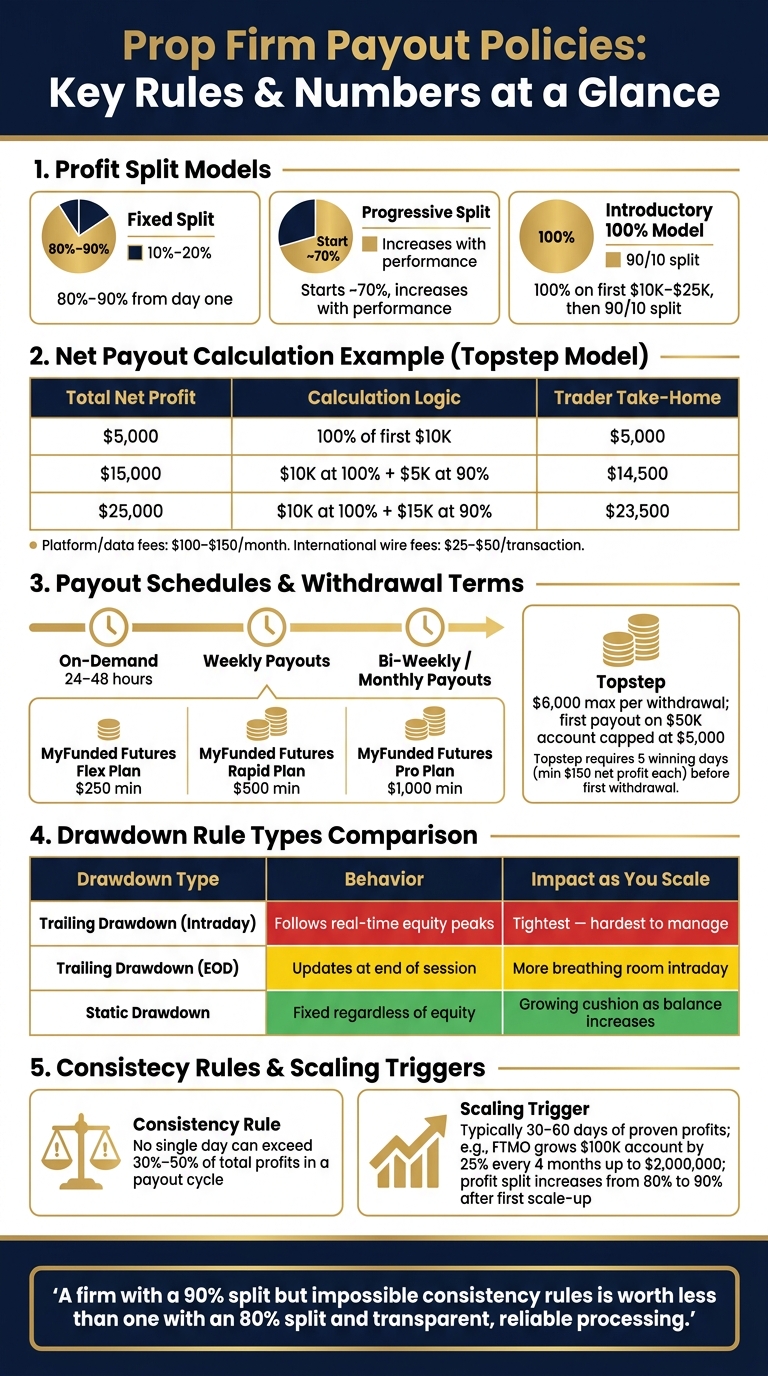
Prop Firm Payout Policies: Key Rules & Numbers at a Glance
Profit Splits and How They Work
Common Profit Split Models
Profit-sharing arrangements in affordable futures prop firms come in a few main flavors, and knowing the structure you're dealing with can help you plan your trading strategy effectively.
Fixed splits are the simplest to understand. From the start, you keep a set percentage of your profits, usually between 80% and 90% [3]. Progressive splits, on the other hand, begin at a lower rate (around 70%) and increase as you reach specific performance benchmarks or grow your account [3]. Then there’s the introductory 100% model, where some firms let traders keep 100% of their first $10,000 in profits - Topstep is a notable example - before switching to a 90/10 split. Others extend this offer to $25,000 before reverting to a similar split [4].
"100% split offers are almost always limited to either the first payout or a specific tier of funding." - Prop Firmapp [2]
Understanding these models is only part of the equation. You’ll also need to calculate how these splits translate into actual earnings after factoring in fees and other costs.
How Net Profits Are Calculated
Your payout is based on net profits, which means gross earnings minus expenses like commissions, platform fees, and data charges [2]. This makes it crucial to calculate your net profits accurately to understand the real impact of a firm's payout structure. Using Topstep’s payout model as an example:
| Total Net Profit | Calculation Logic | Trader's Take-Home |
|---|---|---|
| $5,000 | 100% of first $10k | $5,000 |
| $15,000 | $10k at 100% + $5k at 90% | $14,500 |
| $25,000 | $10k at 100% + $15k at 90% | $23,500 |
Recurring costs can further reduce your take-home pay. For instance, platform and data fees often range between $100 and $150 per month. Additionally, international wire withdrawals can cost $25 to $50 per transaction [5]. These expenses mean that even with a 90% split, you won’t actually keep 90 cents of every dollar earned.
Reading "Max Payout" Claims Accurately
The term "max payout" is often used as a marketing hook and usually comes with conditions. These conditions might include being tied to a specific account tier, a limited introductory period, or even an optional add-on purchased at checkout [6]. In some cases, firms charge an upfront fee to upgrade from an 80% to a 90% split. Before paying for such upgrades, it’s essential to determine if the increased split percentage will significantly boost your earnings.
Consistency rules can also affect payouts, as many firms cap daily profits at 30% to 50% [3].
"A firm with a 90% split but impossible consistency rules is worth less than a firm with an 80% split and transparent, reliable processing." - ThinkCapital [3]
To assess a firm’s true value, focus on the effective take-home rate. This is the percentage you actually keep after accounting for fees, consistency requirements, and minimum trading day rules. It’s the most reliable way to evaluate whether a prop firm’s payout structure aligns with your trading goals.
Prop Firms EXPLAINED: The Rules, the Traps, and the Ones I Trust Most
Payout Schedules, Withdrawal Terms, and Limits
When it comes to your earnings, withdrawal conditions can play just as big a role as profit splits.
Payout Timing and Frequency
How quickly you can access your earnings varies by firm. Most firms offer three main options: on-demand payouts (processed within 24–48 hours), weekly payouts, or bi-weekly/monthly payouts [2]. On-demand payouts are becoming more common and are now seen as a key feature that many traders expect.
The waiting period for your first payout also depends on the firm and plan. For instance, MyFunded Futures allows traders on its Rapid plan to request a withdrawal just 24 hours after their first trade, while the Pro plan requires a 14-day waiting period [1]. Topstep, on the other hand, requires traders to complete 5 winning days before they can request their first withdrawal. A "winning day" is defined as a trading session with at least $150 in net profit [7].
"A winning day at Topstep is defined as any trading session that closes with at least $150 in net profit." - Paul, Proptradingvibes [7]
Beyond timing, withdrawal thresholds and caps are just as critical to understand.
Withdrawal Thresholds and Payout Caps
The minimum amount you can withdraw typically ranges from $100 to $500, depending on the firm and the type of account you hold. For example, MyFunded Futures has different minimums based on the plan: $250 for the Flex plan, $500 for the Rapid plan, and $1,000 for the Pro plan [1].
Payout caps also influence how much you can withdraw at a time. At Topstep, traders are limited to $6,000 per withdrawal, regardless of account size. For its $50K Combine accounts, the first payout is capped even lower at $5,000 [7]. These caps are designed to manage the firm's risk but can make it harder to access larger earnings in one go.
Another important factor is the trailing drawdown buffer. Withdrawing profits doesn’t reset your trailing drawdown high-water mark. This means that taking out too much could leave you vulnerable to breaching account limits.
"The trailing calculation doesn't stop just because you requested a payout... pulling out $2,000 leaves you dangerously exposed." - Prop Firm App [2]
Consistency Rules and Eligibility Conditions
Many firms enforce performance rules before approving payouts. One common requirement is the consistency rule, which ensures that no single trading day accounts for more than 30% to 50% of your total profits during a payout cycle [3]. This rule encourages steady performance across multiple sessions rather than relying on one big trading day. If you exceed the consistency cap on a given day, adjusting to smaller trades in subsequent sessions can help balance your profits and avoid payout delays [9].
Most firms also require traders to close all positions (be "flat") before submitting a payout request [3]. Additionally, some firms have rules about ongoing trading activity. For example, TakeProfitTrader requires traders to have at least one trading day per week to maintain an active PRO account. Failing to meet this requirement could delay your ability to withdraw funds, even if your profits are sufficient [8].
Scaling Plans and Risk Rules
How Scaling Plans Work
Scaling plans are designed to increase your capital allocation once you've demonstrated consistent profitability. Typically, firms require 30 to 60 days of proven profits before granting access to a higher funding tier [12].
The most common trigger for scaling is hitting a cumulative profit target. For instance, FTMO allows a $100,000 account to grow by 25% every four months, with a cap at $2,000,000 [14]. After the first scale-up, FTMO also increases the profit split from 80% to 90% [14].
Some firms use fixed tier upgrades, while others, like The5ers, automatically scale accounts when traders achieve set monthly profit goals [12]. Apex Trader Funding takes a different approach by allowing traders to manage up to 20 funded accounts simultaneously, bypassing traditional scaling models [10].
"Scaling plans are the gateway to greater opportunity... keeping risk balanced with opportunity and helping you grow with discipline at every stage." - Tradefundrr [13]
To make the most of your scaling plan, focus on strategies that maximize your profit retention while adhering to the firm's rules.
Risk Rules That Affect Payouts
Risk rules like daily loss limits, drawdown policies, and consistency requirements play a critical role in determining how much you can grow and withdraw.
The daily loss limit (DLL) serves as a safeguard, acting like a circuit breaker for your account. If you hit the DLL, your account could be terminated - even if your overall balance is still above the drawdown threshold. This means a single poor trading session can wipe out an entire month's gains [11].
Drawdown rules are another key factor. These can vary widely, and the type of drawdown you face will significantly impact your strategy as you scale. Here's how different drawdown types work:
| Rule Type | Behavior | Impact as You Scale |
|---|---|---|
| Trailing Drawdown (Intraday) | Follows real-time equity peaks | Tightens with every gain, making it the hardest to manage |
| Trailing Drawdown (EOD) | Updates only at the end of the session | Provides more breathing room for intraday fluctuations |
| Static Drawdown | Remains fixed, regardless of equity changes | Offers a growing cushion as your balance increases |
Understanding these rules will help you manage your account effectively and avoid unnecessary risks during scaling.
Balancing Risk Rules with Payout Goals
Scaling successfully means carefully balancing withdrawals with preserving your drawdown buffer. For instance, trailing drawdown floors do not reset after a withdrawal. This means that withdrawing a large amount can leave your account vulnerable to sudden losses [2]. To address this, some firms, like MyFundedFutures, limit early withdrawals. On a $50,000 scale plan, the first payout is capped at $1,500, gradually increasing to $3,500 by the fifth payout [15]. This approach encourages traders to build a financial buffer before accessing larger sums.
"A single blown funded account resets your scaling progress and costs months of accumulated growth." - PropJournal [14]
Position sizing is another critical aspect of scaling. For example, doubling your contracts from 2 ES to 4 increases your dollar-per-tick exposure significantly. While this can accelerate profits, it also amplifies the risk of a losing session eroding your drawdown allowance [10] [11]. Instead of maxing out your position size immediately, scale your contracts gradually to ensure steady and sustainable growth.
"The difference between traders who pass evaluations and those who do not is rarely strategy. It is almost always rule management." - Kane Simons, Prop Firm Compare [11]
Setting Up Your Infrastructure for Max Payouts
Maximizing payout opportunities isn’t just about following firm policies - it also hinges on the dependability of your trading setup.
Why Execution Stability Matters
Once you’ve laid out your scaling strategy and risk management rules, there’s another critical factor to consider: the reliability of your trading setup. This is often overlooked but can make or break your performance. Prop firms evaluate your execution, not just your intentions. Issues like missed stops, platform freezes, or dropped connections during crucial moments can lead to breaching loss limits, wiping out weeks of effort.
For futures traders, stability is everything. Latency and uptime are especially important in fast-moving markets. Even tiny delays can lead to worse fills, inaccurate risk assessments, and a higher likelihood of breaking firm rules. In this environment, every millisecond matters.
Enter tools like TraderVPS. Designed specifically for trading, it ensures smooth execution and reduces the risks tied to unreliable setups.
How TraderVPS Supports Futures Traders
TraderVPS is tailored for futures trading, particularly for platforms like NinjaTrader. Its infrastructure is built to meet the demanding execution standards set by top prop firms. Located in Chicago, close to the CME matching engines, TraderVPS servers offer sub-0.52ms latency - a 7–12ms advantage over setups based in New York [16][17].
"Sub-0.52ms latency is essential for swift futures trade execution and reducing slippage." - TraderVPS [16]
The platform uses high-performance AMD EPYC processors, NVMe storage, and Windows Server 2022, ensuring 99.999% uptime [16]. To put its scale into perspective, more than $12.4 billion was traded through TraderVPS infrastructure in a single day as of May 14, 2026 [16].
Here’s how a home trading setup compares to a professional VPS environment:
| Feature | Home PC Trading | TraderVPS |
|---|---|---|
| Latency to CME | High (varies by ISP routing) | <0.52ms via fiber-optic cross-connect [16] |
| Uptime | Vulnerable to outages | 99.999% guaranteed [16] |
| Operation | Requires PC to stay on 24/7 | Operates 24/7 |
| Hardware | Consumer-grade | AMD EPYC, NVMe, enterprise-grade |
| Execution | Higher slippage risk | Reduced slippage, rapid fills |
Using a VPS like TraderVPS can transform your trading efficiency and help you avoid costly disruptions.
VPS Configuration Best Practices
Getting a VPS is just the start. Proper configuration is key to ensuring your setup supports your trading goals and protects your payout eligibility. Here are some practical tips:
- Set NinjaTrader to auto-start after VPS reboots. Combine this with a "High Performance" Windows Power Plan to prevent CPU throttling during volatile sessions [17].
- Use SSD or NVMe drives to speed up database operations and avoid unnecessary delays [16][17].
- Match your VPS plan to your trading needs:
- For 4–5 accounts, use 4–5.5GB RAM and 2–4 CPU cores.
- For 10+ accounts, scale up to 12GB+ RAM and 4+ CPU cores [17].
- Enable multi-monitor RDP support to manage complex chart layouts across multiple sessions. This is especially useful when monitoring several instruments simultaneously [16].
Conclusion: Choosing the Right Prop Firm for Max Payouts
After exploring payout structures, risk rules, scaling plans, and execution requirements, it’s clear that maximizing earnings with a prop firm boils down to a few crucial factors.
Key Takeaways for Futures Traders
A thorough look at payout policies and risk rules highlights that transparent and manageable terms are just as important as high profit splits. It’s not just about finding the firm with the highest split - restrictive or unclear conditions can end up costing you more than a firm offering slightly lower splits but with straightforward rules.
Key elements to watch for include drawdown rules, consistency thresholds, and payout buffers. These factors directly impact how much you can actually take home. For example, the type of drawdown (End-of-Day vs. intraday trailing) and consistency thresholds (usually requiring 30%–50% of total profits per day) can significantly influence your earnings. Be sure to calculate your post-payout breathing room carefully; withdrawing too aggressively without considering your trailing drawdown floor can lead to setbacks [2].
Another strategy to protect your earnings is diversifying across multiple accounts. Instead of putting all your funds into a single $200K account, consider managing several smaller accounts, such as four $50K accounts. This way, if one account hits its drawdown limit, the others can still generate income [14].
Using TraderVPS to Stay Consistent
While payout policies are critical, reliable execution is equally important for long-term success. Technical issues like connection drops or system freezes can quickly lead to rule violations, wiping out days or even weeks of progress.
TraderVPS is designed to address this challenge, offering futures traders a stable and reliable platform to meet firm requirements consistently. For those managing multiple funded accounts - some firms allow up to 20 Performance Accounts - having dependable infrastructure is essential. A stable setup ensures that technical hiccups don’t jeopardize your eligibility for payouts, helping you stay focused and on track.
FAQs
What’s the real difference between profit split and take-home pay?
The profit split represents the percentage of trading profits a trader earns from the proprietary firm's payout structure and conditions. Meanwhile, take-home pay is the actual amount the trader gets after any deductions or payout terms are applied. This is the final sum deposited into the trader's account.
How do trailing drawdowns change after I withdraw profits?
Trailing drawdowns are designed to adjust in line with your account's equity high, even after you make a profit withdrawal. Essentially, the drawdown limit can shift upward or downward based on how your account performs after the withdrawal. This ensures the limit reflects your current equity situation.
What should I check before trusting a “max payout” claim?
Before believing a "max payout" claim, take a closer look at the fine print. Pay attention to details like payout conditions, profit split tiers, and withdrawal policies. Sometimes, the high payout percentages only apply to specific tiers or under certain conditions. In some cases, firms may lower the profit split after initial payouts or enforce strict rules that could impact your actual earnings. Carefully reviewing the terms will help you avoid surprises and understand exactly how the payout structure works.